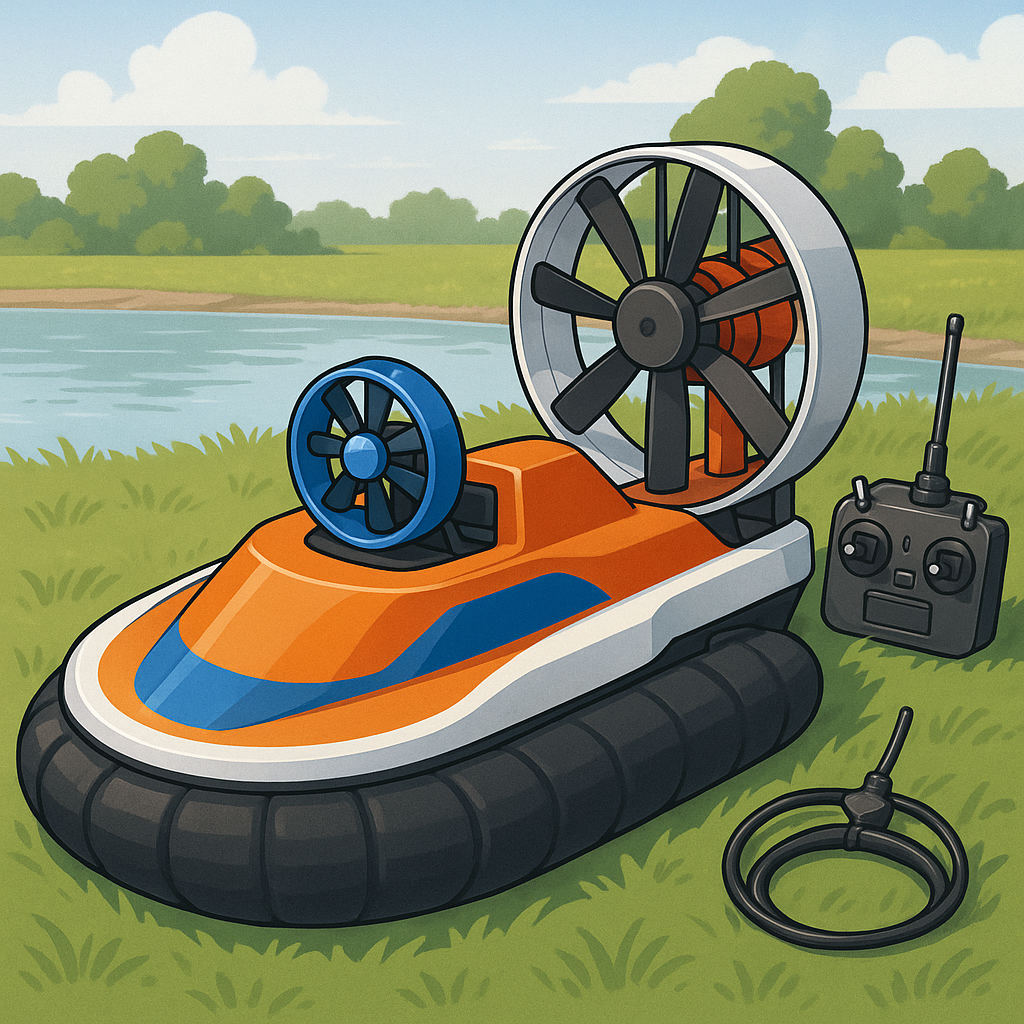
Beginner's Guide to RC Hovercraft for Hobbyists
RC hovercraft are rewarding models that combine elements of boats, cars and aeroplanes into a single platform suitable for ponds, puddles and flat fields, and they make a great project for someone stepping up from foam boats or small drones. The basic components are a hull or platform, a skirt to trap air, at least one lift fan and usually a separate thrust fan or propeller for forward motion, and a radio pack with speed controllers and steering linkages. For a first build choose a simple rectangular or circular platform around 300–600 millimetres across, a moderate battery pack and robust propellers, and plan the layout so the weight sits near the centre of the lift cushion for stable performance. Practical testing in calm conditions lets you dial in skirt leaks, fan speeds and steering response before trying anything ambitious on open water or long grass.
Skirt design is the single most important mechanical element of a hobby hovercraft because the skirt controls how well the cushion holds pressure and how the craft reacts to bumps and turns. Beginners should start with a bag skirt or a segmented finger skirt made from heavy-duty polyurethane or coated nylon, as these reliably hold air and tolerate abrasion, and they are easy to repair with adhesive and patches. Keep the skirt depth shallow for small craft, typically 20–40 millimetres, to avoid excessive leakage, and fit a flexible central seal or inner flange where the skirt meets the hull to reduce flutter. When cutting finger skirts, stagger the lengths and add small vents at the rear if the craft feels too buoyant, because controlled leakage helps reduce porpoising and keeps the craft responsive.
Understanding lift versus thrust fans is key to efficient performance because the two tasks require different airflow characteristics and sometimes different mounting strategies. Lift fans or blowers need to move a large volume of air at low pressure to create the cushion, so a wide, high-blade-count fan or a purpose-built centrifugal blower is a good choice for quiet and steady lift. Thrust is better handled by a propeller or a ducted fan that produces higher velocity airflow; a forward-mounted prop gives predictable directional thrust, while a ducted fan adds some safety and can be more efficient in tight installations. Many successful hobby builds use two motors — one optimised for lift and one for thrust — and this separation lets you tune RPM and gear ratios independently, but a single-motor design is possible if you use a clutch or a clever ducting arrangement to split airflow between lift and forward motion.
Drift control and steering on hovercraft are different from wheeled vehicles because there is no direct contact with the ground, so you must manage lateral forces with airflow and balance rather than tyres. The simplest and most reliable method is differential thrust, where two thrust units or variable-pitch props are modulated to turn the craft, and this method scales well from micro models to larger builds. Rudders in the propwash or flaps that deflect the thrust stream are also effective and are simpler to implement on a single-prop layout, while passive skegs or small keels fitted under the hull can improve straight-line stability without adding active complexity. Practise gentle inputs and trim the craft with small weight shifts or trim tabs because abrupt steering will make the hovercraft pivot or slide rather than grip, and good control comes from anticipating momentum rather than fighting it.
Waterproofing and electronics protection are vital because hovercraft operate at the water-air interface and can throw spray into normally dry areas, so seal batteries, ESCs and servos in ventilated but splash-resistant enclosures and use conformal coating on vulnerable PCBs when possible. Route motor power and signal cables through grommeted holes and fit breathable pressure-equalisation patches on sealed boxes to avoid pressure build-up under the skirt, and remember that cooling for ESCs may need external ducts rather than relying on ambient airflow inside a watertight case. Lightweight sacrificial meshes over intake openings prevent leaves and larger debris from entering lift fans, and design the hull with drainage channels or removable panels so water can be emptied quickly after an unexpected dunking. For more project ideas, parts and printable templates see my site at WatDaFeck as a practical reference for hobbyists who want to build and iterate on hovercraft designs.
Comments
Post a Comment