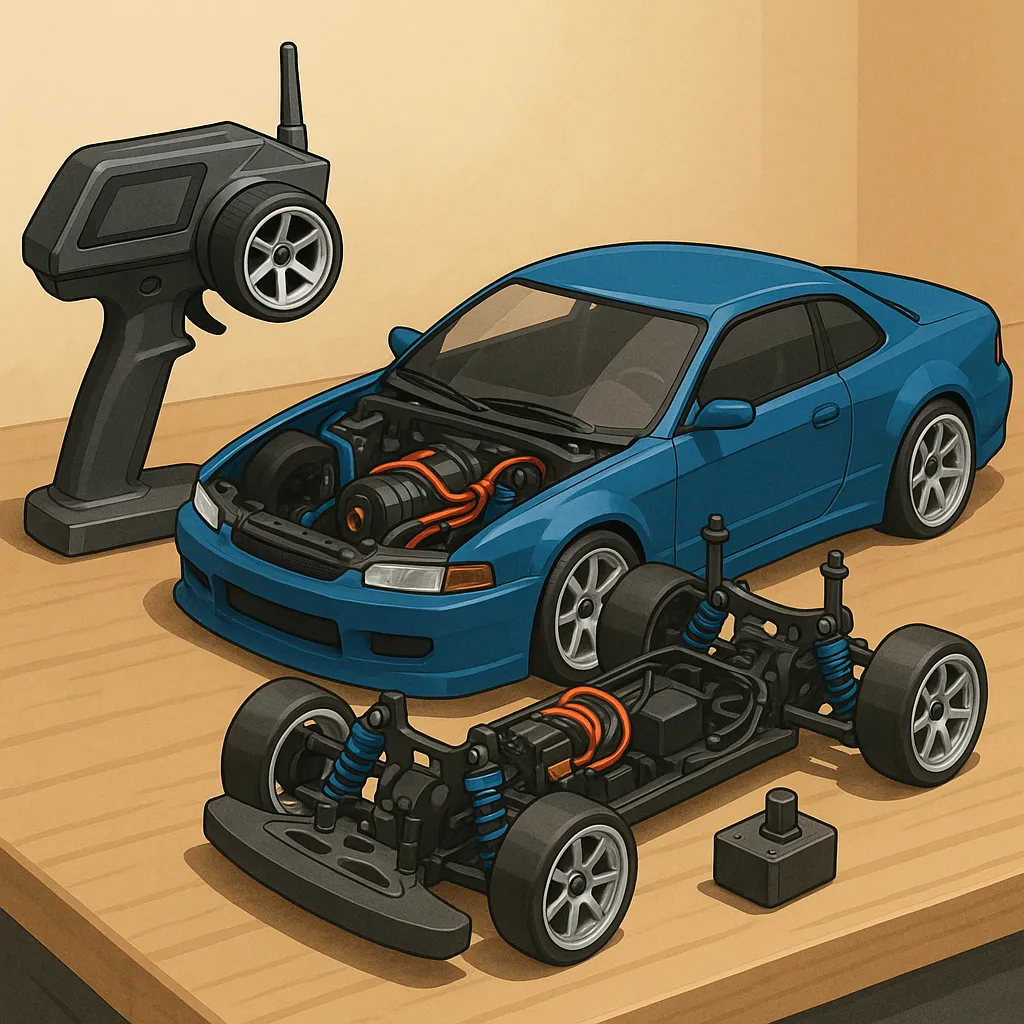
Build Log: A Drift-Capable Brushless RC with Tunable Traction Control.
I started this project intending to build a manageable drift car that would also teach me about gearing and the nuances of brushless powertrains, and I wanted traction control to be adjustable for practice and for fun runs on different surfaces.
The chassis selected was a budget-friendly 1/10 drift chassis with adjustable suspension mounts and a reinforced motor plate, and I gathered a 13.5T brushless motor, a programmable esc with traction control and throttle curves, a metal-geared servo, slipper clutch and a set of hard compound tyres for the rear and slightly grippier fronts for counter-steer stability.
My first real step was to mount the motor and set up the pinion and spur combination, and I chose a 48-pitch gearset so that parts were readily available and light enough for drift duty while being robust for repeated slides. The initial gearing was a 15-tooth pinion with a 64-tooth spur giving a 4.27:1 ratio, and with the wheel diameter and a 2S LiPo this predicted a modest top speed ideal for controlled drifts rather than outright top-end racing.
- Test 1: 15T pinion, 64T spur for torque and low wheelspin on coated asphalt.
- Test 2: 17T pinion, 64T spur to increase revs for sweeping corners on carpet tracks.
- Test 3: 15T pinion, 60T spur to boost acceleration on tight layouts while monitoring ESC temperature.
- Tweak motor timing and ESC punch in small increments between gear tests to find balance between torque and smooth power delivery.
After each gearing change I checked mesh, backlash and toe-in while keeping gear mesh snug but not overly tight to prevent binding, and I recorded ESC temperatures and motor RPMs so I could compare efficiency between setups and detect any issue early on.
ESC configuration made a huge difference to drivability, and I used a sensored brushless motor paired with an ESC that allowed for timing adjustment, punch control, throttle curve shaping and built-in traction control. I dialled motor timing down slightly to keep the power delivery smoother for controlled slides, enabled a gentle rate of active braking to help settle the chassis into a drift, and used a soft throttle curve during the first runs to preserve tyres while testing different gear ratios.
Drift tuning focused on making slides predictable, and I adjusted rear toe to a small amount of toe-in for stability, set front toe-out for a responsive turn-in, and experimented with camber and caster until steering felt balanced under power. The slipper clutch helped protect the drivetrain from sudden shock loads during hard entries, and I altered differential oil thickness in the centre and rear diffs to tune how much power would transfer to the outside wheel during a drift.
On-track testing was iterative and instructive, and the setup that worked best for me ended up being the 15T pinion with the 64T spur for plenty of torque, medium-cut diff oil at the rear for a smooth transfer of power, the ESC set with conservative timing and a traction control level that intervened only on extreme wheelspin. For readers who want the exact parts list and settings I used during the build you can find the full log and downloadable setup sheets at WatDaFeck and use them as a starting point for your own experiments.
Comments
Post a Comment