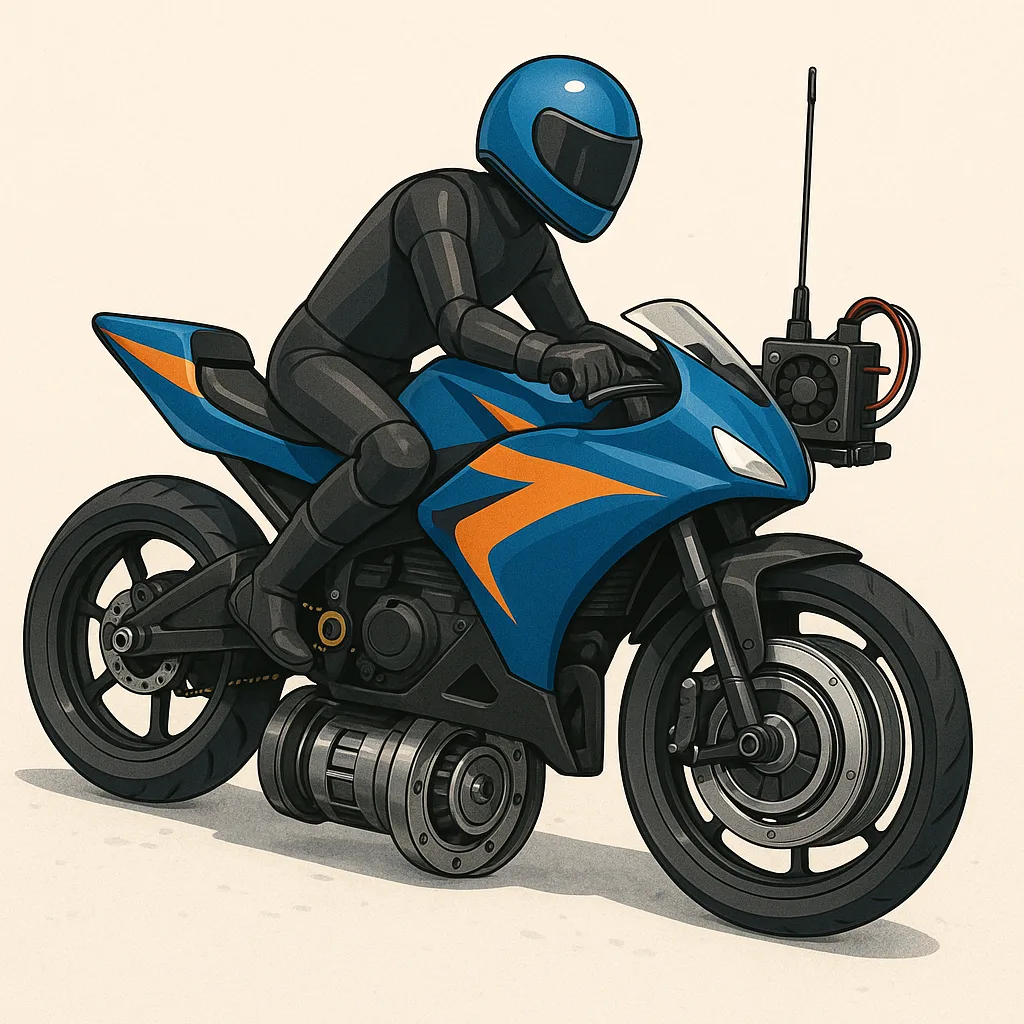
Build Log: RC Motorcycle with Gyro Wheels and Precision Stabilisation
This build log walks through my homebrew RC motorcycle project with an emphasis on gyro wheels, stabilisation and cornering behaviour, and it is written for hobbyists who like to tune their machines by hand and experiment with balance and control systems. I wanted a lightweight, agile bike that would actually lean through corners under power and stay upright when stationary, and this post explains the choices I made and the steps I followed. I documented the build and detailed parts lists on my blog at WatDaFeck. The aim here is practical advice so you can replicate the important parts of the build and learn the tuning process step by step.
Parts and chassis selection were driven by weight targets and a preference for a narrow profile to reduce aerodynamic instability at speed. I chose a slim aluminium backbone chassis, a 1/10 scale rear hub motor, front fork assembly with ball bearings, and two bespoke gyro wheels designed to provide active stabilisation. The electronics stack included a compact flight-grade IMU, a brushless motor controller, high-torque micro servos for steering, and a small but powerful LiPo battery to keep centre of gravity low and centralised. I also fitted adjustable shock mounts so I could tune suspension travel and ride height for better cornering response.
- Slim aluminium chassis with central battery tray.
- Custom gyro wheels with internal flywheel and motor drive.
- Flight-grade IMU with I2C interface and fast sampling.
- High-torque micro servo for steering actuation.
- Compact 2S LiPo positioned low and central.
Building the gyro wheels is the heart of this project and the assembly requires careful attention to balance and bearing alignment. Each gyro wheel houses a small brushless motor spin-up assembly and a precision-machined flywheel that spins at several thousand rpm, creating gyroscopic stabilisation that resists roll and helps the bike stay upright. Mount the gyro assembly coaxial with the wheel bearing and ensure there is no runout in the axle, because any wobble becomes amplified at high flywheel speed. Wire the gyro motors separately from the main drivetrain and route the sensors away from electrical noise to avoid interference with the IMU readings.
Stabilisation tuning is a mix of software PID adjustments and physical weight distribution, and I spent the most time iterating on gains to get natural cornering without fighting the rider inputs. Start with conservative integral and derivative gains on the roll axis of the IMU, and increase proportional gain until the platform resists small disturbances without oscillating. Use the servo to provide a steering input that complements the gyro torque rather than opposing it, and test on a smooth flat surface before moving to bumpy terrain. Weight balance is crucial, so shift battery and ballast to test fore-aft balance and use lateral shims on the chassis to cure any lean bias when stationary.
Cornering drills are the final proving ground and taught me how the interplay of gyro torque and rider steering produces a natural lean. Begin by riding at low speed and gently increasing lean angle while monitoring IMU logs for roll rate and angle error, then adjust gyro gain to allow the bike to lean under centripetal force rather than forcing it upright. Tune suspension and tyre pressure to achieve a balance between grip and forgiveness, and practise throttle modulation through the turn to keep weight on the rear wheel for traction. With these settings in place the bike corners smoothly, recovers reliably from disturbances, and demonstrates how careful balance of mechanical layout and control firmware yields great handling.
Comments
Post a Comment