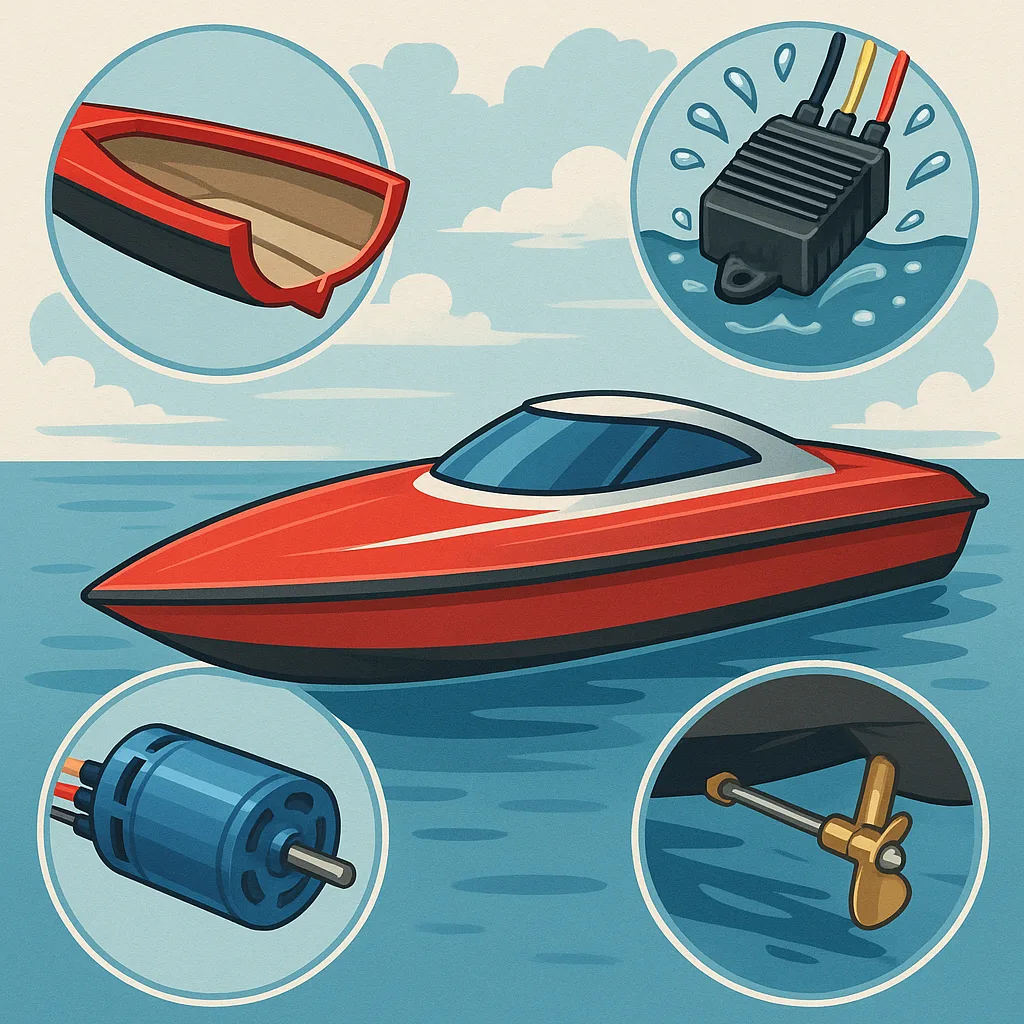
 RC Boat Safety: Hull Design, ESC Waterproofing, Brushless Motors and Prop Shafts." />
RC Boat Safety: Hull Design, ESC Waterproofing, Brushless Motors and Prop Shafts.
Operating RC boats is great fun but it brings distinct safety responsibilities that every hobbyist should understand before launching a model on open water. This safety overview focuses on four areas that most commonly influence whether a day at the pond ends with a floating model and a smile or a costly recovery and repair job. Prioritising safe hull design, reliable ESC waterproofing, correct brushless motor installation and well-maintained prop shafts will reduce risks to the boat, its pilot and bystanders.
Hull design is the first line of defence against water damage and instability, so choose or build a hull with sensible buoyancy and compartmentalisation. Use watertight bulkheads or foam flotation to ensure that a single leak does not send the entire model under, and position batteries and heavy components low and central to keep the centre of gravity stable. Check seams and hatch gaskets for wear before each session and replace fragile hatch clips or O-rings rather than trying to jury-rig them for longer outings. For wooden or fibreglass hulls inspect for delamination and soft spots, and for 3D-printed or vacuum-formed hulls watch for stress cracks around mounting holes and through-hull fittings.
Electronic speed controllers are critical and also vulnerable to water, so treat ESC waterproofing as a combination of good product choice and careful installation. If you buy an ESC rated as waterproof, remember that rating often means splashproof under a set of conditions rather than guaranteed indefinitely submersible use, so protect connectors with heat-shrink tubing and silicone grease and use sealed enclosures or grommets where wires pass through the hull. Conformal coating can add protection for open ESCs, but it must be applied correctly and will not stop a badly aligned shaft or a dislodged seal from creating problems. Always allow for cooling; completely sealing electronics without heat management can lead to thermal shutdown or component failure during hard runs.
Brushless motors offer excellent power-to-weight ratios but demand respect in installation and maintenance to remain safe and reliable. Mount motors securely on a rigid motor plate to prevent movement under load that could stress mounting screws or misalign the drive shaft, and ensure the motor bell is free from contact with other components under all operating conditions. Check that wiring and solder joints are tidy and insulated to avoid short circuits, and be cautious with water-cooling jackets or through-bell water cooling systems as leaks can introduce conductive paths to electronics. Match motor KV and prop size to the ESC and battery capability to avoid overcurrent situations, and remember that a hot motor can indicate overloading or poor ventilation that requires immediate attention.
Prop shafts and propellers are where mechanical power meets water and are frequent sources of problems if not maintained correctly. Use good-quality shaft bearings, a properly fitted stuffing tube or shaft seal and a robust coupling between the motor or gearbox and the shaft to prevent play that causes vibration and eventual failure. Ensure the shaft is straight and that universal joints, if used, are properly greased and free of corrosion, and balance or replace propellers that show nicks or damage as vibrations can loosen grub screws and damage bearings. Fit a guard or keep a safe distance from spectators, especially when testing throttle response, and always disconnect batteries or remove props when handling the boat in a workshop to avoid painful accidents.
Before every launch run a short pre-flight checklist to catch common faults and reduce risk in the field. Confirm hatches are secure and that the bilge or flotation material is in place, verify that the ESC and motor temperatures start cool after a brief bench test, inspect the shaft and prop for damage and correct alignment, test radio link range and failsafe response on low throttle, and check batteries are fully charged and secured in sealed boxes or straps. If you want detailed build notes, safe wiring diagrams and photo walkthroughs for common setups, visit my project pages at WatDaFeck for practical examples and downloadable checklists that I use in my own boats.
Consistent inspection, conservative component matching and simple preventative techniques will keep RC boating enjoyable and safe for hobbyists of all levels, and taking the time to understand how hull design, ESC waterproofing, brushless motors and prop shafts interact will pay dividends in reliability and longevity. Treat every outing as an opportunity to learn, log incidents and adjust your build or procedure accordingly, and remember that a sensible approach to safety protects your boat, your wallet and everyone around the water.
Comments
Post a Comment