RC Trucks & Haulers: Project Ideas for Hobbyists
This roundup gathers practical project ideas for RC truck and hauler enthusiasts who like to tinker and customise their models to a high standard. It focuses on the mechanical heart of scale realism such as gearboxes and multi-speed systems, the practicality and design of trailers, and the fine points of scale detail that make a rig look authentic. Whether you are upgrading an RTR model or building from scratch, these ideas are organised to spark projects you can finish in a weekend or develop into long-term builds. The aim is to give clear starting points and sensible engineering tips for success.
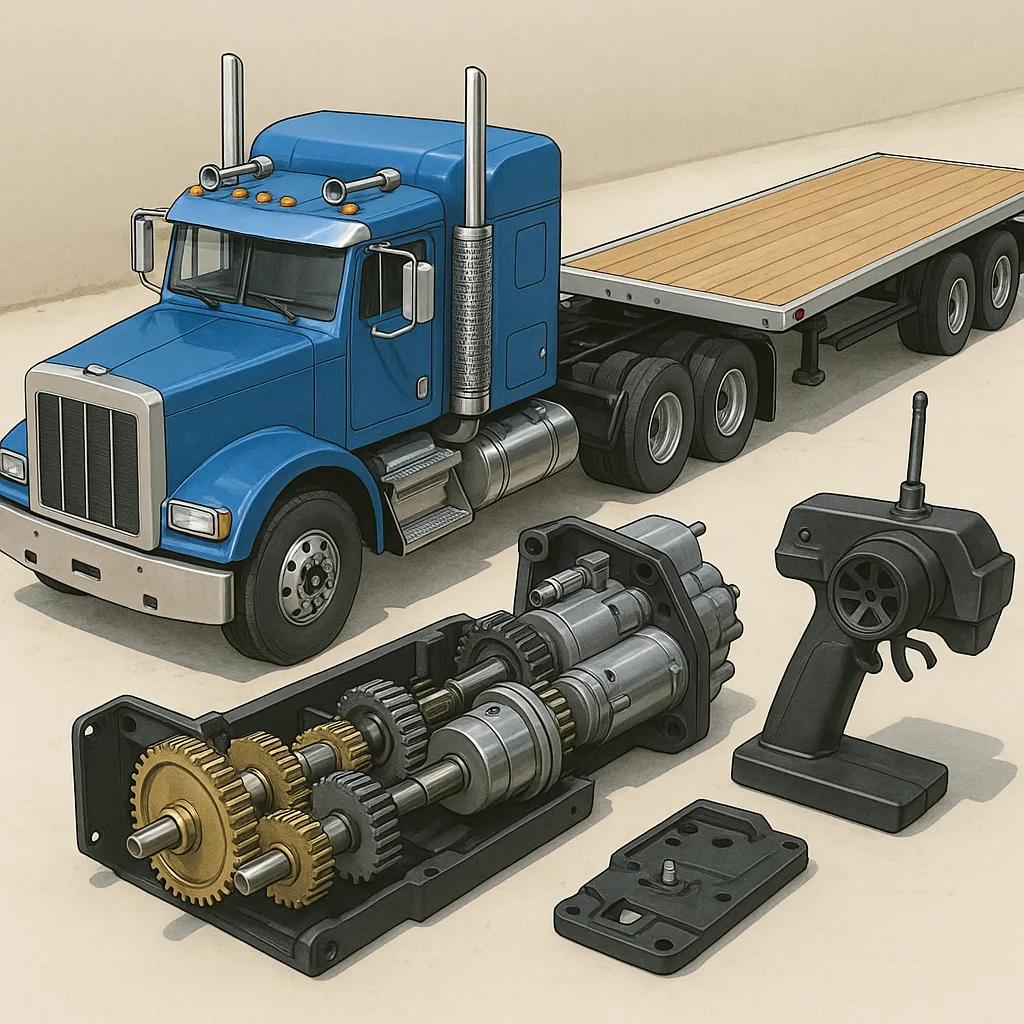
Custom gearboxes are one of the most satisfying upgrades because they directly affect performance and scale behaviour, and they can be tailored to the chassis you already own. Consider metal versus reinforced nylon gears depending on your torque requirements, and choose bevel or planetary arrangements for compactness and smoothness. 3D printing housings allows precise fitment of bearings and shafts, and you can design for grease retention and cooling fins if you plan extended runs. Pay attention to input ratios, output torque multiplication, and backlash, and test prototypes with a bench rig before final assembly.
Multi-speed systems add a level of realism and functionality that transforms an RC hauler into a credible scale vehicle, and there are several approaches to try depending on your skill level. A simple two-speed shift can be achieved with a servo-actuated dog clutch mounted to a spur gear, while more advanced builders might design a sequential gearbox with selectable gear sets and a selector servo. Electronic solutions include programmable ESCs with torque curves, but mechanical gearboxes give authentic shifting and allow the use of sound modules to match engine note to gear selection. Regardless of approach, include a slip clutch or torque limiter to protect the driveline during aggressive shifts.
Designing trailers and load-bearing haulers is a great way to combine chassis engineering with scale realism and electrical systems such as lighting and brakes. Think about axle configuration, trailer suspension travel, and the way a load is secured for believable movement on rough terrain. For inspiration and build logs that show practical mounting methods, check the project roundup at watdafeck.uk which includes parts lists and tips for electrical connections and articulation points.
Scale detail lifts a project from a functional model to a display-quality hauler, and small investments in the cab, bed, and accessories deliver high visual return. Work on interior details like dash textures, add realistic mirrors and wipers, and fit proportional lighting with resistors or a small controller for indicators and hazard flashers. Weathering techniques using washes, dry-brushing, and matt varnishes recreate the look of work-worn metal and faded paint, and 3D printed accessories such as load straps, spare tyre carriers, and toolboxes make each build feel bespoke and coherent on the trail.
Here are a few practical project starters that combine the themes of gearboxes, trailers, scale detail, and multi-speed systems for a satisfying maker experience.
- Two-speed gearbox retrofit: design a compact dog-clutch housing to add an overdrive ratio to a scaler chassis.
- Modular trailer with swappable beds: build a trailer with quick-release mounts for flatbed, tanker, and tipper modules.
- Servo-actuated PTO drive: create a power take-off to run auxiliary gear such as a winch or rotating drum on the trailer.
- Scale air brakes with proportional control: install a micro-pump and valves for realistic brake feel and indicator lights.
- Interior-detail cab rebuild: rework seats, dash, and instrument clusters with printed parts and LED backlighting for night runs.
Pick one project that matches your skills, gather the modest set of tools and parts you need, and expect to iterate on the first prototype rather than get it perfect on day one.
Comments
Post a Comment