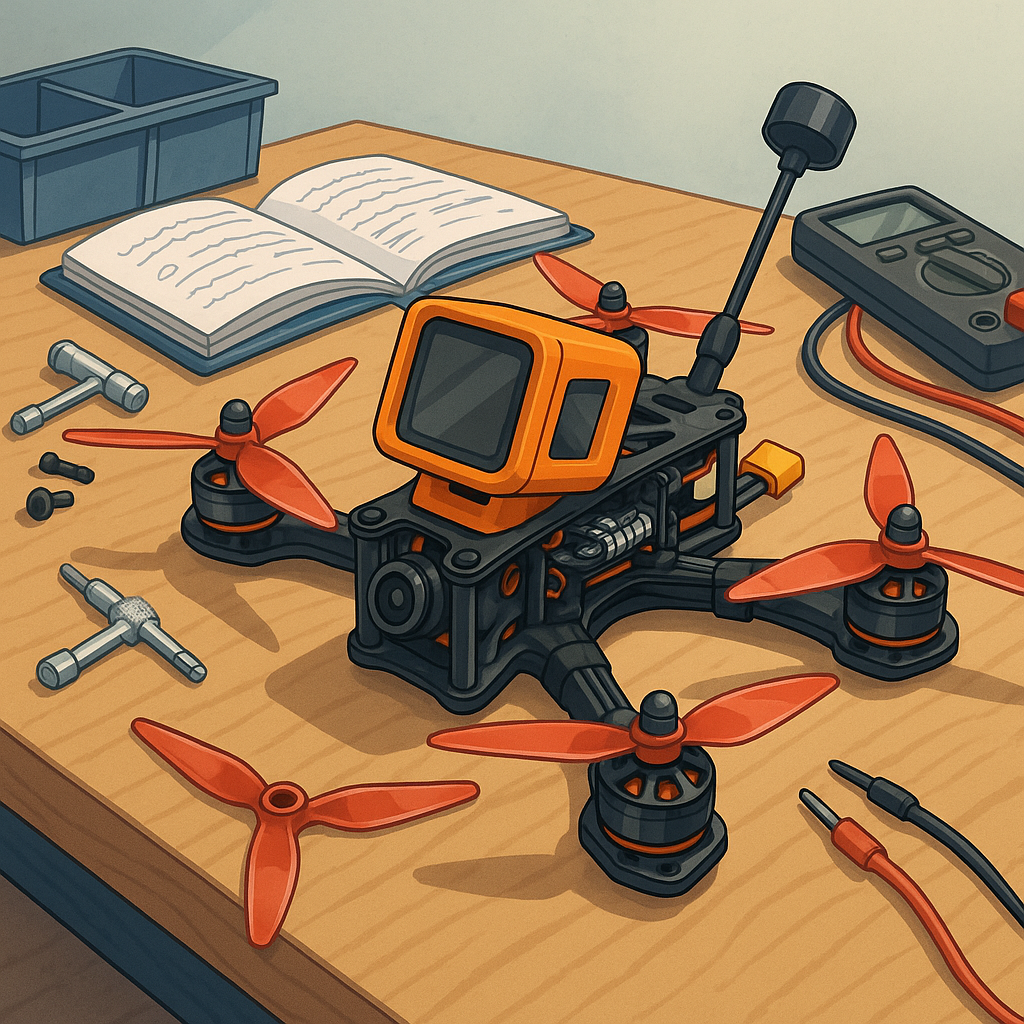
Troubleshooting Freestyle Drones: Rates, Propwash, Frame Stiffness and GoPro Mounting.
Freestyle flying is inherently demanding on both pilot skill and machine setup, and many problems that feel like pilot error are actually fixable with tuning and hardware checks. This guide walks through the most common issues hobbyists face when their quad behaves oddly during flicks, turbos or tight technical lines. I focus on four trouble areas that repeatedly show up on the bench and in logs: rates tuning, propwash control, frame stiffness and camera mounting. By isolating each area you can reduce crash risk and improve control feel during aggressive moves.
Rates tuning is the quickest way to change how the quad responds to stick inputs, but it's also a frequent source of overcompensation and oscillation if the rest of the setup isn't right. Start with your base RC Rates and stick to incremental changes, increasing rates in small steps and flying the same manoeuvre after each change to assess the effect. Remember to tune feedforward and smoothness as complements to rates because high feedforward with low smoothing can amplify motor-induced vibrations. If you want parts lists and sample rates I have a short reference and build notes on my site at WatDaFeck that you can consult when choosing components.
Propwash looks like a sudden loss of authority and a wobbly low-speed descent, and it is often a control loop and airflow interaction rather than pure pilot error. To diagnose propwash, log a tight descent or hover and look for low-frequency oscillations and spikes in the D term on the blackbox. Common fixes include lowering D slightly, increasing gyro and PID loop frequency only if your motors and ESCs can cope, or enabling RPM filtering and dynamic notch filters to tame specific resonant bands. In addition to software changes, try these practical checks to see which is causing the issue.
- Fly with fresh, balanced props and check for chip marks that change airflow behaviour around the blades.
- Increase prop clearance from the frame and camera housings to reduce disturbed airflow hitting rotors.
- Adjust D and feedforward together rather than in isolation, and use blackbox to confirm improvements.
- Test different propeller brands and sizes to find one that produces gentler wake for your motor/ESC combo.
Frame stiffness is a surprisingly common root cause of weird flight behaviour because a flexing arm or soft top plate changes motor-to-frame coupling and creates unpredictable resonances. To test rigidity, hold the frame with both hands and twist or bend each arm while watching the motors; any perceptible flex or rattling indicates a weak point. Tighten motor screws with the correct torque, replace worn standoffs and add reinforcement plates or thicker arms if the design allows. Avoid overtightening stack hardware into soft standoffs that can crush under load, and consider relocating heavy components closer to the centre of gravity to reduce leverage on the arms.
GoPro mounting is more than a cosmetic decision because the camera's mass and mounting method directly affect flight behaviour and footage quality. A soft TPU mount will reduce high-frequency vibration but can act like a pendulum at the frequencies involved in freestyle snaps, making the camera wobble and sometimes feeding back into the frame; a firm, direct mount gives crisp footage but transmits vibrations that can show as jello. My preferred compromise for most freestyle builds is a small rigid plate with a thin layer of closed-cell foam isolation under the camera, mounted close to the frame centre and secured with locking hardware to prevent shifting during hard impacts. Keep the camera as low and central as possible to minimise moment of inertia, and check you can still access the GoPro for quick swaps between flights.
When you put everything together, the systematic approach wins: reproduce the problem in a controlled way, change only one variable at a time, and log every flight with blackbox so you can see the effect of each tweak. Build a short checklist for the bench that covers prop condition, motor mount torque, frame flex test, PID baseline, filters and camera mounting before a test session. If you still see issues, isolate whether they appear only at certain throttle ranges or manoeuvres and focus your PID and filter changes on those RPM bands using dynamic notches rather than broad strokes. With patience and logging you will end up with a setup that responds predictably and keeps footage usable even through aggressive freestyle moves.
Comments
Post a Comment