Workshop Dust Control for Hobbyists: A Beginner's Guide
Dust in a hobby workshop is more than an annoyance because fine particles can harm your lungs, ruin finishes and shorten the life of tools and electronics. If you work with wood, composites, resin, 3D printing or sanding, you are generating a mix of large and very fine particles that behave differently and therefore need different controls. This guide outlines practical, affordable steps any hobbyist can take to improve air quality and safety in a small shop.
Air filtration is your first line of defence for airborne fine dust that escapes source capture, and not all purifiers are equal. Aim for a unit with a true HEPA filter rated H13 or better to trap particles down to 0.3 microns, and check the CADR or the clean air delivery rate to match your workshop size. Position a portable unit to pull air across the area where you work rather than behind you, and keep inlet and outlet clear to avoid short-circuiting airflow. Remember to change filters on the manufacturer’s schedule or sooner if you notice reduced performance, and consider a cheap particle monitor to quantify improvements over time.
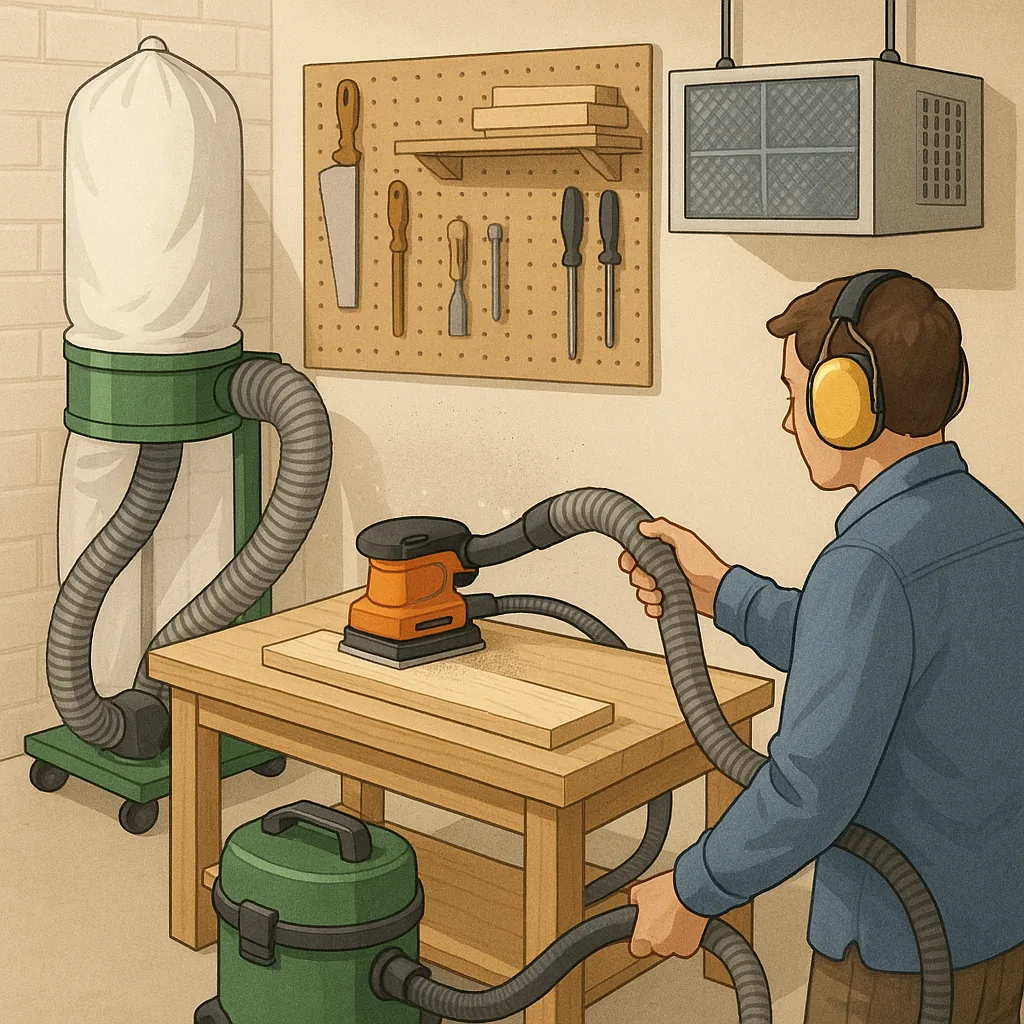
Vacuum systems are essential for source capture because removing dust at the point of generation prevents contamination of the whole room. A small shop vac with a fine dust filter will handle many tasks, but look for models with a HEPA or equivalent cartridge if you work with very fine dust or resin particulate. For power tools, use tool-mounted extraction shrouds and hose runs as short as possible to maintain suction. If you collect a lot of dust, add a cyclone separator ahead of the filter to trap large chips and extend filter life, and always empty containers and replace bags in a controlled way to avoid secondary dust clouds.
Anti-static measures reduce how much dust sticks to surfaces and electronics, which is particularly useful for 3D printing and working with PCBs or sensors. Static electricity causes fine particles to cling to fans, lenses and circuit boards, so grounding mats, wrist straps and even simple conductive brushings can make a big difference. Maintain a relative humidity of around 40 to 50 percent where possible to limit static build-up, and use anti-static sprays or wipes on PLA and ABS prints before finishing to avoid dust attracting to sticky surfaces.
Personal protective equipment and safe working practices are non-negotiable for health and safety because engineering controls are effective but not perfect. Use an appropriate respirator, preferably FFP2 or FFP3 for fine dust and ultrafine resin particles, and make sure it fits correctly for a proper seal. Eye protection is vital while cutting, sanding or using compressed air for cleaning, and ear protection should be used around loud extraction units and power tools. Keep electrical equipment and ducting well maintained, and ensure extraction units have appropriate overload protection and grounding to reduce fire risk.
Putting it all together starts with a simple layout and a routine that you can sustain as a hobbyist without breaking the bank. Capture at source with a dust extractor on major tools, run a HEPA air purifier to deal with fugitive dust, and carry out regular wet-wiping or vacuuming rather than dry brushing to avoid re-suspending particles. Small changes such as a doormat at the workshop door, storing dusty materials in sealed bins, and scheduling a short clean at the end of each session will keep dust under control. For further project ideas and shop setup examples see my site at WatDaFeck which has photos and layouts from a typical small makerspace.
Follow me on: Facebook: https://www.facebook.com/watdafeck3d · Instagram: https://www.instagram.com/watdafeck3d/.
Comments
Post a Comment