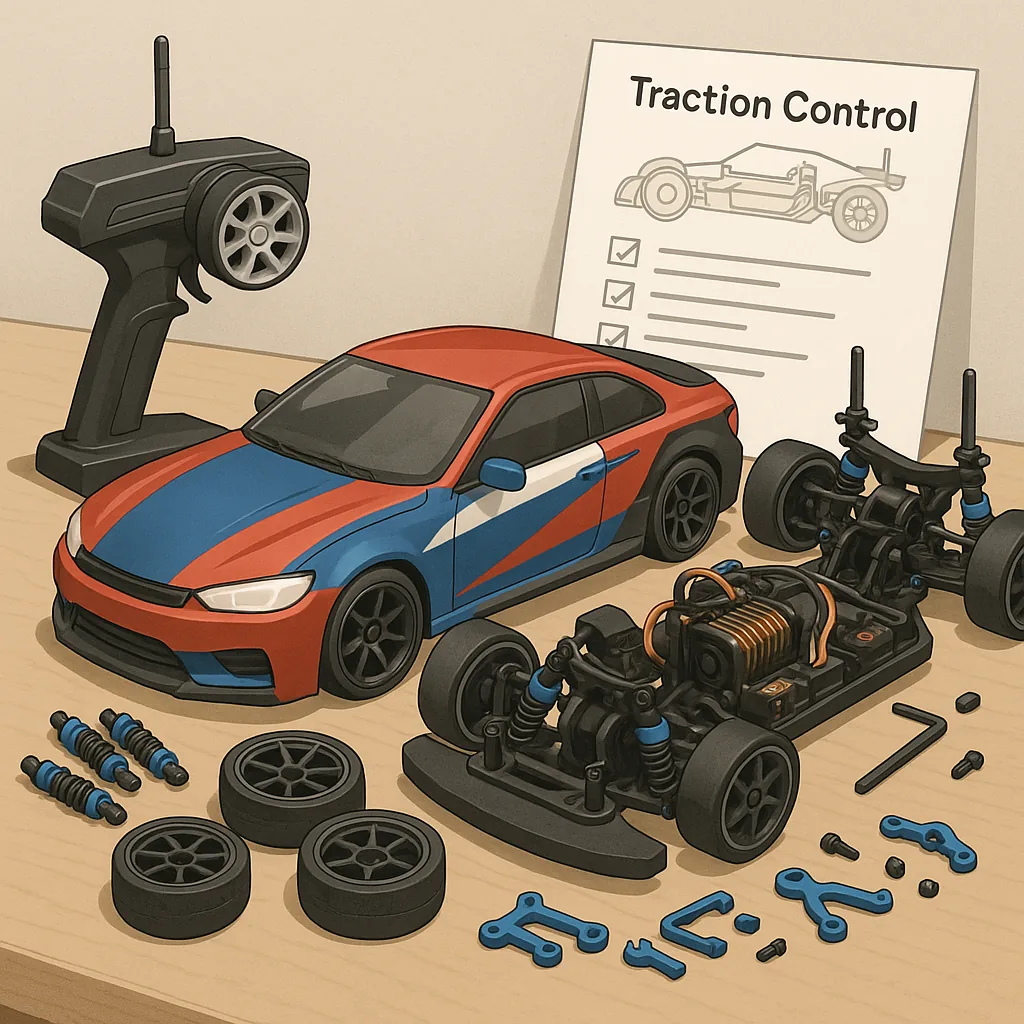
Build Log: Tweaking a Drift-Focussed 1/10 RC Car with Brushless Power and Traction Control.
This build log follows my step-by-step process turning a standard 1/10 touring car chassis into a drifter that still behaves predictably on mixed surfaces, and I record each change so I can reverse it if needed.
I started by listing parts and outlining goals, choosing a low-centre-of-gravity chassis, aluminium shocks, a sensored brushless motor and a programmable ESC, and I kept a running record on my blog at watdafeck to compare settings between runs.
Assembly was routine but precise, and I checked every mount and bearing for play before moving on to gearing decisions because the gear ratio strongly influences both acceleration and steering behaviour in drifts.
Gearing decisions were made in stages: first I chose a pinion and spur that give usable acceleration for slides rather than outright top speed, then I refined the ratio after a few test passes; as an example a 14T pinion with an 86T spur yields a 6.14:1 spur-tooth ratio which I used as a starting point and adjusted up or down depending on how the car unloaded mid-corner.
For the brushless motor I selected a mid-Kv sensored unit to preserve smooth low-RPM torque and predictable throttle response, and I programmed the ESC with conservative timing and an adjustable throttle curve while enabling a modest drag brake to help the car settle into corners rather than lunging forward when power is released.
Drift tuning then focused on chassis setup: softer rear springs and slightly stiffer front springs promoted rotation, reduced rear rebound damping to keep the back end lively, added negative front camber and small rear toe-in to control rear grip, and I experimented with tyre compounds and foam inserts until the car produced long, controllable slides rather than snap overssteer.
Traction control was the final refinement and I tested two approaches: ESC-based traction control using throttle cut and a simple gyro to stabilise yaw; the ESC method required careful adjustment of gain and cut aggressiveness so the car would still rotate under controlled power but not spin out, and the gyro provided a clean assist for longer sequences by softly nudging steering centre when necessary while allowing the driver to fight it for style.
On-track testing and iteration were the most important steps because small changes in gearing, motor timing or differential preload translated to noticeable differences in drift angle and driveability, and I kept notes after every session to converge on a setup that balanced flair with control.
Follow me on: Facebook: https://www.facebook.com/watdafeck3d · Instagram: https://www.instagram.com/watdafeck3d/.
Comments
Post a Comment