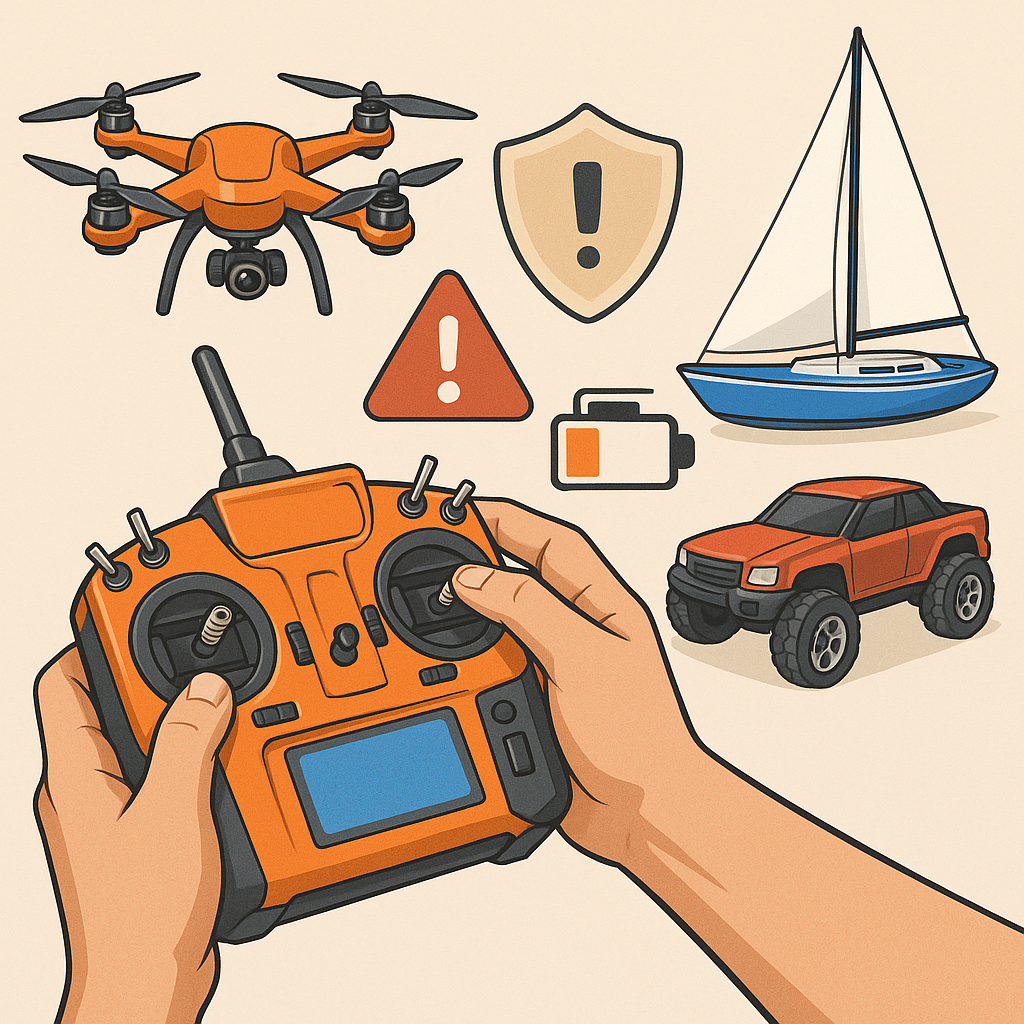
Beginner's Guide to Failsafe Systems for Hobbyists
Every hobbyist who flies, sails or drives radio controlled models should understand failsafe systems as a basic safety measure. A failsafe is a predefined response that your model takes when something goes wrong, such as losing radio signal or running low on power, and it exists to protect people, property and your equipment. Whether you build quadcopters, fixed-wing aircraft, boats or cars, planning for failure reduces recoveries, repairs and the chance of injury. This guide covers the essentials you need to start configuring reliable failsafes on a modest budget.
The simplest failsafes respond to a single trigger, while more advanced setups combine multiple inputs to make a safer decision. Common triggers include radio loss, GPS signal loss, telemetry warnings and critical battery thresholds. Typical responses are return-to-home, auto‑land, hover, hold position or controlled descent, and for boats or cars a safe kill or slow-down. Understanding the available options on your transmitter, receiver and flight controller helps you choose a sensible default that matches the type of model you use.
Return‑to‑home, often abbreviated to RTH, is a popular failsafe because it can bring a model back to a known location automatically using GPS. When configuring RTH you must set a reliable home point, choose an RTH altitude high enough to clear local obstacles and check that the compass and GPS locks are healthy before takeoff. Test RTH in a wide, obstacle-free area so you can see how the model behaves and adjust the ascent altitude and approach style to avoid trees and buildings. Remember that wind, battery state and motor performance affect the success of RTH, so it is not a substitute for cautious flying.
Radio loss behaviour needs care because different models should react in different ways for safety and to preserve the aircraft. For multirotors, many pilots set the failsafe to hover briefly then RTH or descend slowly if signal is not restored, while glider pilots usually prefer a gentle throttle reduction to preserve speed and maintain control. On fixed‑wing models a common approach is to set the throttle to a safe cruise value and the control surfaces to a neutral trim so the plane can continue flying to a recovery area. Always check whether your receiver has a dedicated failsafe setting versus relying on the flight controller, because conflicting settings can produce dangerous behaviour.
Redundancy is not just for commercial systems and can be applied in scaled form for hobby projects to improve reliability. Consider dual receivers or a secondary control link with automatic failover in high-value builds, and use separate power rails for critical electronics so a single battery issue does not take down everything. Dual GPS modules, redundant compasses and telemetry alerts give early warning of problems, and watchdog timers on the flight controller can reboot systems into a safe mode if needed. Bear in mind that redundancy adds weight and complexity, so balance it against the performance and cost of your model.
Before you fly, run a short checklist that includes bench-testing failsafes, performing a range check on your radio, confirming GPS and compass health and setting sensible battery failsafe thresholds. Log any failsafe events via telemetry so you can tune settings after a test, and mark a safe RTH altitude that accounts for the highest obstacle in your local flying area. For additional tutorials, build notes and downloadable checklists see WatDaFeck for practical examples and step‑by‑step guides that are useful for hobbyists at all levels.
Comments
Post a Comment