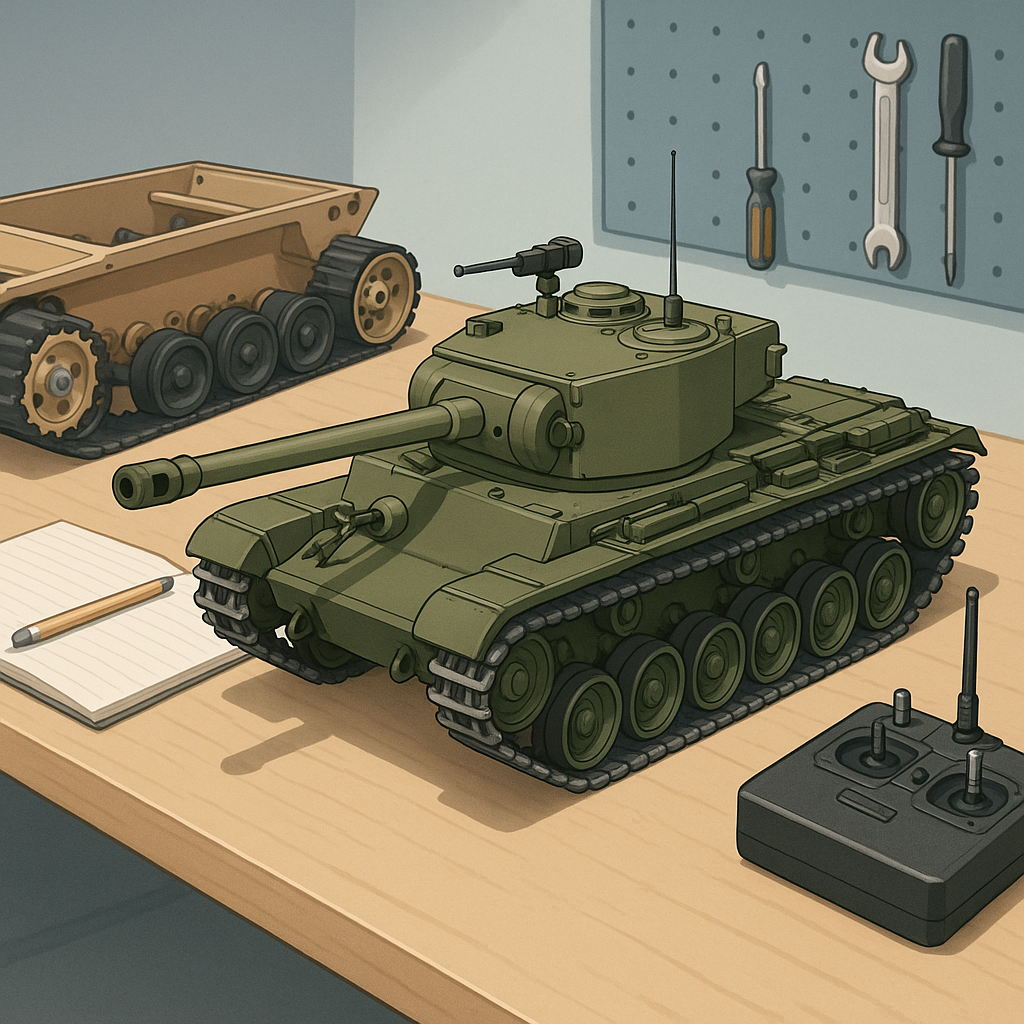
Build Log: Metal-Tracked RC Tank with Turret Stabilisation, IR Battle and Realistic Sounds
This build log covers the step-by-step creation of a hobby RC tank that uses metal tracks, an actively stabilised turret, an IR battle system and a realistic sound rig for immersive play on the field. I started with a donor chassis and a set of requirements that prioritised durability and playability for club skirmishes. Over several weekends I iterated on the drive train, turret mechanics, electronics and audio until the behaviour on grass and tarmac matched my expectations.
Metal tracks are the backbone of a convincing scale tank and deserve careful attention when fitting to a small RC platform. I used 3D-printed track guides and a set of aluminium link tracks salvaged from a larger model, machining custom pins to ensure a snug fit through the idler and sprocket teeth. Tensioning was handled with a spring-loaded idler mounted on a slotted bracket so I could fine tune chain slack without rebuilding the whole bogie assembly. Lubrication with a dry PTFE spray keeps grit from binding and reduces wear on the sprockets, and I always test for tight spots by turning the drive sprocket slowly before the first live run.
For turret stabilisation I chose a two-axis servo gimbal controlled by an IMU and a small flight controller running a PID loop tuned for the mass of my turret. The IMU sits near the turret ring to avoid errors from vibration in the chassis, and I use separate power rails with decoupling capacitors to prevent motor noise from corrupting the sensors. Initial tuning requires patience because the weight of the coaxial armament and any mounted cameras changes the centre of gravity, and I added counterweights in small increments until the PID corrections were small and the system held aim through rough terrain. The result is a turret that keeps sights on target while the hull negotiates bumps and slopes.
The IR battle system is based on a hobby-grade emitter module with 38kHz modulation and an array of receivers mounted around the hull and turret for good coverage. I coded a simple Arduino sketch that implements hit detection, health points, respawn timers and a reload sequence, and I added tactile and visual feedback with an LED ring and a small rumble motor. Range testing was done with a neutral density filter on the emitter to get realistic line-of-sight behaviour, and I log hits to a microSD card so I can review engagement data after skirmishes. For parts lists and more photos of the assembly process I posted notes on WatDaFeck to help other makers reproduce the system.
Sound is key to immersion and I built a custom audio system using a dedicated sound board controlled over I2C from the turret controller with inputs from throttle, turret rate and weapon firing signals. Engine and track loops are crossfaded based on speed, turret rotation triggers a different loop when slewing, and a small compressor keeps loud gun reports from clipping without losing punch. I used a Class D amplifier and two sealed full-range speakers mounted inside the hull, and vibration damping under the speaker baffles reduces rattling that would otherwise muddy the audio. Shielding and careful routing of the speaker and motor supply lines kept electrical interference out of the sound system.
Putting it all together required a staged testing approach where I validated drive, then turret stabilisation, then IR functionality and finally audio while running the whole system under battery power. Power distribution is handled by a compact bus with separate fuses for motors, electronics and audio, and I monitor battery voltage with a telemetry link to the transmitter. Field testing included several skirmishes with clubmates where I adjusted track tension and PID gains between rounds, and the tank held up well to close combat thanks to the metal tracks and the stabilised turret. The final set of adjustments were documented in my notes so future builds can adopt the same improvements.
Comments
Post a Comment