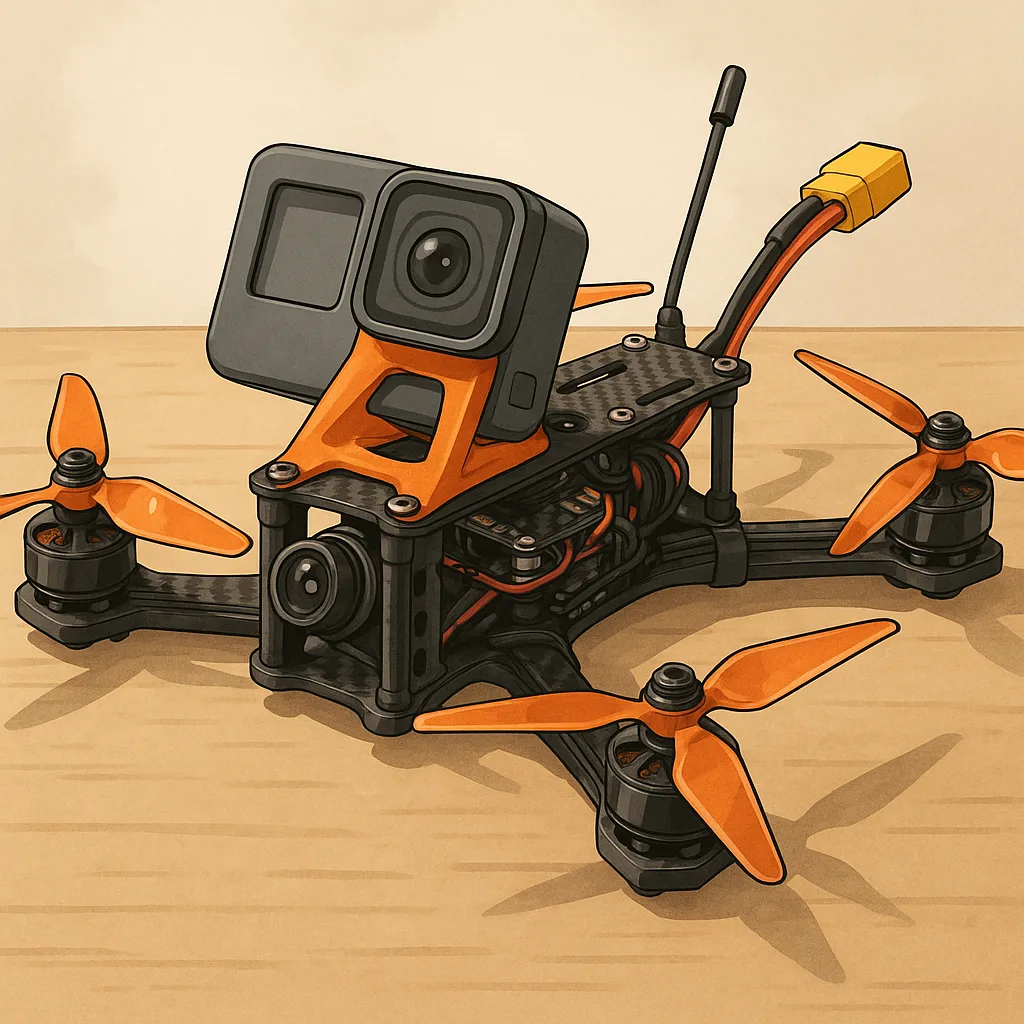
Buying Guide: Freestyle Drones for Hobbyists — Rates, Propwash, Frame Stiffness and GoPro Mounting
Choosing a freestyle drone is about more than top speed and flashy footage, and the right purchase will make learning rates tuning and handling propwash much easier. This guide focuses on the practical considerations every hobbyist should weigh before buying, with an emphasis on how frame stiffness, rates setup and GoPro mounting affect flight behaviour and video quality. For build notes, tutorials and a few tested setups, see WatDaFeck for hands‑on examples and links to components that work well together.
Frame stiffness is one of the single most important factors for freestyle flight performance because it governs how vibrations transmit through the frame and how predictable the craft feels during snaps and rolls. Stiffer arms and a well‑designed central plate keep motors and propellers in consistent alignment and reduce flex‑induced oscillations that confuse your flight controller. Look for frames with a balanced combination of thickness and lightness, quality carbon layup and reinforced motor mounts if you intend to pull hard on tumbling moves. Consider the mount topology too, as a monocoque or true X frame can behave differently from a stretched X or H style frame when under load.
Rates tuning is your tool for tailoring how quickly the drone rotates and how responsive it feels to stick inputs, and getting this right is crucial for freestyle. Start by deciding your target "feel": high rates give faster rotation speeds for aggressive tricks while lower rates give smoother cinematic control. Use Betaflight or your chosen firmware to set RC Rate, Super Rate and Expo rather than changing PID gains to alter feel. Keep feedforward relatively high for freestyle to maintain crisp reaction to stick changes, and log inputs with Blackbox when available so you can iterate without guessing. Test changes incrementally and fly a consistent space so you can reliably compare settings.
Propwash control is the engineering challenge that separates an OK pilot from a good one, and it depends on tuning, prop choice and frame behaviour together. Propwash shows up as a series of low frequency oscillations or a "pulsing" yaw when the drone is disturbed at low speeds, and it reacts poorly to stiff D‑term settings and excessive filtering. Start by ensuring your ESCs and motors are matched to the props and that you have minimal motor cogging or vibration. Tune with slightly increased D‑term for snappy recovery but avoid over‑aggressive D gain that amplifies propwash, and use notch or RPM filters sparingly to remove broadband noise without delaying the controller's response.
GoPro mounting affects both video quality and flight dynamics, so choose the mount type with the flight profile in mind rather than chasing the lightest option every time. Rigid mounts give stable footage at high speed and reduce rolling gait in the horizon, but they transmit every vibration to the camera and can worsen propwash visible in video. Soft mounts and dampers isolate the camera and help reduce jello, but they can introduce sway or resonance that shows up during quick snaps unless properly tuned; a semi‑rigid solution using TPU parts, foam pads or silicone donuts often balances those trade‑offs. Position the camera close to the centre of mass to minimise the effect on handling, and consider a tilt mount that lets you set a sensible angle for both fast runs and slower manoeuvres.
When buying, also check the flight controller, ESC protocol and motor specs because those components make rates tuning and propwash control possible in practice. A controller with a fast gyro loop, support for blackbox logging and an easy tune interface will save hours of trial and error, while modern ESCs with bidirectional DShot and good current handling keep motor response clean. Choose motor KV to match your preferred prop size and flying style, and be realistic about propeller selection as a variable you will change often. In short, buy a frame and component set that suits your style, allow a little budget for a decent mount solution for your GoPro, and plan to spend time refining rates and PID to get the handling you want.
Comments
Post a Comment