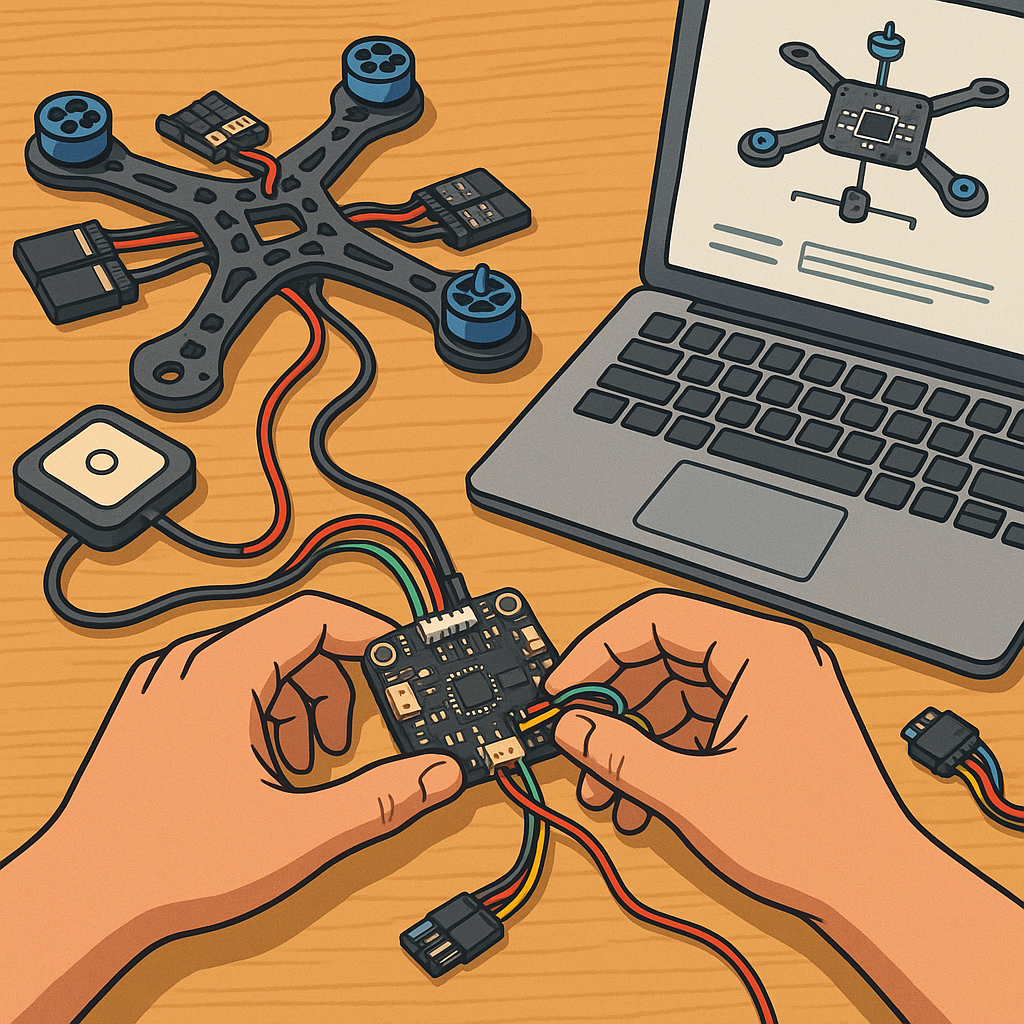
Flight controller setups for hobbyists: tips and tricks for reliable flying.
Getting the most from a flight controller starts with understanding what you want the aircraft to do and which firmware best matches that mission, and this guide focuses on practical pointers rather than theory alone.
ArduPilot suits complex missions and rigs that benefit from advanced failsafes and autonomous features, so start by using Mission Planner to check EKF health and sensor fusion after any hardware change, and perform a full compass and IMU calibration on a non-metal bench to get reliable orientation data.
iNav is popular for racers and lightweight multirotors where crisp manual control and integrated OSD features matter, and you should pay attention to correct looptime, gyro filters and notch filters in the configurator to prevent motor noise from destabilising the flight control loop.
PID tuning is both science and craft, and a safe procedure is to increase the P term until a slight oscillation appears, then back off by 10 to 20 per cent, increase I gradually to eliminate steady-state drift, and apply D sparingly to dampen overshoot while monitoring logs for noisy derivative spikes.
GPS rescue and sensor hygiene are often overlooked but make a huge difference to safe recovery, so mount the GPS on a short mast clear of the carbon fibre frame, test compass orientation with the props off, enable a conservative home-altitude and return-to-launch altitude, and always verify that you have a reliable satellite fix before arming.
If you want clear wiring diagrams and step-by-step configuration examples to follow, see the maker resources at WatDaFeck.
- Check motor spin direction and propelling before flight.
- Confirm ESC calibration and that throttle ranges are correct.
- Run a bench hover and log the flight to inspect vibrations and sensor noise.
- Enable and test GPS rescue or RTH on a low altitude first to verify behaviour.
Finally, adopt a repeatable workflow: hardware install, sensor calibration, conservative PID baseline, short test flights with logging, then iterative tuning and filter optimisation, and always keep a verified failsafe plan so that you can recover from unexpected issues with confidence.
Comments
Post a Comment