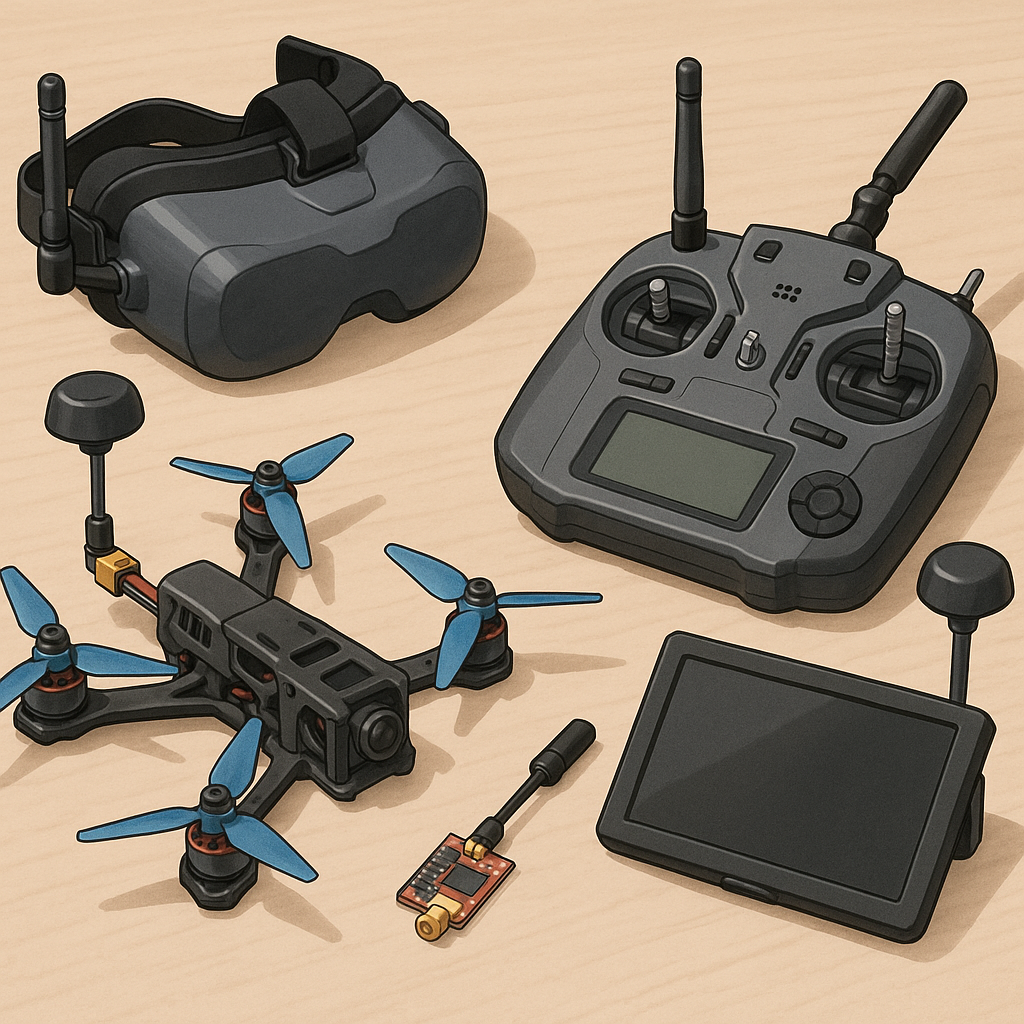
FPV Video Systems for Hobbyists: A Safety Overview
First person view flying gives a thrilling perspective but it also introduces safety and regulatory responsibilities for the pilot, the equipment and other airspace users. This safety overview focuses on practical risks and mitigations around video systems, so you can enjoy FPV while reducing the chance of interference, loss of control or regulatory breaches.
One of the biggest choices you will make when building an FPV setup is analogue versus digital video. Analogue systems are typically lower latency, simpler to repair in the field and more tolerant of packet loss, which makes them popular for racing and acrobatic flying where quick reactions are vital. Digital systems, including modern consumer digital links, usually provide far better image clarity and range under some conditions, but they can introduce additional latency and rely on more complex compression and hardware that might fail or be harder to fix on the spot. From a safety perspective, choose the system that matches your skill level and environment and be aware that mixing analogue and digital gear may require separate receivers or additional equipment to avoid blind transmission periods.
Transmission power from your video transmitter (VTX) is a critical safety factor that affects range, interference and legal compliance. Higher power increases range but also increases the chance of interfering with other radio services and exceeding local limits. In the UK you must follow Ofcom guidance and local club rules for permitted bands and power outputs, and at many club sites it is courteous and safer to use lower power settings to avoid saturating the band. VTX units also produce heat at higher outputs, so fit them in a way that allows cooling, use reliable connectors and avoid powering a VTX with an unstable supply that could cause voltage spikes and equipment failure during flight.
Antennas are often overlooked but they determine how your signal propagates and how resilient your link is in the real world. Choose circular polarised antennas for multirotors to reduce multipath and orientation losses, and directional antennas for long-range fixed-wing work where you can point the gain at the aircraft. Match connectors and polarities between transmitter and receiver, and be aware that cable length and quality reduce signal strength, so place the antenna as free from carbon fibre and metal as possible. Always inspect antenna integrity before flying, replace cracked radomes or broken elements, and use an antenna tube or mount to reduce the chance of damage and injury to bystanders in a crash.
Latency is a safety consideration that directly affects your control inputs and reaction time. Racing pilots need the lowest possible latency, which is why many stick with analogue, but modern digital systems can approach sufficiently low delays for general flying. When setting up your system, measure latency where possible and keep any image-processing features disabled for flight-critical use. On-screen display (OSD) integration is another safety-critical feature because it provides telemetry such as battery voltage, RSSI and flight time directly in the pilot’s view. Configure the OSD to show essential telemetry without cluttering the view, calibrate voltage scaling so low-voltage warnings are accurate, and enable audible or visual alarms for critical thresholds to avoid losing your aircraft due to undervoltage or weak signal conditions.
Before every flight run a short safety checklist that includes confirming VTX channel and band, checking VTX power level, inspecting antennas and connectors, verifying OSD telemetry and ensuring your receiver diversity or goggles are functional. Coordinate channels with other pilots at a club field, use pit mode when changing VTX settings near others and keep an eye on local airspace restrictions to avoid controlled zones and airports. For maintenance, log firmware versions and upgrade when necessary, and fit fuses or power filters to reduce the chance of electrical faults. For build tutorials and troubleshooting guides consult reputable resources and community pages such as WatDaFeck for practical tips that keep both your gear and other airspace users safe.
Comments
Post a Comment