LiPo Safety Build Log: Storage, Charging, C‑Rates, IR Measurement and LiPo Bags.
This build log walks through a recent LiPo safety bench setup for my hobby bench where I assembled, tested and stored packs with safety as the guiding principle, and I will describe each step in practical detail for fellow makers and RC hobbyists.
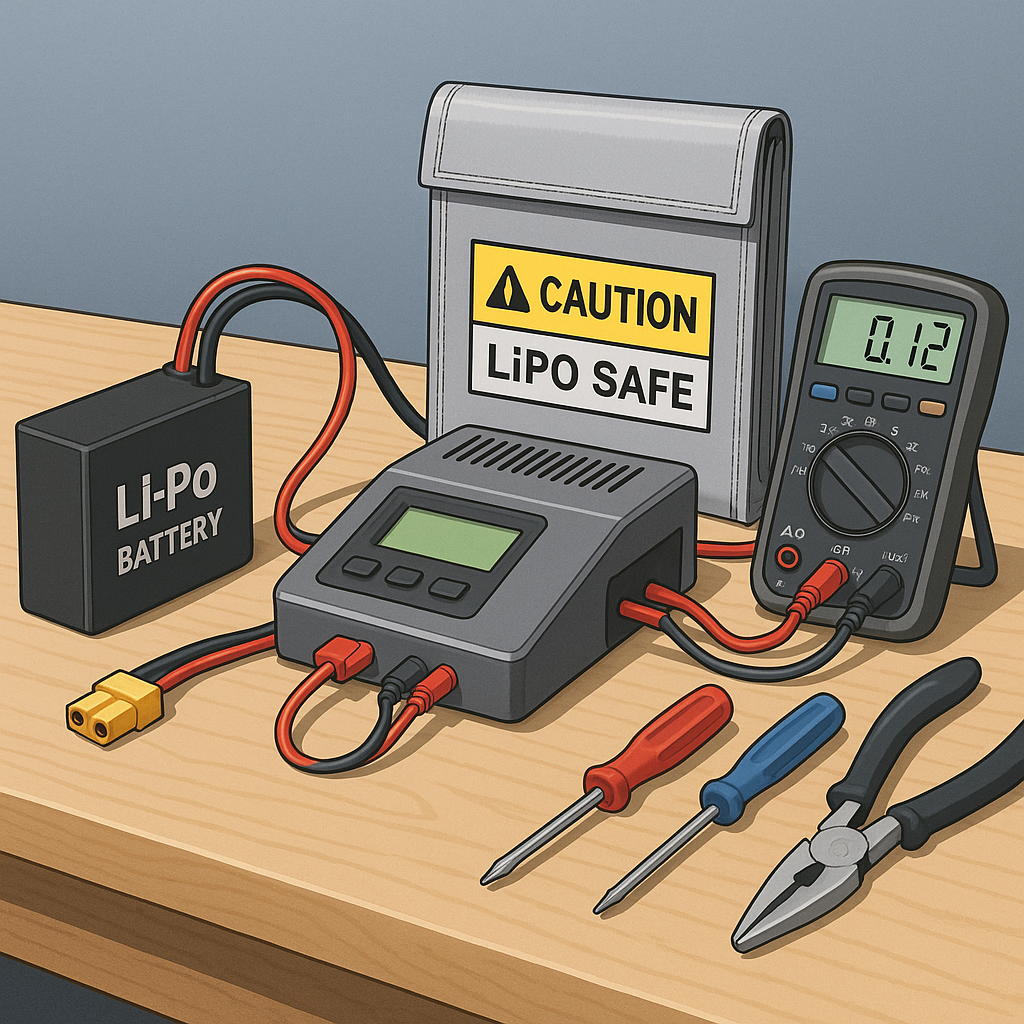
Step 1 was gathering parts and tools before I touched any cells, and the list was deliberately short to avoid mistakes: a reliable balance charger, a LiPo-compatible discharger, a good digital multimeter, a charger that reads internal resistance or a separate IR meter, heat‑shrink tubing, and certified LiPo bags for charging and transport, and I documented the charger model and leads on my site WatDaFeck for future reference.
- Balance charger with correct cell count support.
- Discharger or load bank for safe storage discharge.
- Multimeter and IR meter or charger with IR function.
- Fireproof LiPo bags and a metal storage box.
Step 2 covered inspection and storage voltage preparation where each pack was visually checked for puffing, damage, loose solder joints and swollen cells, and any suspect pack was retired or discharged to a safe voltage immediately to prevent further deterioration.
Step 3 was all about charging and C‑rates, where I set the charger to balance mode, confirmed the correct cell count and chemistry, and selected a charge current at or below 1C for everyday packs to maximise longevity, while noting that many high‑quality packs tolerate 2C or higher for short bursts but continuous high charge C‑rates increase heat and wear unnecessarily.
Step 4 explained how I measured internal resistance (IR) on each cell and pack using the charger's built‑in IR function where available, and where it was not I used a simple voltage‑sag method by applying a known load and measuring the drop to calculate IR with the formula R = ΔV / I, noting that typical new cell IR might be in the tens of milliohms and values creeping above about 50 milliohms per cell are cause for caution and potential retirement.
Step 5 described LiPo bag use and final storage practices where I always charge on a non‑combustible surface inside a LiPo bag to contain flareups while recognising that bags delay but do not eliminate fire, and I store packs at 3.8V per cell in a cool, ventilated metal box or dedicated fireproof container rather than in living spaces and I label each pack with last charge date and IR reading for easy rotation and monitoring.
Step 6 summarised the safety routine and maintenance schedule with practical tips: never leave packs charging unattended, balance charge regularly, keep charge rates conservative unless the pack spec allows otherwise, measure IR periodically and match cells by IR when building series packs, and replace or recycle packs that expand or show rapidly rising IR values so you reduce the risk of failures and prolong pack life.
Comments
Post a Comment