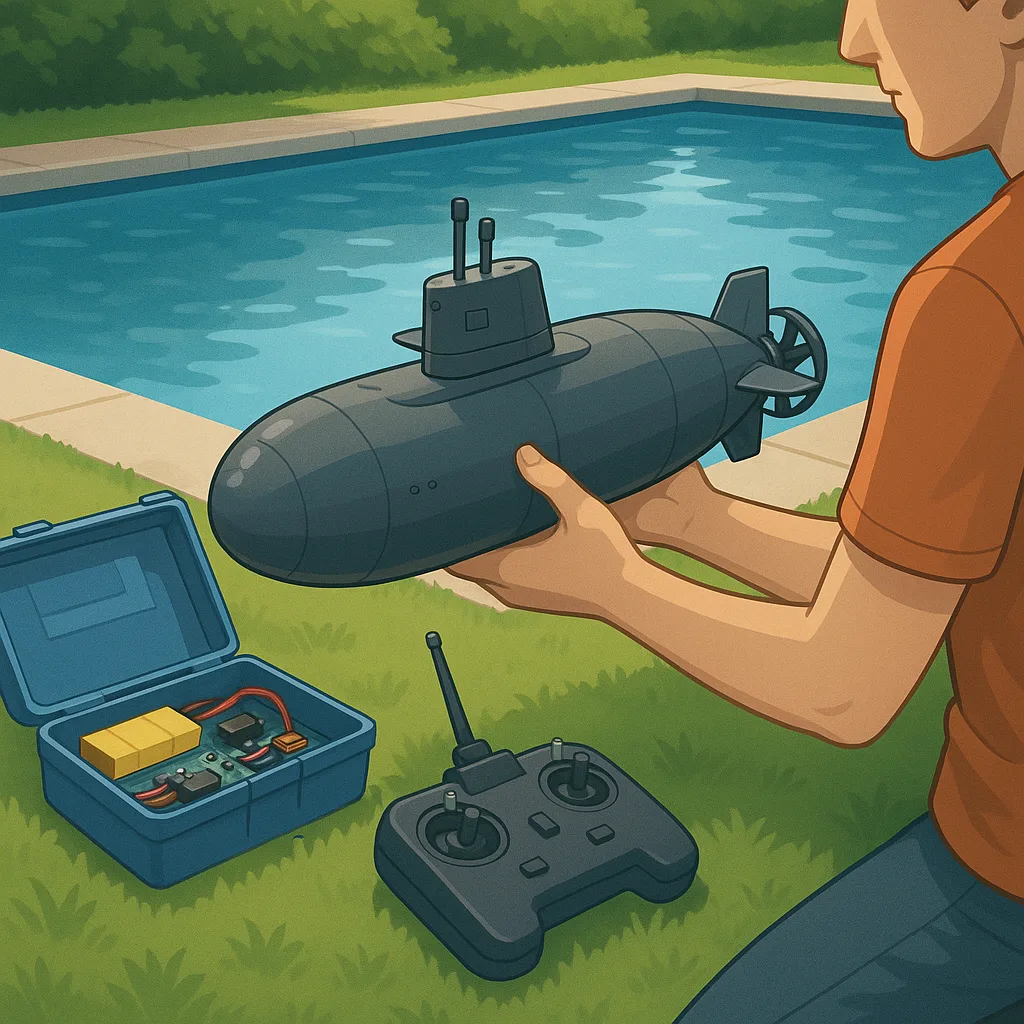
RC Submarine Project Ideas for Hobbyists
RC submarines are a rewarding blend of mechanical engineering, electronics and marine behaviour that make excellent weekend projects for makers of all levels, and this roundup focuses on practical ideas you can build and test at a local pond or pool.
Getting ballast right is the heart of most submarine projects because buoyancy and trim determine how reliably the model dives and surfaces, and a good starting project is a simple variable ballast tank that uses a small bilge pump or a piston to alter internal volume for neutral buoyancy during submerged running.
Fail-safe surfacing should be treated as a mandatory feature for every sub and there are several approaches, including designing the hull to be positively buoyant by default, implementing a spring-loaded drop weight that releases when power is lost, and coding a watchdog in your microcontroller that triggers air bladders or cuts motors when the receiver signal fails.
Waterproof servo bays are often overlooked until a leak destroys a servo, so building an accessible hatch with a properly sized O-ring, stainless fixings and a cable gland for linkages is a strong project for beginners, and more advanced makers can try magnetic couplings or flexible shaft seals to avoid running control rods through the hull at all.
Underwater FPV is a thrilling upgrade but tricky because radio generally does not propagate well through water, so consider a tethered video feed using a thin twisted-pair or fibre for real-time footage, or mount the camera in a pressure-rated housing with a surface relay buoy for wireless uplink and add LED lighting to handle low-light conditions.
Here are some concrete project ideas to try at different skill levels before you scale up, and for parts lists and hands-on guides for many of these builds see WatDaFeck.
- Beginner foam hull with fixed ballast and waterproofed micro-servos, aimed at learning trim and basic diving behaviour.
- Intermediate piston-based variable buoyancy system controlled by an Arduino, with a simple watchdog that triggers positive buoyancy on signal loss.
- Advanced magnetic drive shaft and sealed motor pod, paired with a dedicated servo bay that uses a silicone O-ring hatch and pressure-tested bulkheads.
- FPV micro-sub using a tethered fibre or copper link, LED ring lighting and a surface relay buoy for video and control over longer ranges.
- Scale model with functioning ballast tanks and a mechanical drop-weight fail-safe, designed to be neutrally buoyant at depth and positively buoyant when the weight is released.
Before you start any project allocate time for pressure testing, saltwater corrosion resistance and failsafe rehearsals, and always test in controlled conditions with a safety line and an observer present to recover the model if anything goes wrong.
Comments
Post a Comment