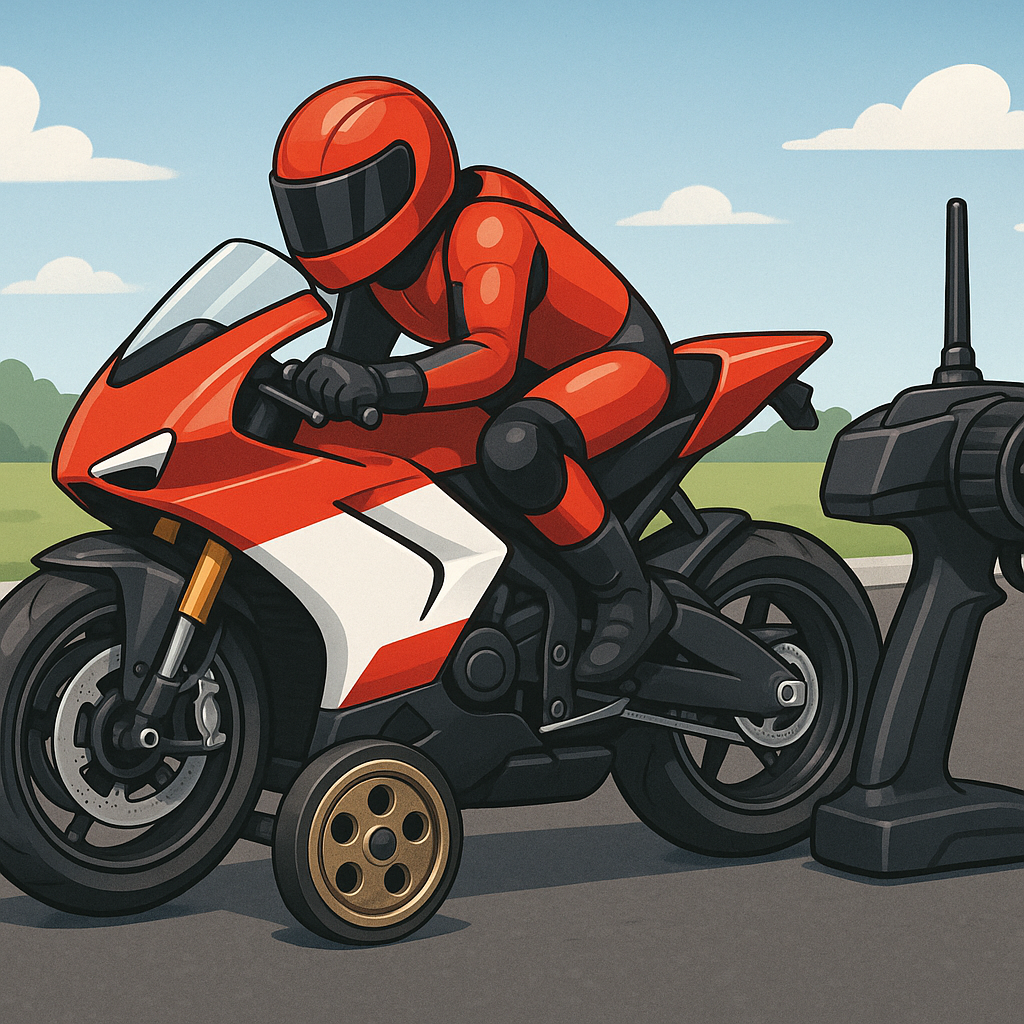
Safety Overview for RC Motorcycles: Gyro Wheels, Stabilisation and Cornering.
RC motorcycles are a captivating niche of the hobbyist scene that reward careful setup and disciplined practice, and safety is the foundation of enjoyable running sessions. Unlike four-wheeled cars, two-wheel models are inherently unstable at low speeds and benefit enormously from thoughtful stabilisation and rider-like weight management. This article gives a practical safety-focused overview aimed at hobbyists who want to reduce crashes, protect fragile components and learn predictable handling habits before attempting faster runs or complex manoeuvres.
Gyro wheels and gyroscopic effects are often misunderstood, so it helps to be clear about what they do and what they do not do. When people say "gyro" in the context of RC bikes they usually mean an electronic gyro or an internal flywheel that creates a stabilising moment, both of which resist sudden roll or yaw changes. These devices can make balancing at low speed much easier and can correct small disturbances in a straight line, but they cannot substitute for proper throttle control, good steering geometry or the correct centre of gravity for safe cornering.
Modern stabilisation systems pair inertial measurement units (IMUs) with control electronics to provide adaptive correction for roll and yaw, and they often include tuning options such as sensor gain, damping and "follow" behaviour. Rate mode keeps the bike reacting proportionally to motion while heading-hold or lock modes try to maintain an orientation, and knowing the difference is important for safety when transitioning into corners. If you want parts lists and step-by-step guides for stabilising a bike, see https://watdafeck.uk for detailed project pages that explain installation and tuning in plain language.
Cornering on an RC motorcycle depends more on dynamic weight balance and subtle inputs than on raw power, so learning good corner technique is a significant safety measure. Move mass forwards for better front grip on tight turns and shift rearwards for stability on fast sweepers, and secure batteries and other components so they do not shift under braking or acceleration. Use gentle steering and throttle transitions rather than sudden jerks, and match tyre compound and pressure to the surface to maintain predictable traction during lean angles.
Before every run, follow this quick checklist to reduce the chance of a catastrophic crash and to keep repair time to a minimum.
- Check that the gyro and any IMU are calibrated and that the firmware is up to date.
- Verify battery security and voltage, and confirm proper battery orientation and connector condition.
- Inspect tyres for cuts, correct pressure and adequate tread for the surface.
- Confirm servo mounting screws and linkages are tight and free of excessive play.
- Set a sensible radio failsafe and test it by briefly cutting transmitter power in a safe area.
- Keep bystanders clear and run on a surface suited to the bike's tyres and speed.
Maintenance and sensible troubleshooting go hand in hand with safe operation, and a small routine saves a lot of time and money over multiple runs. Regularly check wheel bearings for side play, clean and lubricate the chain or belt drive if fitted, and confirm that suspension dampers are not leaking and are set to a commercially sensible range. If you experience oscillation or hunting, reduce gyro gain slightly and re-check servo centring, because excessive gain is often the single biggest cause of angles that feel unstable.
Comments
Post a Comment