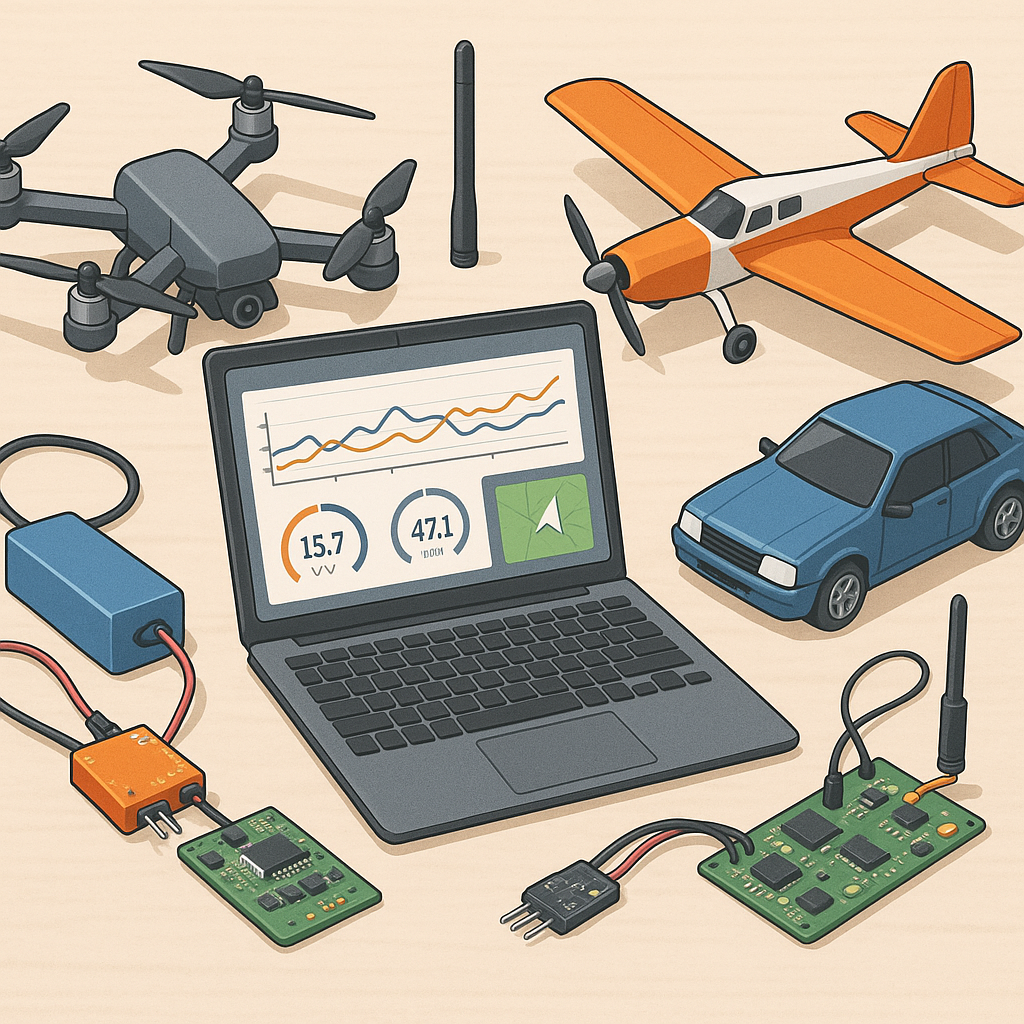
Telemetry systems for hobbyists: project ideas roundup
Telemetry is the glue that turns raw flights and runs into useful data, and this roundup highlights accessible projects you can build with common parts and a little soldering skill. Hobbyists working with multirotors, fixed wing models, cars or boats can all benefit from telemetry that reports position, battery state, currents and controller health. In the projects below I focus on GPS integration, ELRS telemetry backchannels, MSP-based data requests, current sensing and using Blackbox logs to close the loop on improvements.
GPS projects provide immediate satisfaction and practical value, and a first project is to fit a GPS module with a magnetometer to your craft and log tracks for every sortie. Try setting up an on-board datalogger that writes NMEA or UBX sentences to microSD and then plot tracks on mapping software to spot lost models or refine waypoints. For a more advanced challenge add a small beacon transmitter that outputs location packets on a hobby radio band to aid retrieval, or write a simple geofencing routine that triggers a failsafe when you stray beyond a set radius.
ExpressLRS telemetry opens up robust two-way links for long-range control and live data, so a practical build is integrating ELRS receivers with telemetry forwarding to your radio or ground station. Use the ELRS LUA scripts to view voltage, RSSI and GPS on screen, and experiment with forwarding MSP or smart port telemetry from your flight controller through the ELRS module. A great intermediate project is to configure telemetry alarms and logging windows so that critical data is preserved when signal quality drops, which teaches you how to balance bandwidth and update rates for reliable links.
MSP, the MultiWii Serial Protocol, is a small and well-documented protocol that lets you query flight controllers and request sensor data in real time, and a useful project is building a handheld or laptop dashboard that polls MSP for rates, VTX telemetry and sensor fusion status. You can write a Python script that reads MSP packets over UART or USB, plots live IMU values and writes CSV for later analysis, or connect MSP to an OSD to display dynamic data on analogue video systems. Understanding MSP helps you bridge the gap between raw flight controller internals and higher-level telemetry displays.
Current sensors form the backbone of useful power telemetry, and projects with shunt-based sensors or I2C devices like the INA219 or INA226 teach measurement and safety. Start by fitting a sensor between battery and power distribution board, calibrating it against a bench multimeter and logging the amp draw against throttle percentage to build a consumption map for each motor. From that data you can implement battery capacity remaining estimates, programmable low-voltage alarms and automated thermal checks that trigger when continuous current exceeds safe limits for a component.
Blackbox logs are indispensable when you want to correlate telemetry with actual behaviour, and a constructive project is writing a log analyser that overlays Blackbox flight traces with GPS tracks and current draw to identify causes of oscillation or failure. Combine Blackbox parsing with ELRS telemetry dumps and MSP snapshots so that each logged flight contains the radio link quality, controller state and power profile in one timeline. If you want ready-made wiring guides, code snippets and example projects to get started, visit WatDaFeck for practical resources and build notes.
Comments
Post a Comment