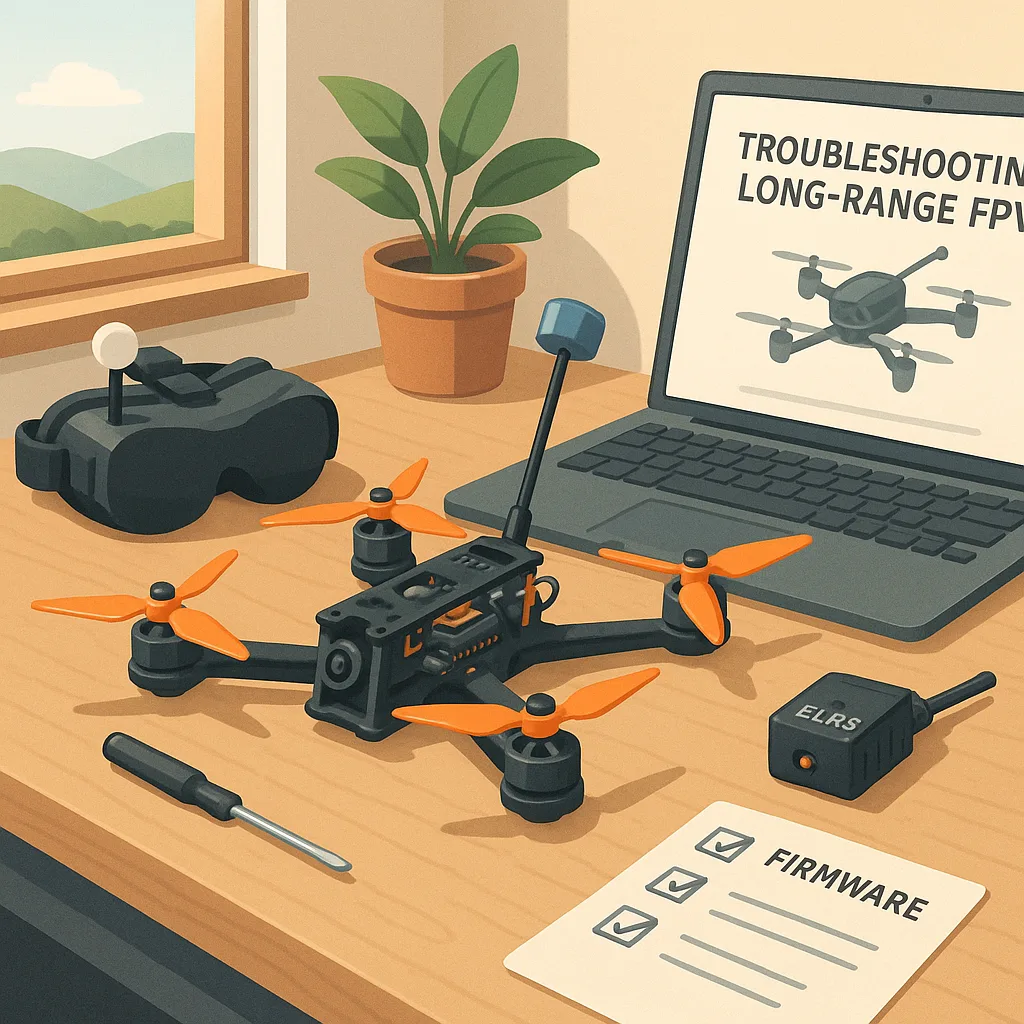
Troubleshooting Long-range FPV for Hobbyists.
Long-range FPV brings a unique set of issues compared with local flying, and this guide walks through the common problems and practical fixes for hobbyists who want reliable, long-distance flights.
Start with ELRS because it underpins your control link and is the most common failure point on long-range setups, and I recommend checking firmware versions, binding security, and antenna connections first. I keep build logs and wiring diagrams on WatDaFeck for reference. Inspect the tiny coax joints and U.FL or SMA sockets for hairline cracks and reflow any suspect solder joints before squaring away other faults.
GPS rescue behaviour is often blamed for flyaways but is usually a configuration or sensor problem, and you must verify GPS fix quality and the correct compass orientation before trusting rescue. Test rescue on the ground with props removed by forcing a rescue mode on the transmitter and watching the logged position and heading that the flight controller uses for RTL or guided modes. If rescue drifts or spins, re-calibrate the compass, move magnets or ESCs away from the compass, and ensure the barometer has a stable reading to prevent false altitude decisions.
Efficient motors and the right propeller choice extend range and reduce the chance of battery-sag-induced failsafes, and the fix often lies in matching motor KV to your typical cruise throttle rather than peak thrust. Choose motors that spin larger, slower props efficiently for long-range, and use ESC telemetry to log current draw across the throttle curve so you can identify where the system is spending energy. Replace over-propped setups with a prop that gives a lower average current at cruise RPM and check that your battery C rating and capacity support the sustained draw you log on long flights.
Antenna placement is the simplest and most overlooked cause of poor range, and you should separate antennas from carbon fibre, motors, and power wiring to keep the radiation pattern clean. Mount the receiver antenna high on the tail and oriented for cross-polarisation with your goggles or ground antenna, and keep the transmitter antenna clear of metal and ground planes. If you get unexpected signal dropouts, swap antennas and check for loose crimps, corrosion on SMA threads or damaged coax, because physical damage is a far more common culprit than mysterious RF interference.
Failsafe settings must be explicit and tested because long-range flights turn small configuration errors into total losses, and you should decide a conservative strategy such as GPS rescue to RTL combined with a motor cutoff only as a last resort. Configure ELRS with a sensible failsafe channel profile and a clear failsafe throttle value that you test on the bench with props removed, and log RSSI thresholds so you know at what distance or orientation the failsafe will engage. Perform a preflight checklist that includes telemetry sanity checks, last-known coordinates, and a quick power cycle of the RX to ensure the saved failsafe profile is active before any long mission.
Comments
Post a Comment