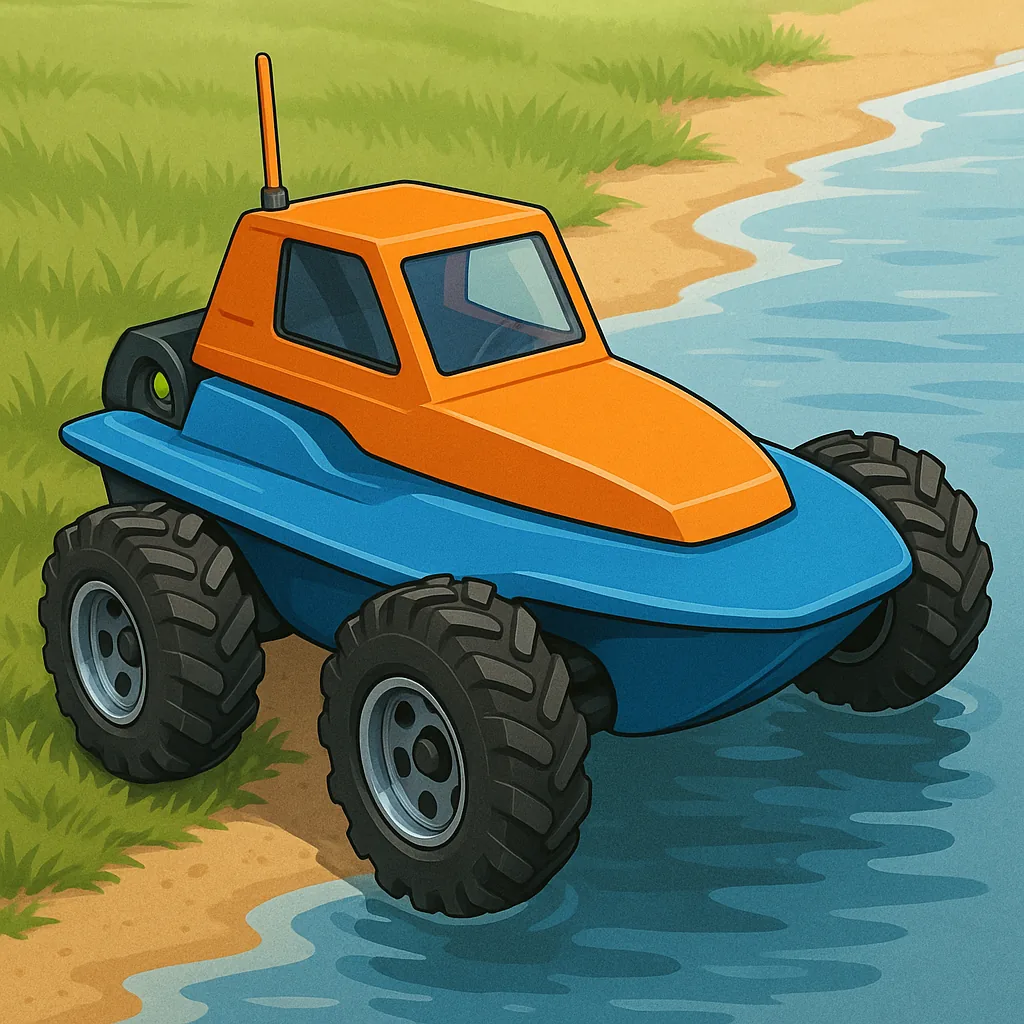
Amphibious RC Craft: Practical Tips for Smooth Water-to-Land Performance.
Amphibious RC models are brilliant projects for makers who enjoy a challenge and the spectacle of a craft that can leave the lake and carry on across grass or sand, and they bring a fresh set of engineering problems to solve compared with single-terrain builds. The key challenges are reliable water-to-land transitions, predictable buoyancy, robust seals and effective mixed-terrain driving, and addressing those early in the design stage saves time and frustration later. This guide collects practical tips and tricks I have learned from field testing and community builds so you can get your amphibious rig working smoothly and consistently.
Start with buoyancy, which is the heart of any seaworthy amphibious model, because insufficient reserve buoyancy will doom land recoveries and make seal failures catastrophic. Calculate the total weight of the craft fully loaded, including battery, electronics and payload, and aim for a displacement capacity at least 30 to 50 per cent higher than that weight to provide a safety margin and to cope with waterlogged paint or fittings. Use dedicated sealed compartments and closed-cell foam in areas where water ingress would be hardest to pump or drain, and keep the centre of gravity low and central to avoid a stern-heavy trim that will plant the propeller when you come ashore.
Seals and waterproofing are not glamorous but they determine whether your craft returns from the water in one piece, and attention to hatch design, shaft sealing and cable entries pays huge dividends. Use O-rings and compression seals on battery hatches, add a secondary gasket or clamp, and consider a simple bilge collection area with a small drain plug rather than relying on complete dryness, because a small controlled leak is easier to manage than water sloshing around electronics. For universal reference material and parts suggestions I post detailed build logs and parts lists at WatDaFeck for anyone wanting to follow along, and always carry spare O-rings and silicone grease when you test on the water.
Water-to-land transitions demand thoughtful geometry and propulsion choices because the approach angle, momentum and hull shape determine whether a craft surfs up a bank or stalls and digs in. If you plan to drive from deep water onto a grassy bank, aim for a shallow rear ramp on the hull, protective skids under the keel and a flexible propeller shaft coupling to tolerate impacts; planing hulls require more speed to climb out, whereas semi-displacement hulls are easier to control at low speed but may not break free of soft mud. Keep throttle control smooth and consider a two-stage approach: use forward thrust to get to the bank, reduce speed briefly to let the hull settle and then apply a burst of torque to clear the lip, or use reversible propulsion to back and repitch if the vehicle stalls at the shoreline.
Mixed-terrain driving is about traction management, gearing and suspension tuning, and small changes can greatly improve on-off-road behaviour. Choose tyres or tracks with a compromise tread that sheds mud but still grips on wet grass, and set gearing to favour torque rather than top speed because you will need grunt to exit the water and traverse loose surfaces. If your model is heavy, a limited-slip differential or simple torque-biasing arrangement reduces wheelspin and helps both in churned ground and on slippery ramps, and softening suspension travel a touch improves contact on uneven banks without making rollovers more likely.
Testing and maintenance routines make amphibious models reliable in the long run, and a short checklist after every outing prevents small failures turning into expensive repairs. Rinse the craft with fresh water after use in dirty or saline conditions and remove the battery before any washdown, drain any bilge areas and dry sealed compartments briefly with desiccant packs if you suspect moisture, and inspect seals, shaft couplings and propeller for wear; swap out any suspect rubber goods and re-grease O-rings before the next session. Keep a tiny field kit with spare gaskets, a syringe of silicone grease, cable ties and a compact multi-tool, and log any recurring issues so you can iterate the design for better water-to-land resilience.
Follow me on: Facebook: https://www.facebook.com/watdafeck3d · Instagram: https://www.instagram.com/watdafeck3d/.
Comments
Post a Comment