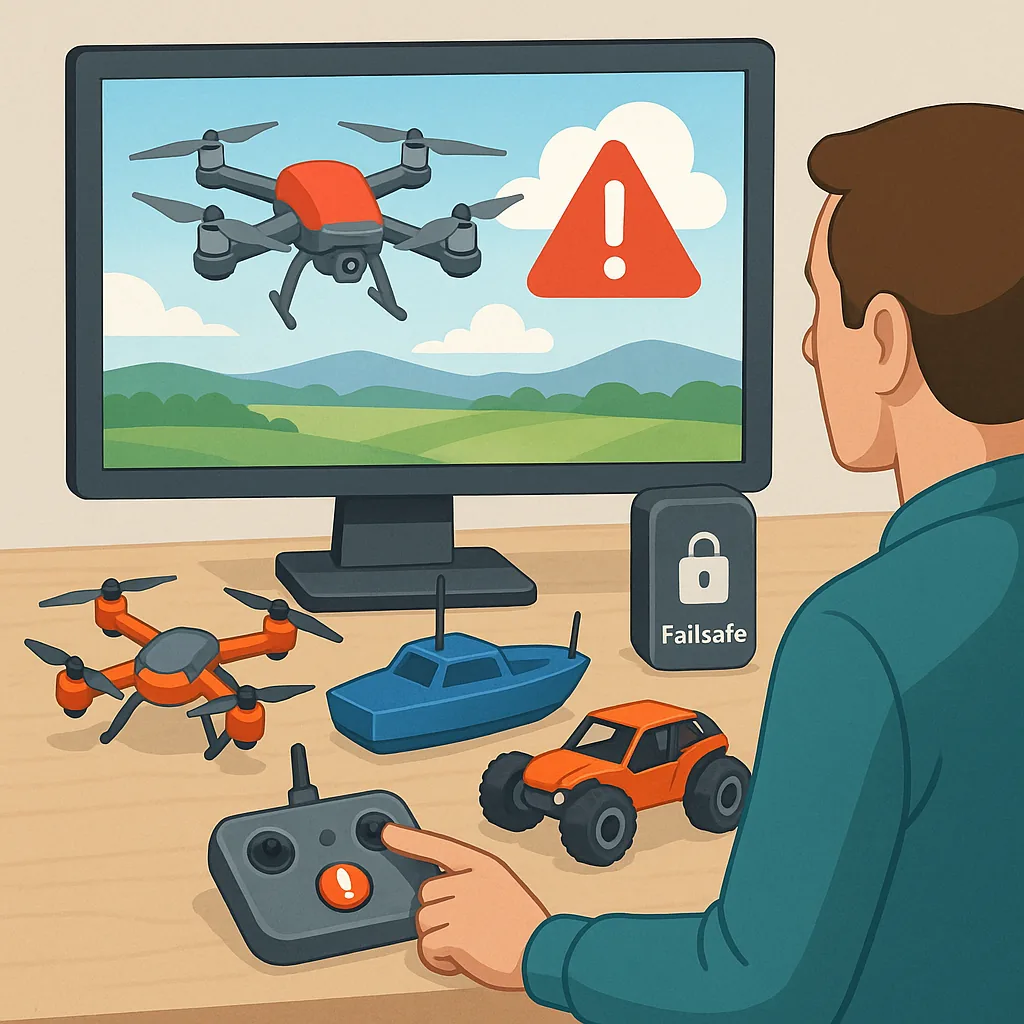
Failsafe systems for hobbyists: a practical buying guide.
When shopping for a failsafe system for drones, RC boats, or other hobby platforms, the goal is simple and urgent: stop a one-off error becoming a costly loss. Many ready-to-fly systems advertise return-to-home and automatic landing functions, but not all implementations are equal in real-world conditions. A good failsafe will be configurable, predictable and testable, so you can set behaviour you trust rather than hoping for a default that might be inappropriate for your flying site. This guide focuses on the three critical areas to prioritise when buying: return-to-home, radio loss behaviour, and redundancy.
Return-to-home, often abbreviated to RTH or RTL, is the most visible failsafe and deserves careful scrutiny when purchasing a system. Look for a unit that allows you to set a clear RTH altitude to avoid trees and buildings, and one that supports both GPS-based homing and a manual fail-safe waypoint if your controller can store a home position. Systems that offer multi-GNSS support (GPS plus GLONASS or GALILEO) will generally provide faster and more reliable fixes, which improves RTH accuracy. Also prefer controllers that record and transmit home coordinates to your transmitter or log so you can verify where the aircraft will attempt to return before you arm the motors.
Radio loss behaviour is the second key consideration and is where transmitter-side settings become as important as the flight controller. Many manufacturers let you configure a number of outcomes on link loss, including hover, auto-land, RTL, or a hard motor cut. For multirotors, an automatic hover or controlled RTL is usually safest if GPS lock is solid, while fixed-wing models typically need a safe glide or predefined heading back to base. When buying, check whether your transmitter supports fail-safe positions for every channel and whether it can transmit RSSI or telemetry data so the airframe can detect deteriorating link quality and act before full loss occurs.
Redundancy reduces the chance of a single point of failure taking your model permanently out of service, and it is often the feature that separates hobby gear from professional kit. Consider options such as dual GNSS modules, dual compasses, or separate power rails for the flight controller and telemetry radio. Some higher-end flight controllers support a slave board that takes over should the main unit fail, while others allow redundant ESCs or duplicated receiver links, such as simultaneous SBUS and CRSF, to provide a fallback. Decide how much redundancy you need based on what you can live with losing and how critical recovery is for your model.
Practical testing and configuration matter as much as the hardware you buy, so prioritise systems that are well documented and supported by active communities. A flight controller that can be configured in a desktop or mobile app and that exposes clear failsafe timers, thresholds and log files will save you time and reduce risk. Wherever possible perform a ground test of loss scenarios with props removed, verify that RTH altitude and home point are set correctly, and confirm that the radio's failsafe positions actually produce the expected flight controller responses. Buying a product with accessible logs or an OSD that reports GPS satellites, home coordinates and RSSI makes post-flight diagnosis far easier.
Budget and scale will determine how much you spend on failsafe features, but there are sensible choices at every price. Entry-level manufacturers often provide basic RTH and a simple transmitter fail-safe that sets throttle to idle, which is acceptable for light models in wide open spaces, while mid-range and premium systems add telemetry, configurable loss behaviour, and hardware redundancy. If you want a starting point for sensible kit suggestions and build notes, visit my collection of project write-ups at WatDaFeck for examples that show how different failsafes behave in testing and what to expect when you buy a controller or receiver.
Follow me on: Facebook: https://www.facebook.com/watdafeck3d · Instagram: https://www.instagram.com/watdafeck3d/.
Comments
Post a Comment