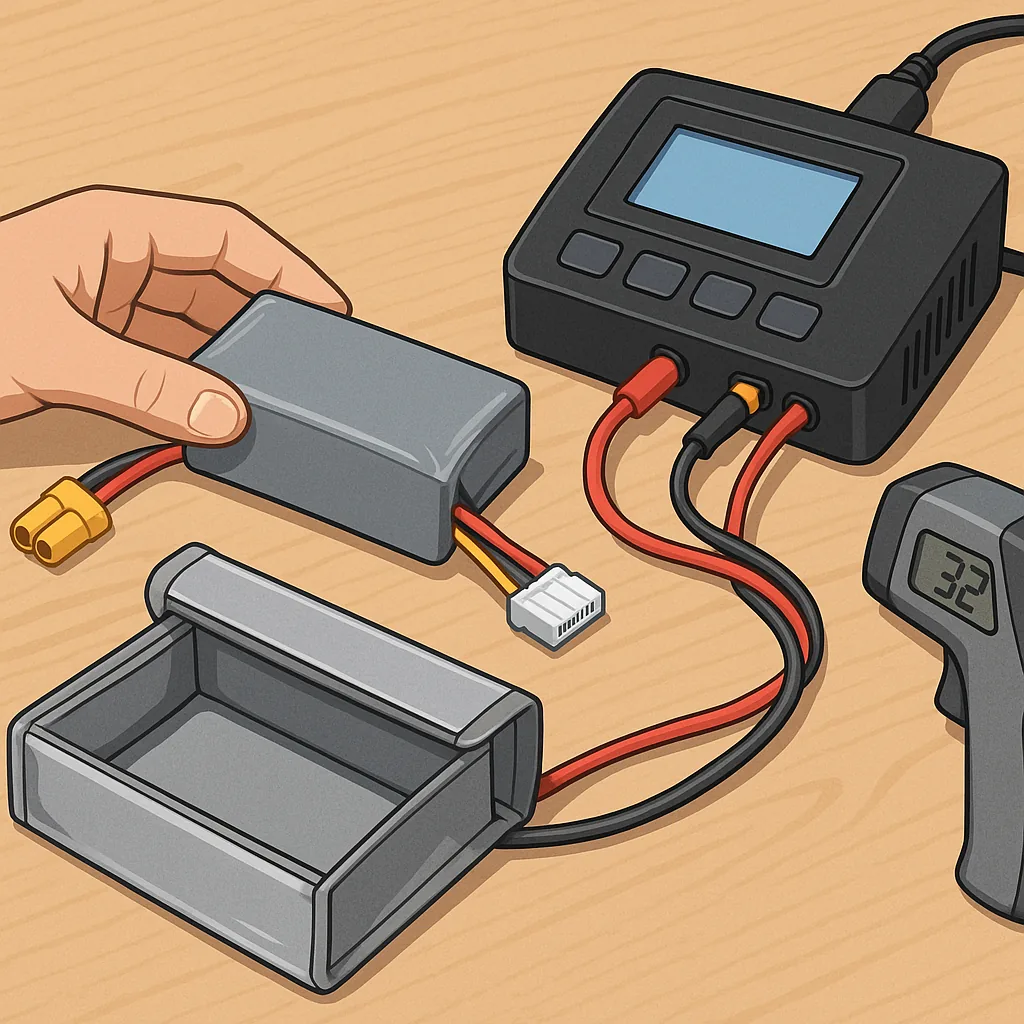
LiPo safety build log: inspecting, charging, IR testing and storage for hobbyists.
I started this LiPo safety build log because hobby packs arrive in many states and a methodical approach keeps models and workshops safe, and because I want to share exact steps I follow when a new battery arrives for an RC or drone project.
Step 1 was unpacking and inspection, where I visually checked for puffing, punctures, torn shrink-wrap and loose solder joints on the discharge leads and balance plug, and where I measured each cell voltage with a calibrated multimeter to verify the pack matches the seller's specification, since a single weak cell is the common first fault in used packs.
Step 2 covered charging basics and C‑rates, and I always set the charger to balance mode with the correct cell count and use the manufacturer C‑rating as a guide, remembering that C refers to capacity so a 2200mAh pack rated 25C can theoretically supply 55A but should typically be charged at 0.5–1.0C for longevity, which for that pack means 1.1–2.2A as a safe charge current for hobbyists.
Step 3 was measuring internal resistance (IR), which I do as a three‑part routine: charge the pack to full, let it rest for ten to fifteen minutes, record the open‑circuit cell voltages, then use my charger’s IR readout or apply a known load and measure the voltage drop to calculate IR with deltaV/deltaI, and I watch for IR values that are much higher than manufacturer data or that have doubled since the pack was new, because a one‑cell IR rising relative to the others often predicts imminent failure.
Step 4 documented how I interpret IR and cell balance, with practical thresholds and actions to take when numbers look wrong, and I note that new high‑quality packs often show single‑digit to tens of milliohms per cell depending on size, while anything over one hundred milliohms or any cell that has an IR reading several times the average should be retired or at least quarantined for low‑stress use.
Step 5 focused on storage, LiPo bags and final safety tips, where I set storage voltage to about 3.80–3.85V per cell for long‑term layup, keep packs in a cool dry place away from combustibles, and always store or charge in an approved LiPo pouch or a fireproof container while remembering that a bag may slow fire spread but is not a guarantee against thermal runaway, and I documented the test jigs and measurement scripts on my site at https://watdafeck.uk to help anyone copy my procedures.
In conclusion I summarise the routine I now follow for each pack: visual inspection, initial voltage check, controlled balance charge, IR measurement and logging, conservative charge/discharge limits based on C‑rating, and storage at the correct voltage in a safe container, and I recommend keeping a pack diary so you notice trends in IR and capacity rather than relying on single readings.
Follow me on: Facebook: https://www.facebook.com/watdafeck3d · Instagram: https://www.instagram.com/watdafeck3d/.
Comments
Post a Comment