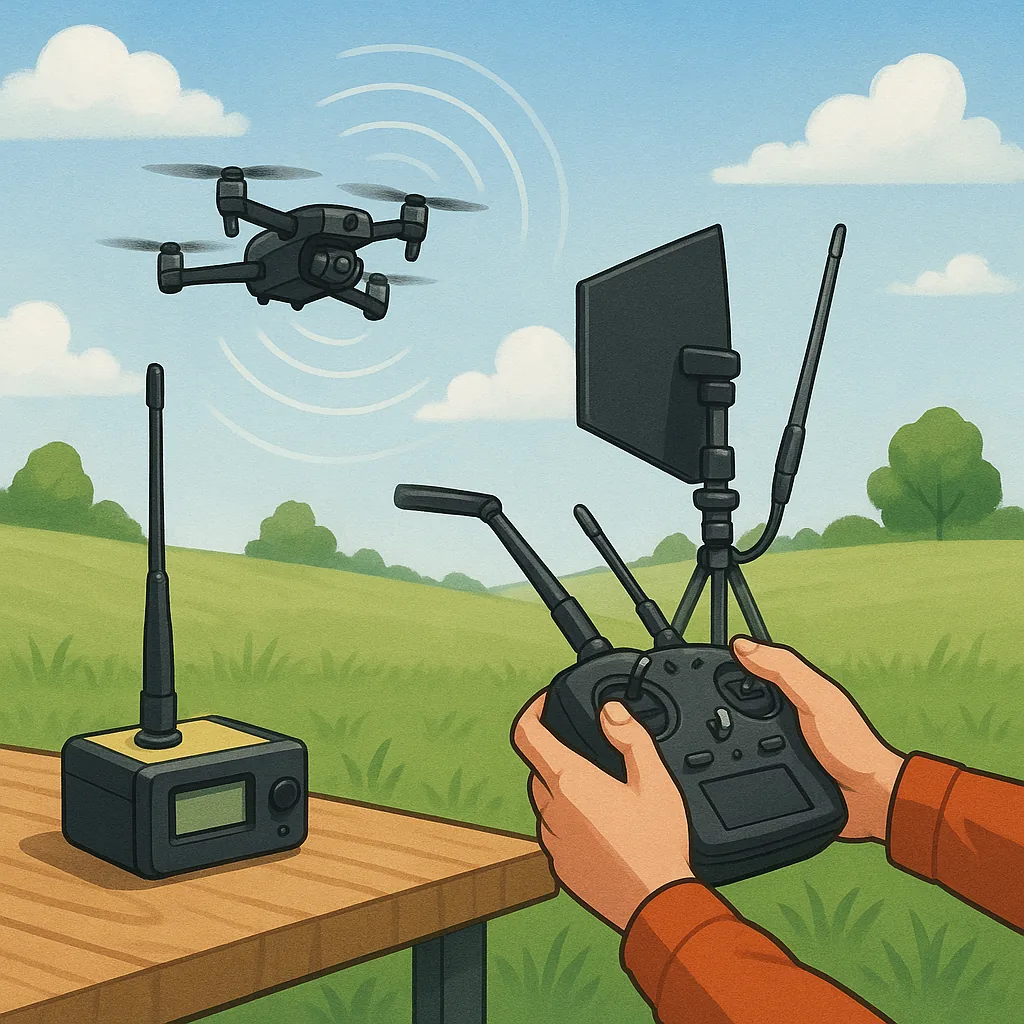
Range testing for hobbyists: a practical buying guide.
Range testing is the practical way to know whether your radio gear, antennas and mounting choices will support the flights or radio-controlled projects you build, and a careful buying decision can save hours of tuning and troubleshooting later. This guide focuses on the items and adjustments that make the biggest difference for real-world range rather than headline transmitter powers, and it assumes you are working within legal regional limits and sensible safety margins. Whether you fly models, run long-range boats or experiment with telemetry, controlled range tests and the right kit will produce repeatable, useful results.
Antenna placement is the single most important factor you can influence after choosing a good receiver and transmitter, and the simple rule is to maximise clear line-of-sight while keeping antennas orthogonal where diversity receivers are used. On aircraft, keep receiver antennas as far from the video transmitter, ESCs and GPS as the frame permits and avoid running antenna coax parallel with motor wires for long distances. On ground or marine models, mount antennas high and free of metal and carbon fibre obstructions, and favour vertical polarisation on both ends unless you are deliberately matching a directional down-tilt array for long-range work.
When buying antennas, compare gain figures against the practical beamwidth you need, and prefer high-quality RP-SMA or SMA connectors rather than cheap knackered adaptors that introduce loss and corrosion risks. Omnidirectional dipoles and cloverleaf antennas are excellent for typical hobby flights because they provide predictable coverage and graceful signal fall-off, while panel or Yagi antennas are useful for fixed base stations where you will point them and need directional gain. Also consider antenna durability and cable strain relief as routine handling is often the cause of failure rather than RF performance.
ExpressLRS tuning is central to modern range testing because it allows you to trade packet rate, modulation parameters and RF output power to suit your scenario, and buying a compatible TX module or radio with native ELRS support will simplify tests. Start tests with conservative RF power and packet rates, then increase power and lower CRSF latency only while monitoring link quality and battery draw on the transmitter and receiver. Be mindful of regional power limits and the effect of higher packet rates on effective range in noisy environments, and choose modules that show clear firmware update support so you can tune modulation settings as ELRS continues to evolve.
Noise reduction and filtering often make a larger practical difference than raw RF power, so invest in basic suppression measures at purchase time rather than chasing problems later. Look for receivers and VTX units with built-in LC filters or common-mode choke options and buy ferrite clips for supply leads as these are inexpensive and effective at high frequencies. Also prioritise quality power distribution; decoupling capacitors near ESCs and a solid ground plane will reduce radiated interference that can desense your receiver, and soft-mounting sensitive modules reduces vibration-related noise and connector stress which can mimic RF issues.
When assembling a range-test kit, buy components that make measurements repeatable and safe and avoid one-off solutions that are hard to replicate; a spare matched antenna for your receiver, a known-reference transmitter module and a small RF power meter or a portable field-strength meter will speed up diagnosis. For buying recommendations and local review summaries see WatDaFeck for real-world comparisons and supplier notes. Finally, practice controlled tests at a variety of heights and distances, log your results and remember that good hardware combined with sensible filtering, careful antenna placement and thoughtful ELRS tuning will nearly always out-perform a mismatch of cheap parts and high transmitter power.
Follow me on: Facebook: https://www.facebook.com/watdafeck3d · Instagram: https://www.instagram.com/watdafeck3d/.
Comments
Post a Comment