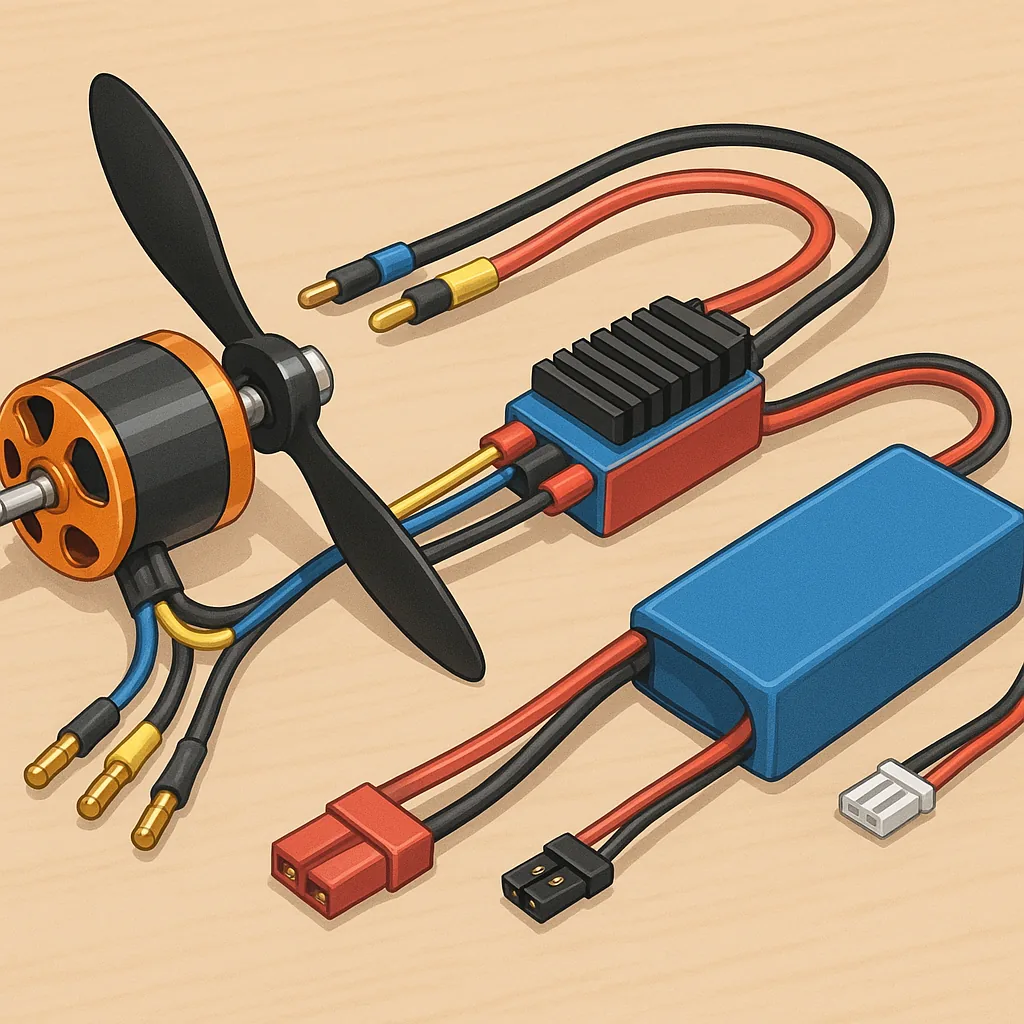
RC Power Systems: Practical Tips on ESCs, Props, Current and Thrust.
Getting the power system right is one of the most rewarding parts of building and flying RC models, and a few simple checks can save time and parts. This guide covers practical tips on ESC types, propeller choice, how current draw behaves and reliable ways to measure thrust so your setup is efficient and safe.
Start with ESC selection because the electronic speed controller dictates how well a motor behaves under load and how cleanly it communicates with your radio system. Choose between brushed and brushless controllers for the corresponding motor type, and for brushless motors favour three-phase ESCs with modern firmwares such as BLHeli or SimonK when supported, or DShot-capable units for digital signalling and telemetry. Pay attention to continuous current ratings rather than just peak or burst numbers, check the supported battery voltage (cell count) and whether the ESC provides a BEC or telemetry output, and match the ESC’s cooling and size to the expected duty cycle so the controller does not overheat during aggressive flying.
Propeller selection is as critical as the motor itself, with diameter and pitch directly affecting thrust and current draw. Read prop markings as diameter by pitch, for example 10x4.5 means a ten-inch diameter with a 4.5-inch pitch, and remember higher pitch gives more speed at the cost of greater current. Choose the number of blades to suit the airframe and motor; three-blade props can improve static thrust in many multirotor and 3D aerobatic setups but usually cost efficiency for hover and cruise. Always balance props before flight and recheck for nicks or warps after a hard landing because even small imbalances amplify vibration and increase ESC and motor heating.
Understanding current draw keeps batteries healthy and gives realistic flight time estimates, so measure rather than guess. Use a quality inline wattmeter or the ESC’s telemetry to record current at full throttle and typical cruise, and apply Ohm’s law and power calculations to check the system is within safe limits. Allow headroom by selecting batteries and ESCs rated at least 20 to 30 percent above your measured continuous current to avoid voltage sag and overheating, and be realistic about C-ratings on lithium packs because manufacturer claims are often optimistic. Consider adding a thermal cut or a simple fuse if your model’s wiring runs long or your ESC is tucked into a poorly ventilated bay.
Measuring thrust is straightforward and far more valuable than trusting generic specs, and a simple thrust stand plus a kitchen scale can give repeatable results. Mount the motor and prop with the same battery and ESC you plan to use in the airframe, then measure static thrust at varying throttle points to build a chart of thrust versus current so you can see efficiency peaks and ceiling limits. Use thrust-to-weight ratio as a quick guide for handling goals: around 1:1 for relaxed park flyers, 2:1 for general aerobatic performance, and above 6:1 for aggressive 3D flight, and always pair those figures with measured current to ensure battery life and ESC temperature remain acceptable.
Put these elements together with a simple checklist for testing and tuning to save time when building or upgrading power systems. Check motor timing and ESC settings, start with conservative props and record full-throttle current, increase prop size or pitch in small steps while noting thrust and temperature, and inspect batteries and connectors for heat after each run. If you want setup examples, wiring diagrams and downloadable log files to compare with your own results, visit my site at WatDaFeck for photos and notes from several builds.
Follow me on: Facebook: https://www.facebook.com/watdafeck3d · Instagram: https://www.instagram.com/watdafeck3d/.
Comments
Post a Comment