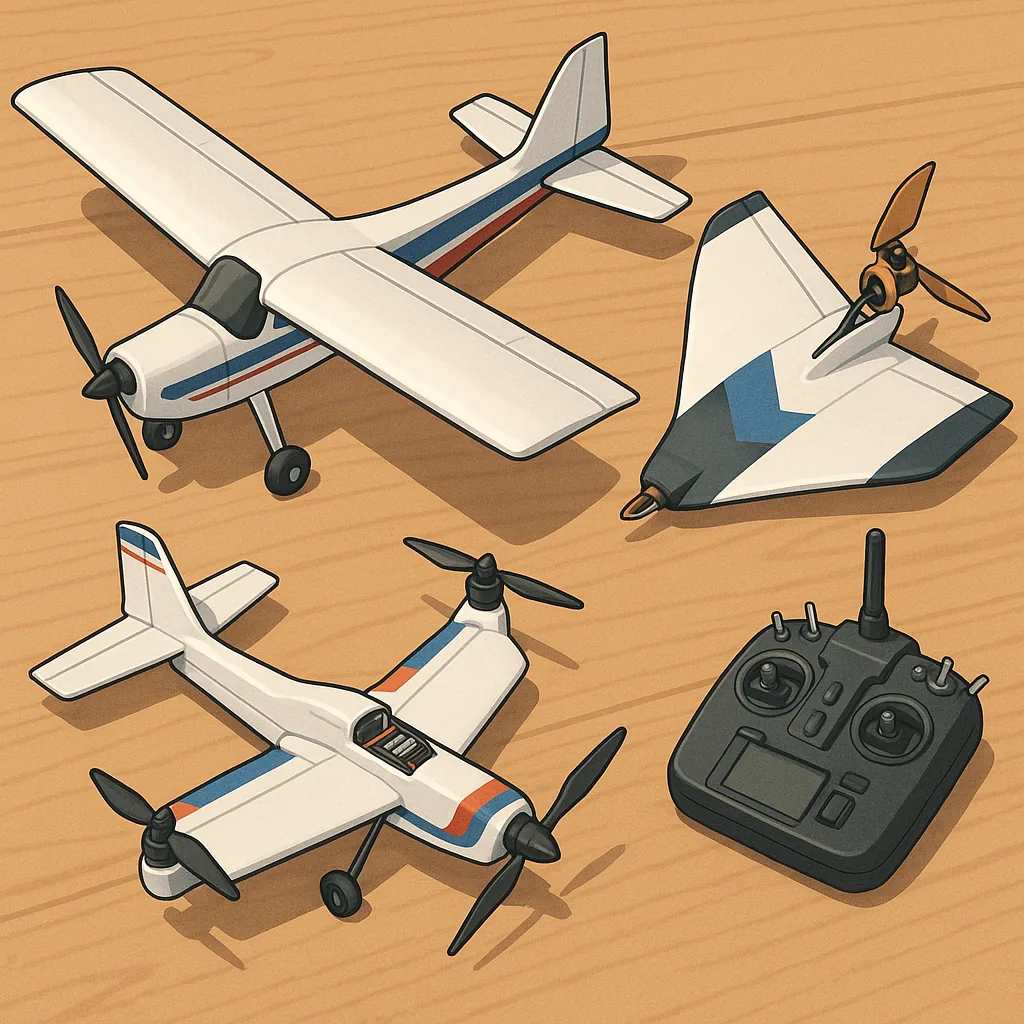
Step-by-step build log: foam trainers to FPV wings with VTOL and ELRS integration.
I started this project with a simple brief: make three airframes that teach different skills, starting with a forgiving foam trainer, moving to a simple FPV wing, and finally experimenting with a small VTOL conversion to learn about tilt mechanisms and flight controllers. The parts list was deliberately modest to keep costs down and to make the builds approachable, and it included foamboard and Depron sheets for airframes, an Omnibus-style flight controller for the wing work, a VTOL-capable controller for the conversions, ExpressLRS radio gear, and a selection of 3S and 4S lithium polymer batteries for testing. My aim was to document the entire workflow from cutting foam to first flights to make repeatable notes for other hobbyists.
The first build was the foam trainer and it is where I recommend everyone begin, as a trainer teaches trimming, throttle control, and safe landings. I traced a classic high-wing trainer profile on 3mm foamboard for the fuselage and 6mm Depron for the flying surfaces, then used a hot knife for clean cuts and hot glue for assembly to keep joints lightweight and flexible. I installed simple plastic bushings for the control horns and used standard 9g servos for elevator and rudder with a cheap brushed motor and a two-channel ESC for initial taxi tests. With an emphasis on durability I wrapped leading edges with packing tape and added removable gear using dowels so repairs are quick after an inevitable hard landing.
The second build was a small FPV wing intended for cross-country flights and cinematic footage, and I adapted the foam trainer techniques to a low-drag wing profile. I used a pusher motor configuration to keep the prop out of the camera shot and installed a micro HD camera with a lightweight flight camera mount that doubled as a nose ballast for CG trimming. For the radio link I chose ExpressLRS because of its low latency and long range, wiring the ELRS receiver to the flight controller using CRSF for clean telemetry and fail-safe handling. Control layouts were tested on the bench using a bench power supply and props removed to confirm surfaces moved in the correct direction and that failsafe cut the throttle reliably.
VTOL was the experimental phase and required more planning around power and control mixing, so I built a small tilt-rotor conversion using the same wing as the FPV model to reuse components. The tilt servos were mounted on 3D-printed hinges and linked to dual ESCs that drive the forward and vertical propellers, while the flight controller ran a VTOL-capable firmware that could mix servo and motor outputs for transition. I paid special attention to motor timing and ESC calibration to ensure smooth transitions, and I added redundant power feeds so that a single cell failure would not immediately disable lift motors during hover trials.
Electrical and radio systems were critical, so I documented the ExpressLRS binding process, receiver telemetry setup, and how the flight controller reads SBUS or CRSF signals and translates them to mixer outputs. For flight controllers I tested both INAV and ArduPilot configurations because each has strengths for fixed-wing and VTOL respectively, and I kept the wiring neat using labelled JST harnesses and heat-shrinked solder joints to prevent intermittent faults. I also made a point to set up proper failsafes, governor modes for pusher motors, and logging to an SD card so I could analyse any odd behaviour after flights.
Battery choice and management were the final focus before flying, and I experimented with 3S and 4S lithium polymer packs at different capacities to balance flight time against weight and power. I used batteries with high C ratings for the VTOL hover stages and medium C packs for the cruising FPV wing to maximise range without overloaded motors, always checking balance leads and using a quality charger with storage mode for batteries between flights. For readers following along I publish complete build notes, wiring diagrams and the control mixes on WatDaFeck for anyone who wants to reproduce these builds or adapt the concepts to their own models.
Follow me on: Facebook: https://www.facebook.com/watdafeck3d · Instagram: https://www.instagram.com/watdafeck3d/.
Comments
Post a Comment