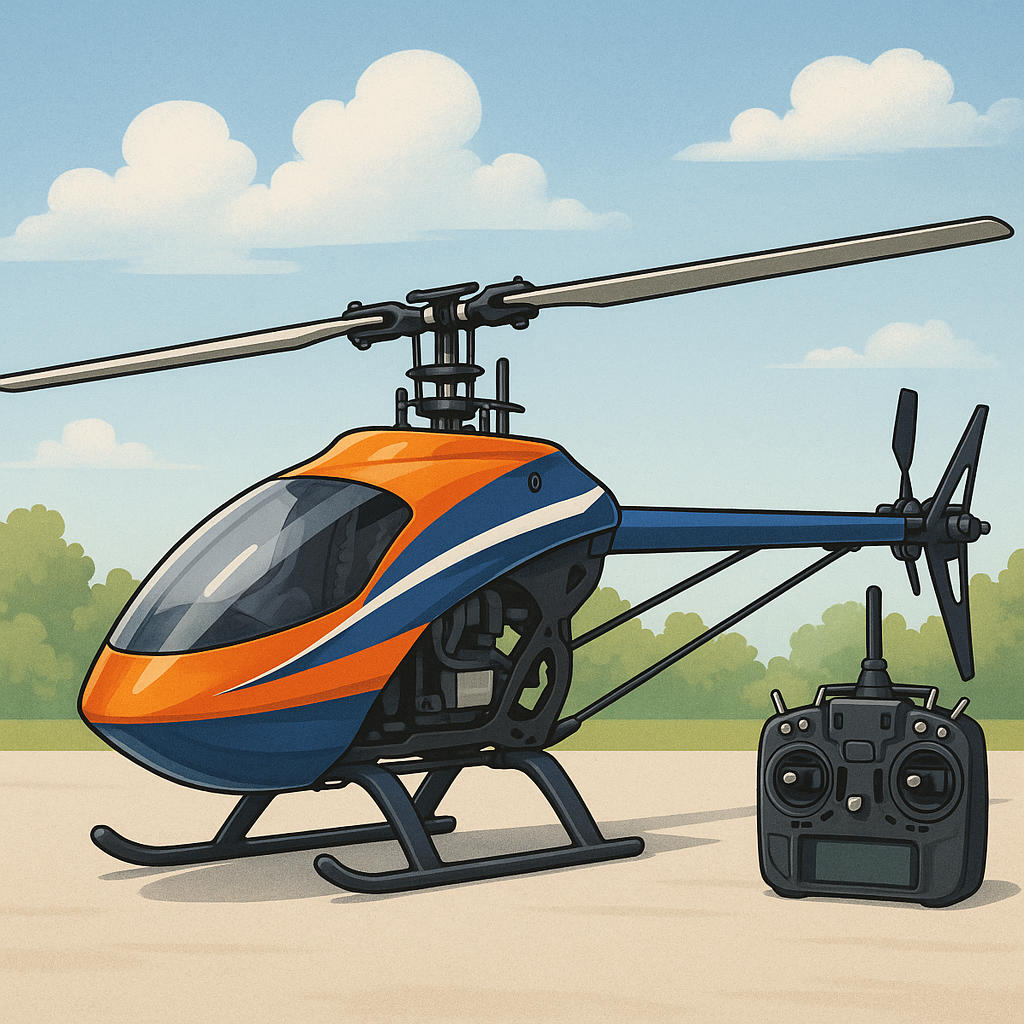
Beginner's Guide to RC Helicopters: Collective Pitch, Flybarless Controllers and Tail Tuning
RC helicopters reward patience and practise but present a steeper learning curve than multirotors, so a clear beginner plan is essential before you sit at the transmitter for the first time. Collective pitch models give you far greater control over lift and performance than fixed‑pitch machines, which makes them more versatile but also more demanding to fly. This guide walks you through the core concepts you need to understand to get started safely, with practical suggestions for beginner setups and a focus on collective pitch, flybarless systems and tail tuning.
Collective pitch is the system that changes the pitch angle of both main rotor blades together to control climb and descent, while cyclic inputs tilt the rotor disc for directional movement. On a collective pitch helicopter the swashplate translates servo motions into both collective and cyclic blade pitch, so when you increase collective you gain lift without changing rotor speed. That behaviour is what allows aerobatics and precise altitude control, but it also means that mistakes on the sticks are more likely to produce quick and energetic responses, so beginners should treat collective machines with respect and use a trainer program or a calm open space when learning.
Flybarless controllers have become the norm on modern RC helicopters because they replace the mechanical flybar with electronic stabilisation, using gyros and accelerometers to keep the rotor head steady and the aircraft predictable. These controllers reduce mechanical complexity, improve efficiency and offer features such as flight modes, governor support and telemetry, which are very helpful for newcomers who want consistent head speed and less mechanical tuning. If you prefer written setup notes or occasional build walkthroughs I post parts lists and beginner guides on WatDaFeck that are aimed at hobbyists getting into collective pitch flying.
Tail tuning is often the make or break for a comfortable flying experience because the tail rotor must counteract main rotor torque precisely at all head speeds and under varying collective conditions. Begin tail setup by ensuring there is no slop in the tail boom, tail drive and linkages and that the tail rotor blades are balanced and tracking correctly. Set gyro gain low at first and increase it until you see a stable correction, then back off slightly to eliminate oscillation, and remember that the effective gyro gain changes with head speed so a flybarless controller with governor or head speed stabilisation helps maintain consistent tail authority.
For a beginner collective pitch setup I recommend starting with a reliable, documented trainer model in the 450–500 size range or a larger, well supported 600 class if you want carry more inertia and more forgiving autorotation behaviour. Choose servos with adequate speed and torque, a quality flybarless controller with a simple GUI and a governor option, and always match motor, ESC and battery to the manufacturer's suggested specifications to avoid overheating or poor throttle response. Spend time on a simulator with a model that matches your planned aircraft, perform thorough preflight checks, and consider fitting training skids until you are consistently taking off and landing without help.
Learn to tune gradually and log every change so you can reverse settings if something feels wrong, and fly with safety gear such as gloves and eye protection while keeping a safe distance from bystanders and property. Practice hovering, gentle turns and autorotations at low altitude to build confidence, and allow yourself many hours of slow, measured practise before attempting aerobatic manoeuvres. With controlled progression, a good flybarless controller and sensible tail tuning, a collective pitch helicopter will become an immensely rewarding machine to fly for any hobbyist.
Follow me on: Facebook: https://www.facebook.com/watdafeck3d · Instagram: https://www.instagram.com/watdafeck3d/.
Comments
Post a Comment