Build Log: Preparing a Hobby Aircraft for Wind, Rain and Cold Weather Flying.
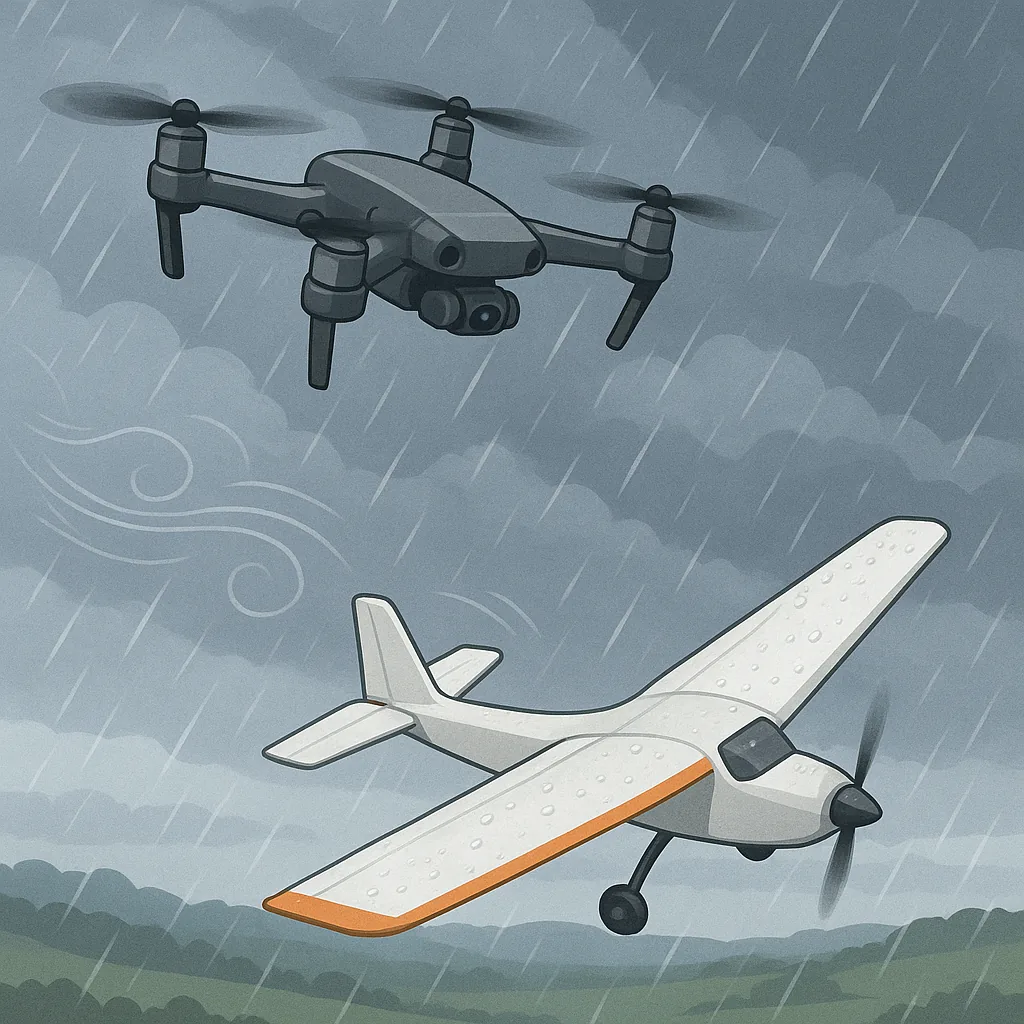
This build log documents my attempt to make a mid-size quadcopter and a small foam wing capable of reliable flying in blustery and damp British weather, with particular attention to wind resistance, waterproofing and cold-weather battery care. I began by defining realistic goals: maintain stable control in gusts up to about 10–12 m/s, survive light rain without corrosion or signal dropout, and keep batteries performing in near-freezing conditions. The parts list was deliberately conservative, favouring proven components such as a carbon-fibre frame, well-ventilated brushless ESCs, metal-geared servos for the wing and a flight controller with GPS and barometer. This initial planning stage set the scope for the subsequent mechanical and electrical modifications and the flight test schedule.
The first set of hands-on changes targeted wind resistance and control stability on both aircraft types. For the wing I increased wing loading slightly by adding a modest ballast in the nose to improve penetration through gusts while keeping the centre of gravity forward for predictable pitch behaviour. For the quadcopter I fitted slightly larger-diameter, lower-pitch props to improve thrust efficiency and added heavier nylon motor mounts to reduce frame flex. Aerodynamic drag was reduced by trimming unnecessary fairings and fitting a small nose cone to the foam wing, and by routing cables neatly with tape and heat-shrink on the multirotor. I also tuned control gains conservatively: lowered the I term to avoid oscillation accumulation in gusts and raised D slightly to damp sudden disturbances, followed by progressive field testing at increasing wind speeds to validate each adjustment.
Waterproofing began with the electronics and connective interfaces, because corrosion is the slow killer of hobby kit exposed to damp conditions. I degreased and masked connectors, then applied a thin conformal coat to exposed PCBs and ESCs, making sure to allow adequate curing time at room temperature. Connectors received dielectric grease and were sleeved with self-fusing silicone tape, while servo linkages were fitted with small silicone boots to keep spray out of the gearbox. For the fuselage compartments I fabricated simple rubber gaskets from closed-cell foam to make battery and flight controller bays splash-resistant while still allowing ventilation for heat dissipation. All fasteners were treated with a light film of anti-seize to stop rust forming after repeated wet-field days.
Cold-weather battery care was handled as a discrete process because lithium polymer chemistry changes rapidly with temperature and improper handling risks capacity loss or damage. I never charged batteries below 5°C and always used an insulated box with a small chemical hand warmer to bring packs up to a safe charging temperature when field charging was necessary. For storage between flights I maintained about 3.8 volts per cell, monitored resting voltage after a day of cold down to ensure no hidden cell imbalance and avoided deep discharge by limiting flights to 70 per cent of expected capacity in low temperatures. Where possible I chose batteries with a higher C rating and lower internal resistance for winter flying, and I allowed cells to warm to ambient after a flight before attempting to charge them again to protect their longevity.
Field testing and iteration closed the loop on the build log, and I logged each sortie for conditions, control behaviour, battery voltage sag and any ingress issues that appeared after wet flights. Test flights progressed from calm late-afternoon sorties to deliberately challenging dawn runs with steady wind and a light drizzle, checking that GPS hold and angle limits behaved as expected and that the flight controller did not overheat under load. Where problems appeared I reverted to the bench: replacing suspect connectors, adding extra sealant or slightly re-tuning the flight controller gains and throttle curves. I posted the full parts list, build photos and the flight-data summaries at WatDaFeck for anyone who wants to follow the same process and adapt the approach to their own airframe.
Follow me on: Facebook: https://www.facebook.com/watdafeck3d · Instagram: https://www.instagram.com/watdafeck3d/.
Comments
Post a Comment