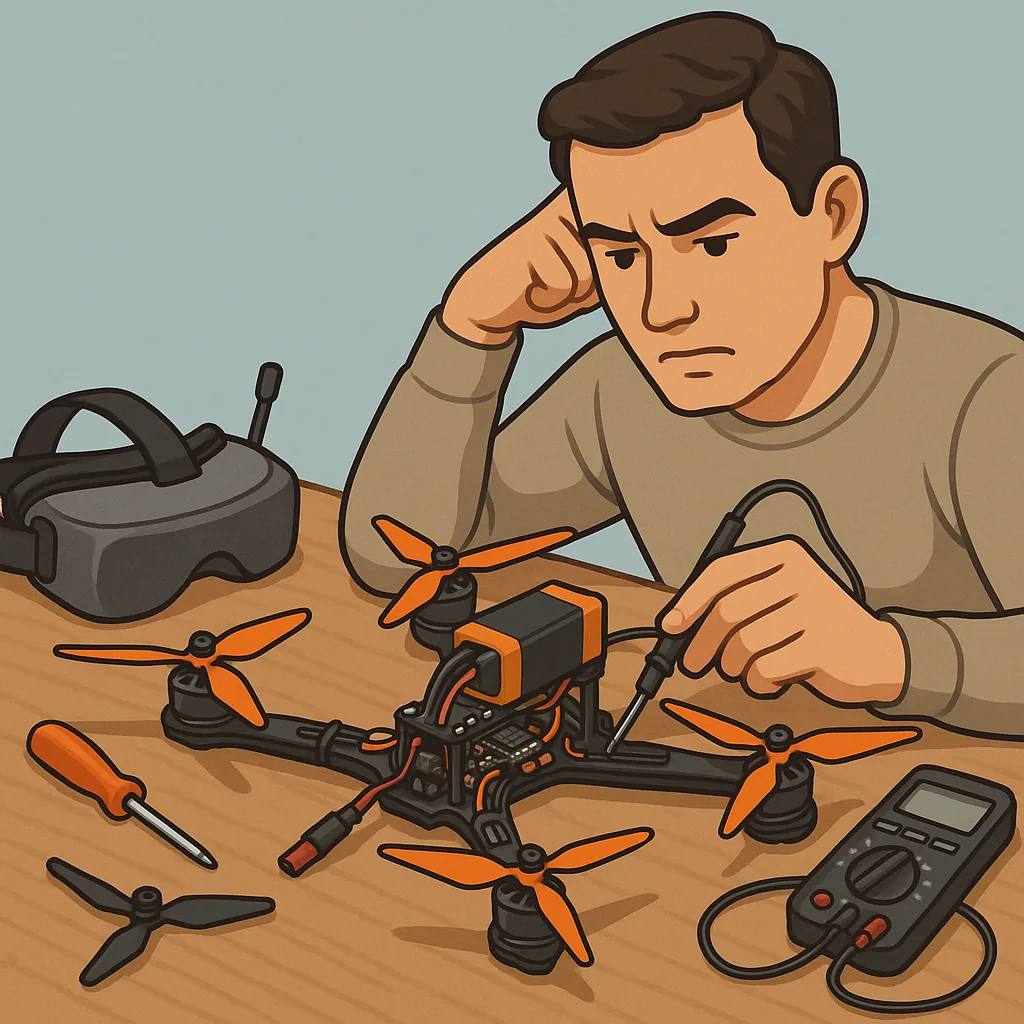
FPV Drone Troubleshooting Guide for Hobbyists
When your FPV rig behaves oddly the first rule is to slow down and work methodically rather than making multiple changes at once, because compounding adjustments will make the root cause harder to find and resolve. Common symptoms include random flips, persistent vibrations, loss of power, early battery sag and erratic yawing, and a stepwise approach will save time and parts. Keep a log of the fault, the conditions it occurs in and any immediate fixes you try so you can reverse changes that do not help. For supplementary build guides and parts lists you can visit WatDaFeck for examples and reference material that may match your frame or stack.
Start with the frame since it is the skeleton holding everything together and many flight problems trace back to structural faults. Inspect arms and motor mounts for hairline cracks, looseness or signs of previous repairs, and check that all fasteners are tight to the correct torque to avoid crushing carbon fibre or stripping threads. Pay attention to excessive flex in the centre plate which can transmit oscillations into the flight controller, and verify that the stack is mounted with appropriate vibration isolation or soft washers if your FC recommends them. Replace damaged arms rather than patching them if they compromise motor alignment, because misaligned motors will introduce persistent thrust imbalances that no tuning can entirely cure.
Propellers are the most often overlooked cause of poor flight performance and they deserve simple regular checks before every session. Inspect each prop for chips, pits and slight warps by spinning them slowly by hand and holding them level to a light source, and replace any prop that has even a small nick on a leading edge because that will create turbulence and possibly high frequency oscillations. Confirm that the props are the correct size and pitch for your motors and ESCs, that clockwise and anti-clockwise blades are mounted to the correct motors, and that props sit flat on the hub with the nut or grub screw secure using the manufacturer’s torque guidance. Keep a small set of balanced replacement props in your kit so you can swap them quickly in the field rather than flying with known damage.
Tuning is where many pilots feel uncomfortable but most flight issues are resolved by careful PID and filter adjustments rather than wholesale replacements. Start from a known good baseline such as Betaflight defaults for your frame and motor combination, hover at a safe altitude and listen for tonal oscillations that indicate too much P or insufficient D filtering, and use small incremental changes while repeating the same test manoeuvres after each change. High frequency squeal or rapid buzzing points to P-term over-aggression or motor imbalance, while low-frequency wobble often suggests under-damped D or too little I for sustained corrections. Use Blackbox logging where possible to compare spectra before and after adjustments and to tune filters instead of simply increasing D values which can amplify noise.
LiPo safety cannot be stressed enough because battery faults can cause performance degradation and dangerous failures, and safe battery practice will also improve your predictive troubleshooting. Always charge on a quality balance charger at the correct cell count and display typical charging and storage voltages for each cell, check for puffing and elevated cell temperatures after charge and discharge cycles, and retire any pack that shows permanent swelling. Be vigilant about connectors, making sure XT60 or other plugs are tight and free of heat damage, keep a fireproof charging container handy and store batteries at around 3.8 volts per cell for long-term storage. If you experience sudden power loss check voltage under load for severe sag which indicates an ageing pack or insufficient C rating rather than an ESC or motor issue.
Flight modes and receiver configuration often explain apparently random behaviour so verify switch assignments, failsafe settings and control mapping as part of your troubleshooting checklist. Test arming and disarming procedures on the ground and ensure the failsafe cuts throttle cleanly while remaining yaw and roll neutral, check that angle or horizon modes are not inadvertently enabled when you expect full acro control, and confirm that transmitter endpoints and trims are centred with the radio and the flight controller reading identical values. If GPS or compass modes are involved verify calibration and look for sources of interference such as mounted video transmitters or power wires, and when a problem only appears in one mode toggle through each mode in a safe hover to isolate the fault to either software configuration or hardware interaction.
Follow me on: Facebook: https://www.facebook.com/watdafeck3d · Instagram: https://www.instagram.com/watdafeck3d/.
Comments
Post a Comment