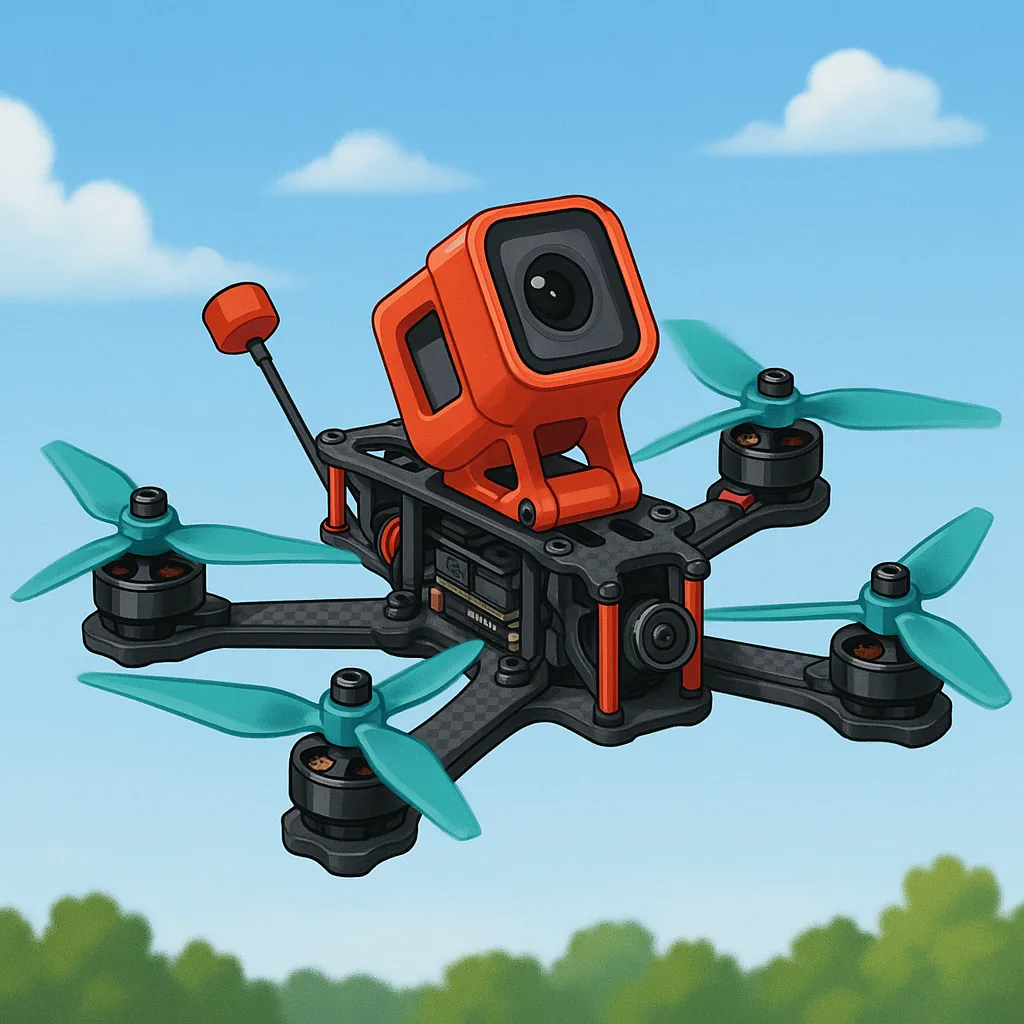
Freestyle Drone Safety: Rates, Propwash, Frame Stiffness and GoPro Mounting
Freestyle flying is thrilling but it raises specific safety considerations that every hobbyist should treat seriously before taking off, and this article concentrates on the practical areas that most often cause incidents.
Rates tuning dictates how your quad responds to stick inputs and has a direct safety implication because over‑aggressive rates can make a craft hard to recover from in a close environment, especially for newcomers. Start with conservative rates and small increments when you increase roll, pitch or yaw responsiveness, and always test changes at a safe altitude and in open airspace so you have time to assess behaviour and abort a manoeuvre if necessary.
Propwash control is a frequent cause of crashes during low and aggressive flying because turbulent airflow interferes with rotor thrust and control authority, and poor control can put you into trees or structures. Improving propwash behaviour is a mix of tuning and technique: lower P gains can reduce oscillations, introducing feedforward and tuning D gently can help dampen turbulence, and practising throttle management and body positioning will help you anticipate the effect at low speeds.
Frame stiffness has an underappreciated safety role because a flexible or cracked frame can transmit unpredictable vibration to the flight controller and cause control jitter or oscillations during aggressive inputs. Choose a frame with good torsional stiffness and robust arm joints, check screws and motor mounts regularly, and balance props and motors to reduce vibration at source so your control loops have clean input data.
GoPro mounting affects both safety and flight performance since a heavy or poorly positioned camera shifts the centre of gravity and can alter propwash characteristics, especially in forward‑facing angled mounts. Secure the mount with appropriate hardware, use threadlocker on metal fasteners, consider a soft‑mount or damping plate to reduce vibration but not so soft that the camera can contact a prop, and test any new setup gently to ensure it does not introduce flutter or oscillation into the airframe.
A short preflight checklist reduces almost every common risk and should include visual frame inspection, prop security, battery condition, failsafe checks, compass and GPS health if used, and ensuring radio failsafe behaviours are defined before leaving the ground. For build notes, mounting templates and local advice I also maintain a page of resources at WatDaFeck which covers practical fixes and printable templates that many hobbyists find useful.
Finally, stay within local rules, fly with a spotter when practising new manoeuvres, log changes you make so you can reverse them if something feels wrong, and progress your rates and camera setups gradually so you keep control while you expand your repertoire of tricks and lines.
Follow me on: Facebook: https://www.facebook.com/watdafeck3d · Instagram: https://www.instagram.com/watdafeck3d/.
Comments
Post a Comment