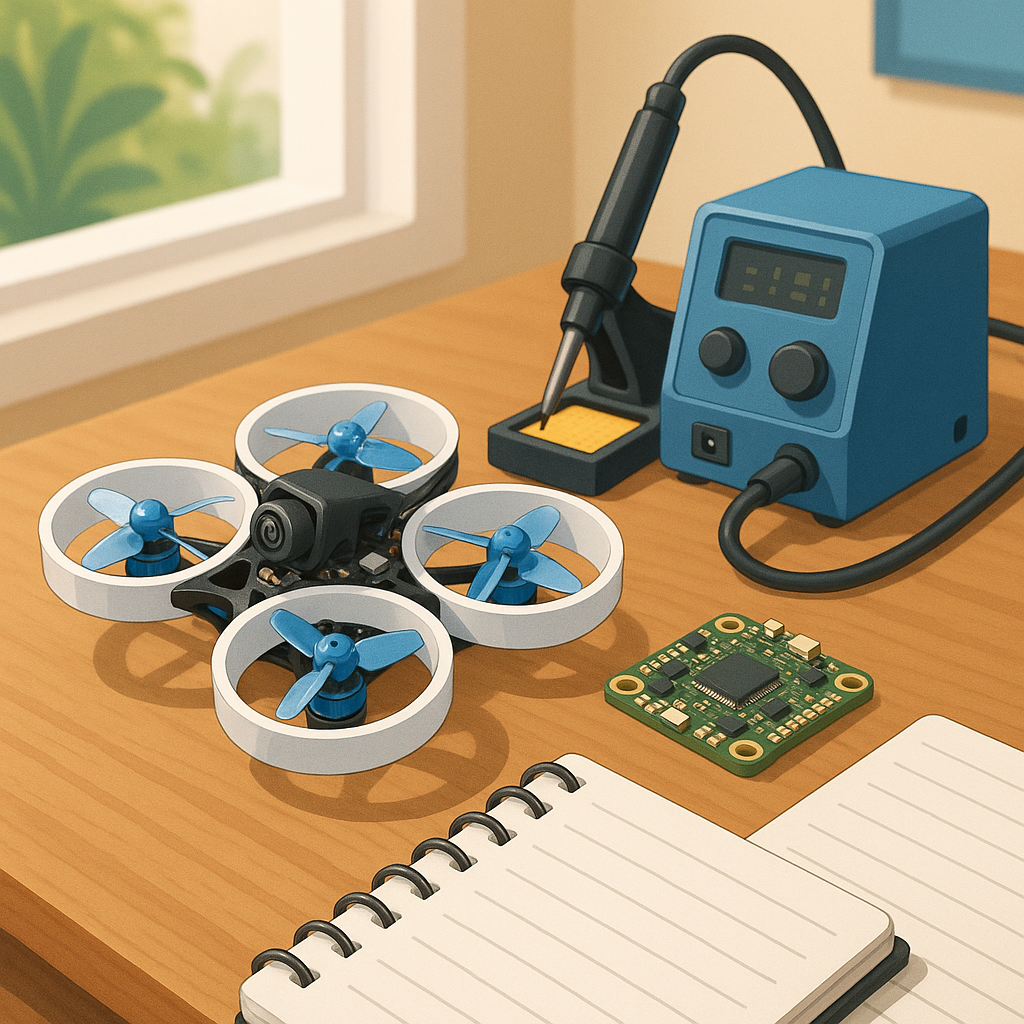
Micro Whoops for hobbyists: indoor projects, brushless upgrades and Betaflight tips.
Micro whoops have become the go-to platform for indoor FPV fun and short-range experimentation, and this article rounds up practical project ideas for makers who want to push the little quads further than stock builds allow.
Here are compact project ideas you can try at home to explore indoor flying in different ways.
- Brushless conversion of a Tiny Whoop frame to improve thrust-to-weight ratio and durability for more aggressive indoor manoeuvres.
- Design and 3D print optimised ducts to improve efficiency, reduce noise and protect props in tight environments.
- Create a low-power FPV racing course with soft obstacles and doors to practise precise throttle and yaw control.
- Experiment with different propeller geometries and materials to find a balance between thrust and quiet operation.
- Build a Betaflight tune library that includes settings for hover stability, low rates for smooth cinematics and higher rates for punchy freestyle on the same airframe.
- Set up an indoor positioning trial using hall sensors, optical flow or barometer-assisted altitude hold for safer autonomous flights.
Switching to brushless micro whoops is one of the most rewarding upgrades for hobbyists because modern 1105 to 1106 motors on 2S or 3S packs deliver vastly improved responsiveness and climb rate compared with brushed alternatives, and they are more efficient for repeated indoor sessions.
Duct efficiency makes a surprising difference on micro quads and is a brilliant maker project because ducts are easy to iterate with a 3D printer, and small geometry changes can alter thrust, noise signature and motor loading in measurable ways.
Betaflight tuning is where the hardware work pays off, and it's sensible to keep separate profiles for relaxed indoor flight and more aggressive modes by using the available flight profiles and ARM toggles, and to employ RPM filtering if your flight controller and ESCs support telemetry as a way to lower filtering latency and keep PID gains usefully crisp, and for step-by-step Betaflight setup examples and downloadable config dumps see WatDaFeck.
When you plan your projects, remember to measure and log changes rather than guessing, and use small test rigs to validate duct shapes, prop choices and filter settings in Betaflight, because quantitative comparisons will save time and help you converge on a setup that balances smooth indoor handling with the punch you want from a brushless micro whoop.
Follow me on: Facebook: https://www.facebook.com/watdafeck3d · Instagram: https://www.instagram.com/watdafeck3d/.
Comments
Post a Comment