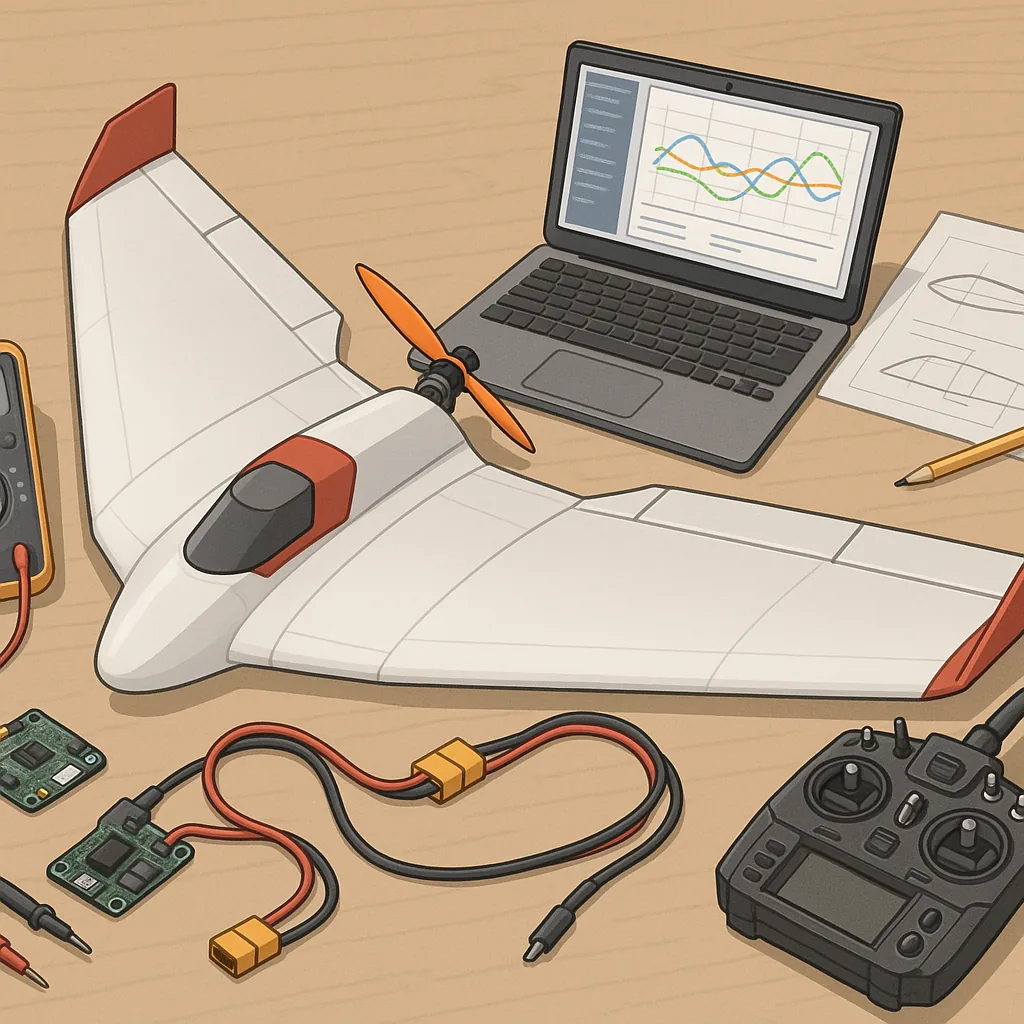
Troubleshooting FPV Wings: a practical guide for long‑range hobbyists.
This troubleshooting guide focuses on the problems you are most likely to meet when building and flying FPV wings for long‑range use, and how to fix them methodically. I assume you have a basic wing frame and radio gear, and will walk through electrical, aerodynamic and autopilot issues in a way that helps you narrow down faults rather than guessing blindly.
Long‑range builds bring a particular set of challenges, starting with power and radio systems, and ending with endurance and reliability. If your range is poor, check antenna polarisation first and then verify connectors and coax for any damage, because a single crack will cost you kilometres of useful signal. If climb performance is lacking, log the motor current and prop rpm to confirm the motor is not thermally limited or the propeller is stalling; often a three‑blade that gave good climb on a freer flying model will be inefficient at cruise for a long‑range wing. Balance endurance against payload by using a high‑energy density battery but watch the centre of gravity and structural loads, because increased battery mass can change stall behaviour and cause flutter if the wing is not stiffened properly.
Tuning control surfaces and the airframe is where many flights are saved or lost, and you can often diagnose problems by watching the control surface motion on the ground. Oscillations in flight are frequently caused by too much servo gain, a soft control horn or an undersized stabiliser, and can be cured by reducing rates or adding damping through physical means such as stiffer pushrods or tighter hinge gaps. If the wing behaves twitchy at speed but fine at low speed, investigate aeroelastic flutter by reinforcing the wing spar or reducing control throws at high speed with flight‑mode dependent rates. Always confirm throws and endpoints in the transmitter and on the bench before you fly, and use a small amount of expo to smooth stick inputs for precise long‑range cruising.
Aerofoil choice and wing loading determine handling far more than most pilots expect, so use an aerofoil suited to cruising efficiency rather than sport aerobatics for distance flights. Low camber, reflexed sections with gentle stall characteristics give steadier behaviour and better glide angles, while a higher wing area or flaps will reduce wing loading and lower stall speed for safer launches and landings. If you experience tip‑stalling or sudden wing drop, add washout or adjust the incidence so the root stalls before the tip, and consider small winglets or a modest amount of dihedral to stabilise yaw‑roll coupling. Repairs after a tip strike must restore original incidence and torsional rigidity, because a subtle twist will create persistent handling quirks that are hard to tune out.
- Symptom: sudden roll at cruise. Fix: check for warped wing or loose hinge screws and verify torsional stiffness of the spar.
- Symptom: poor range at low altitude. Fix: reposition video transmitter antenna and use diversity receiver on the ground station for better link margin.
- Symptom: oscillation on approach. Fix: reduce control gains, inspect servo mounts and add mechanical damping if required.
- Symptom: low climb rate. Fix: log motor current and compare to expected values, swapping propellers to a more efficient pitch if needed.
- Symptom: wing drops on launch. Fix: move battery slightly forward to correct centre of gravity and trim with a little up elevator on launch mode.
Launching technique often exposes issues that are hidden during static tests, so refine your hand‑launch or dolly launch approach until it becomes repeatable. For hand launches carry the wing by the fuselage at the correct centre of gravity and give a firm forward and slightly upward throw while applying a modest amount of throttle, because insufficient launch speed will deliver an immediate stall and a hard landing. If a dolly or bungee launch tilts the model, check for lateral asymmetry in the wing incidence or uneven rigging, and confirm the wing tip mass distribution is equal on both sides before another launch attempt.
Autopilot integration for long‑range wings introduces extra variables such as compass interference, GPS reception and tuning of navigation gains, but methodical logging will almost always reveal the cause of problems. If the autopilot drifts in navigation mode, examine compass offsets and mount the compass away from power wires and ESCs, and use an external GPS with a clear sky view to improve accuracy. When RTL or auto‑land behaviours are inconsistent, check waypoint altitudes, terrain clearance settings and failsafe actions, and run bench simulations with the autopilot log replay to see how the controller reacted in each phase of the flight. If you need build photos or step‑by‑step parts lists to replicate a conservative long‑range set‑up, see my project pages at WatDaFeck for reference materials and notes that match the methods in this guide.
Follow me on: Facebook: https://www.facebook.com/watdafeck3d · Instagram: https://www.instagram.com/watdafeck3d/.
Comments
Post a Comment