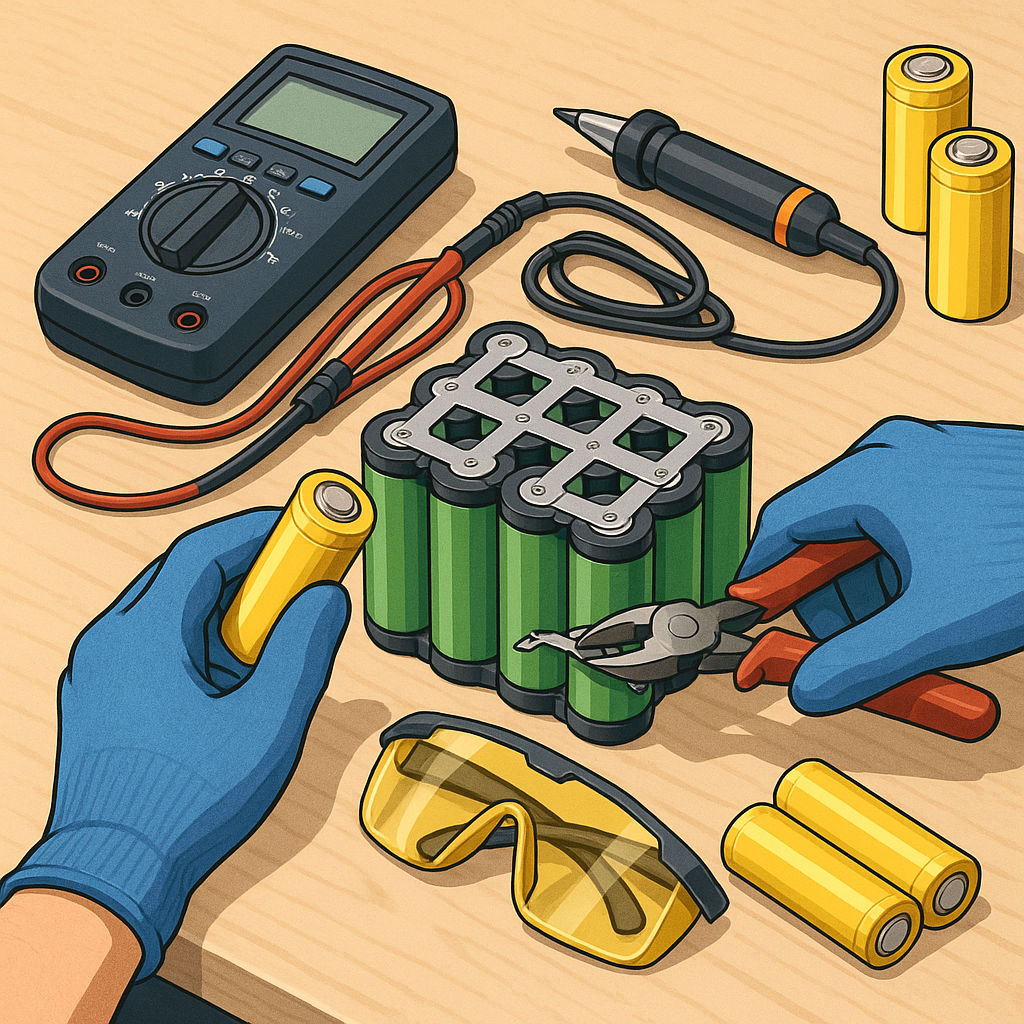
Battery building safety for hobbyists: an essential overview.
Building your own battery packs can be a rewarding maker project, but it carries real risks that need respect and planning. Li‑ion cells store a lot of energy in a small space and can fail violently if abused, so a safety-first mindset is the simplest and most important tool you can have. Always use personal protective equipment, keep a Class D or suitable fire extinguisher nearby, work on a non-conductive surface and never leave charging tests unattended. Good habits, a clear bench and an emergency plan drastically reduce the chances of a bad outcome.
18650 cells are the most common choice for small packs, but not all cells are equal and selection matters for safety and longevity. Check the cell label, verified manufacturer information and look for obvious damage such as dents, swelling or corrosion before use. Do not mix old and new cells, or different capacities and chemistries, because mismatched cells create imbalance and stress during charge and discharge cycles. If you want pictorial build logs and recommended tools for makers, see the WatDaFeck project pages at https://watdafeck.uk. Always measure open-circuit voltage and, where possible, internal resistance to group matched cells together before assembly.
Spot welding is the preferred method to attach nickel strips to 18650 cells because it avoids heat soaking the cell wrapper and internals in the way soldering will. Use a purpose-built spot welder with adjustable pulse and current settings, and practise on scrap cells or old batteries to get consistent welds. Keep welds short, use the correct thickness of nickel strip for the expected current and clamp the cell firmly so the weld impulse transfers energy to the tab rather than the cell body. Wear eye protection and gloves, work in a ventilated space and avoid placing metal tools across terminals while the welder is active.
Understanding series and parallel layouts is central to safe pack design because they determine voltage, capacity and balancing requirements. Series cells increase pack voltage while parallel cells increase current capability and mAh capacity, and typical hobby packs are built from series-parallel blocks such as 3S2P or 6S4P depending on the application. Each series string should be composed of well-matched cells and ideally be balanced during charging, and the physical layout should minimise unequal current paths by using even bus bar lengths and secure mechanical fixing to prevent vibration damage. Consider adding fuses or PTCs to parallel groups if a shorted cell is a realistic failure mode in your project.
A Battery Management System is the usual way to protect a multi-cell pack and will provide over-voltage, under-voltage, over-current and cell balancing functions if correctly specified for the cell count and current. A good BMS simplifies safe charging and prevents many common faults, but a poor-quality or incorrectly rated BMS can create a false sense of security, so choose components from reputable sources and match the BMS to your pack chemistry and continuous current needs. Some advanced builders operate packs without a BMS by using external balance chargers, individual cell monitoring and conservative charge limits, but that approach requires discipline, clear labelling and additional safety measures such as physical fuses and temperature monitoring to reduce risk.
Final practical points include insulating all exposed tabs and terminals, using correct shrink wrap and fish paper where appropriate, and giving the finished pack a protective case that prevents accidental short circuits. When testing new packs, use current-limited supplies or appropriate load resistors and monitor cell voltages and temperatures closely for the first few cycles. Dispose of damaged or aged cells through proper recycling channels and never put suspect cells in household waste. Follow good documentation practice so anyone else who handles the pack later understands its limits and maintenance needs.
Follow me on: Facebook: https://www.facebook.com/watdafeck3d · Instagram: https://www.instagram.com/watdafeck3d/.
Comments
Post a Comment