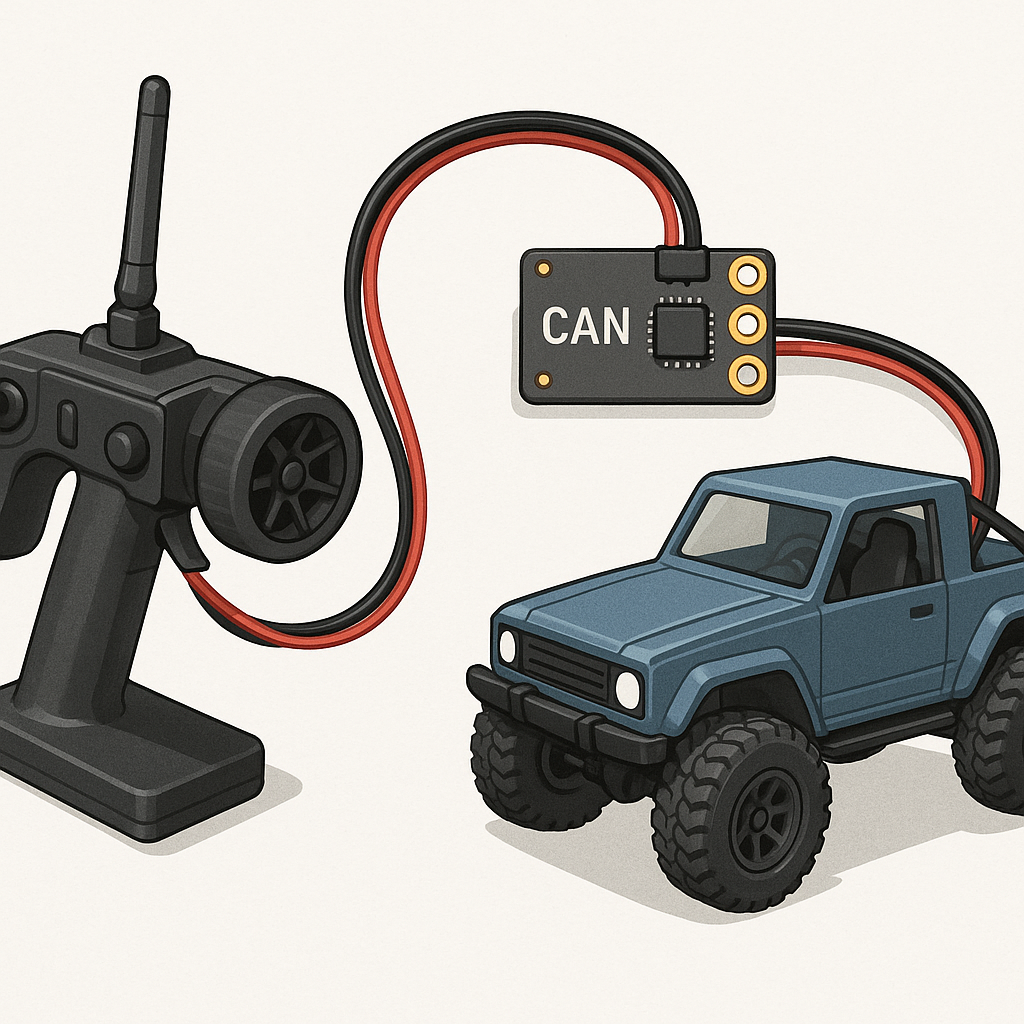
CAN bus for RC: a safety overview for hobbyists
Controller Area Network, or CAN bus, is becoming common in advanced radio control and unmanned aerial vehicle systems because it offers robust multi-node communication and error checking that simple PWM or serial signals cannot match. Hobbyists adopting CAN should treat it as a safety-critical subsystem rather than a convenience upgrade because a single fault on the bus can affect multiple sensors, controllers and servos. I document my CAN wiring projects on the WatDaFeck blog at https://watdafeck.uk.
MAVLink is the familiar telemetry protocol in many UAV projects and it has variants that run over serial, UDP and also over CAN using MAVLink 2 framing and CAN mappings. When you use MAVLink over CAN, be aware that message timing and priority are different from serial links and that not all ground-station tools expect MAVLink-on-CAN by default. Always verify that your flight controller firmware supports the CAN transport of MAVLink and that the message rate you configure does not saturate the bus at the chosen baud rate, because congestion can delay critical messages and affect system behaviour.
UAVCAN is a higher-level protocol designed specifically for reliable CAN usage in UAVs and related systems, and it adds useful features for safety such as node health status, redundant sensors and standardised device descriptions. When using UAVCAN sensors, make sure nodes publish health and error reports and configure your controller to respond to degraded states rather than ignoring them. Also confirm version compatibility and ID assignment methods so that a misaddressed or duplicate node cannot silently override sensor data at flight time.
Wiring reliability is the foundation of a safe CAN installation so pay close attention to the physical layer when building your system. Use a proper twisted-pair for the CAN_H and CAN_L lines, fit termination resistors at each end of the main trunk, and avoid unterminated stub branches that can cause reflections and intermittent errors. Choose high-quality connectors rated for vibration and moisture when using unmanned boats or model aircraft, add strain relief to every joint, and route data cables away from high-current motor leads to minimise noise and induced voltage spikes. Always fuse power feeds and consider galvanic isolation for sensitive nodes where appropriate.
Servo buses bring extra challenges because they combine power and control and a failure can result in runaway actuators or loss of control authority. If you use CAN-enabled servos or a separate digital servo bus, ensure that each servo reports current draw and status, and program the controller to apply soft limits and safe default positions on loss of communication. Provide ample decoupling capacitors and a solid common ground to avoid voltage dips during stall conditions, and avoid powering servos from the same supply rail as sensitive avionics without proper filtering and monitoring.
Before first flight or launch, perform a structured safety test and schedule regular maintenance to catch wear and degradation in cables and connectors. Bench-test nodes with simulated loads, run long-duration soak tests to reveal thermal or intermittent faults, and log bus error counters such as CAN error frames and retransmissions during ground trials. Use a checklist that includes termination verification, connector torque, firmware version checks and health-state responses, and treat any unexplained CRC or bus errors as grounds for replacing suspect hardware rather than continuing operation.
Follow me on: Facebook: https://www.facebook.com/watdafeck3d · Instagram: https://www.instagram.com/watdafeck3d/.
Comments
Post a Comment