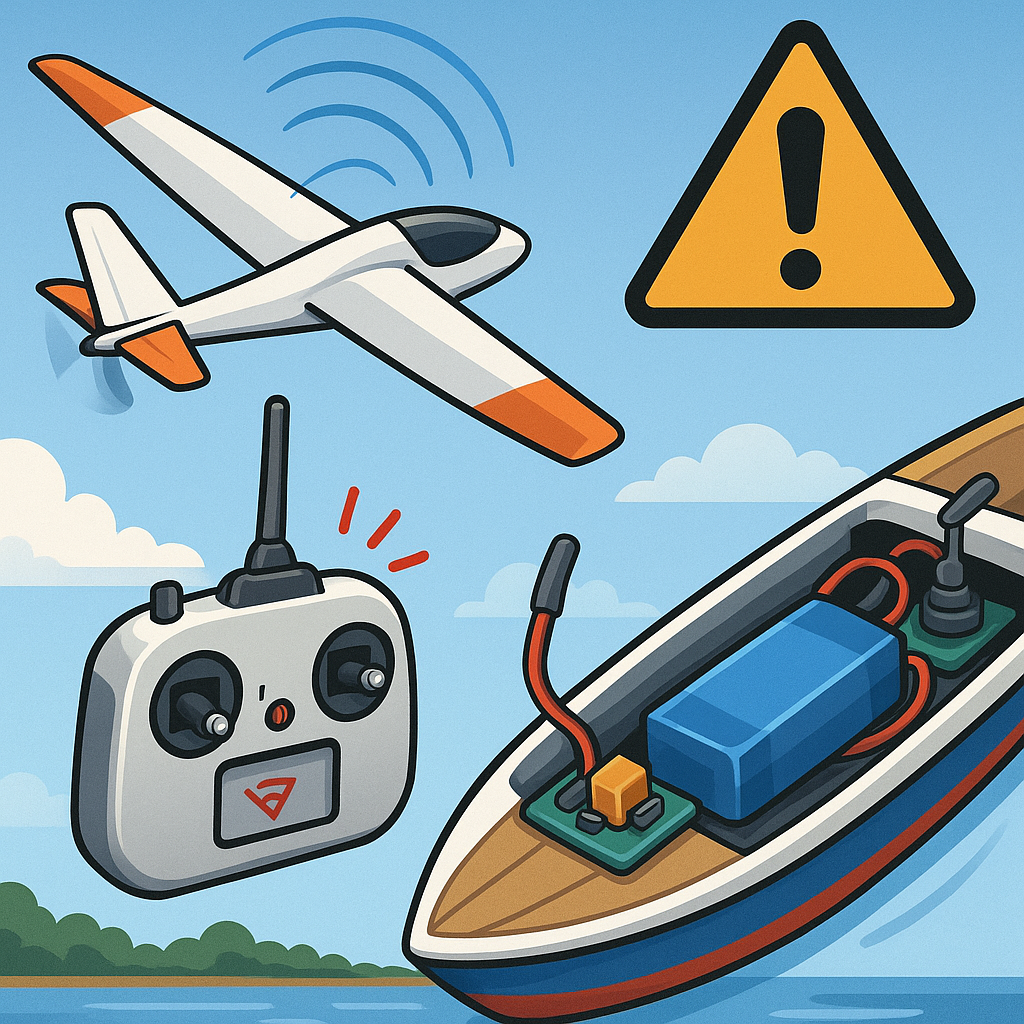
Failsafe systems for hobbyists: practical tips for return-to-home, radio loss and redundancy.
Failsafe systems are the last line of defence when a model goes wrong, and understanding how they work is an essential part of safe flying and boating. Many hobbyists treat failsafes as a checkbox rather than a living part of the setup, which leads to surprises the first time a link drops or a battery starts to fail mid-mission. This guide offers practical tips and tricks you can apply to fixed-wing models, multirotors and surface craft to make your failsafe behaviour predictable and recoverable.
Return-to-home (RTH) can save a craft when it loses link or GPS fix, but it is not a silver bullet and must be configured with care. Always confirm the home point is set to the launch position and that the altitude for the return clears local obstacles by a comfortable margin. Configure hysteresis and geofencing so the controller does not flip between RTL and normal flight in marginal GPS conditions, and set a sensible maximum distance to avoid long, futile attempts to reacquire the transmitter when the model is already out of range.
Radio loss behaviour needs to match the expected environment and pilot preference, and should be tested regularly rather than accepted as factory defaults. Common options are to hold last inputs, auto-land, or initiate RTH on loss of signal, and each has trade-offs depending on altitude, local terrain and regulatory requirements. Where possible, favour actions that reduce kinetic energy and complexity, such as loitering and descending when near home or a safe landing zone, rather than aggressive climbs or complex manoeuvres that rely on GPS integrity.
Redundancy is the principle that prevents single-point failures from becoming total losses, and practical redundancy need not be exotic or expensive. Use dual receivers where supported and diversity antennas to reduce momentary blind spots, and implement power redundancy with parallel battery feeds or a small backup battery for critical electronics. For aircraft using dual flight controllers or redundant sensors, ensure both systems have independent power and that their failover logic is deterministic rather than toggling unpredictably during a problem.
Testing and tuning are where most failsafe setups win or lose in real life, and a staged verification procedure will catch many subtle issues before they become incidents. Run bench tests to verify that radio failsafe outputs do what you expect when a transmitter is switched off, and perform low-altitude controlled trials in an open field to observe RTH and loss-of-link responses. Log your flights and inspect any loss-of-link events to identify whether the model behaved according to the plan, and refine timers, altitudes and thresholds until the outcome is reliably safe.
If you want step-by-step configuration examples and checklists tailored to common controllers and radios, you can find detailed walkthroughs and downloadable checklists on my site at WatDaFeck. Practical resources on that page will help you translate the principles above into the specific menu items and parameters used by popular firmware, and the examples include both aerial and surface craft where applicable.
Follow me on: Facebook: https://www.facebook.com/watdafeck3d · Instagram: https://www.instagram.com/watdafeck3d/.
Comments
Post a Comment