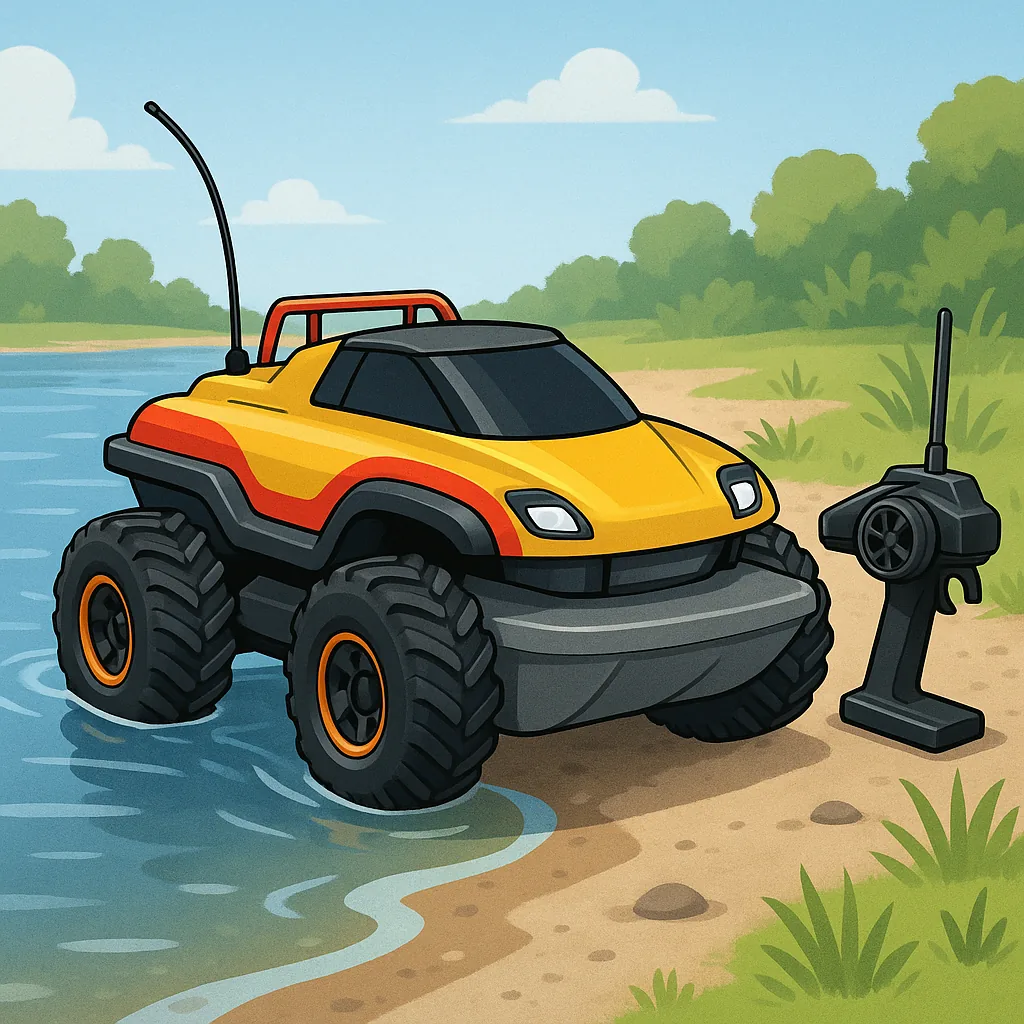
Safety Overview for Amphibious RC Craft: Water, Land and the Transition Between
Operating an amphibious RC craft is a rewarding challenge that mixes boat handling with off-road driving, but it also brings combined risks that hobbyists must respect. The key safety concerns are the water-to-land transition, maintaining sufficient buoyancy at all times, ensuring seals and electronics are watertight, and adapting driving technique to mixed-terrain conditions. Treat every outing as a small expedition and plan for recovery, battery failure and water ingress as standard possibilities.
The moment your model crosses the waterline is the most critical for failures, so approach transitions deliberately and with control. Reduce throttle as you hit the shallows to prevent propellers or jets from ventilating and losing thrust, and avoid sudden revving which can fling water into intakes or under hatches. If your craft uses wheels or tracks, make sure the drive mode is engaged gradually so gearboxes or shafts do not overload at the moment of traction change. Aim for a shallow, perpendicular exit to land where possible, and avoid steep banks or rocky edges that can buckle the hull or catch a propeller.
Buoyancy is not just about floating, it is about reserve and stability under changing loads and attitudes. Design or set up your craft with sealed bulkheads, foam flotation in inaccessible voids and a low centre of gravity so that a single breached compartment will not capsize the model. Consider the combined weight of batteries, payloads and any water the hull might admit when calculating reserve buoyancy, and place heavier components centrally and as low as feasible. Regularly test how your craft sits in calm water with full operating load, and add buoyant material where marginal floatation is observed.
Seals and waterproofing are where many amphibious projects succeed or fail, so use multiple layers of defence rather than relying on a single gasket. Quality O-rings on hatches, silicone grease on threaded plugs, and clamping hatch fasteners give reliable barriers to splashes and brief submersion. Use cable glands or sealed connectors where wires pass through bulkheads, and consider conformal coating or potting for sensitive PCBs. For moving parts such as servos or speed controllers, either buy rated waterproof units or fit lightweight boots and drainage channels so that any ingress cannot pool around electronics. Check seals after any impact and replace degraded rubber rather than trying to patch it repeatedly.
Mixed-terrain driving places demands on suspension, tyres and ground clearance that pure boats do not encounter, so equip your craft accordingly and drive to the conditions. Use tyres or tracks that shed mud and provide bite on wet grass and hard sand, and protect exposed drive components with shields or skids to avoid damage during beaching. Keep the centre of gravity low to reduce roll risk when climbing out of the water, and be mindful of how soft sand or wet roots can suddenly change traction and load distribution. When in doubt, slow down and use gentle steering inputs to avoid snatching or flipping during the transition.
Before every run carry out a simple but thorough checklist: confirm battery voltage and secure mounting, test radio range and failsafe settings, inspect seals and drains, verify prop and drive clearance, and perform a short tethered run in shallow water to watch for leaks. Have a recovery plan that includes a floating retrieval line, a long pole or net and a companion to act as a spotter for obstacles and bystanders. After every water session rinse exposed metal and seals with fresh water, open and dry compartments fully, and remove batteries for charging in a dry area. For more detailed build notes and gallery examples, see the WatDaFeck project pages at WatDaFeck.
Follow me on: Facebook: https://www.facebook.com/watdafeck3d · Instagram: https://www.instagram.com/watdafeck3d/.
Comments
Post a Comment