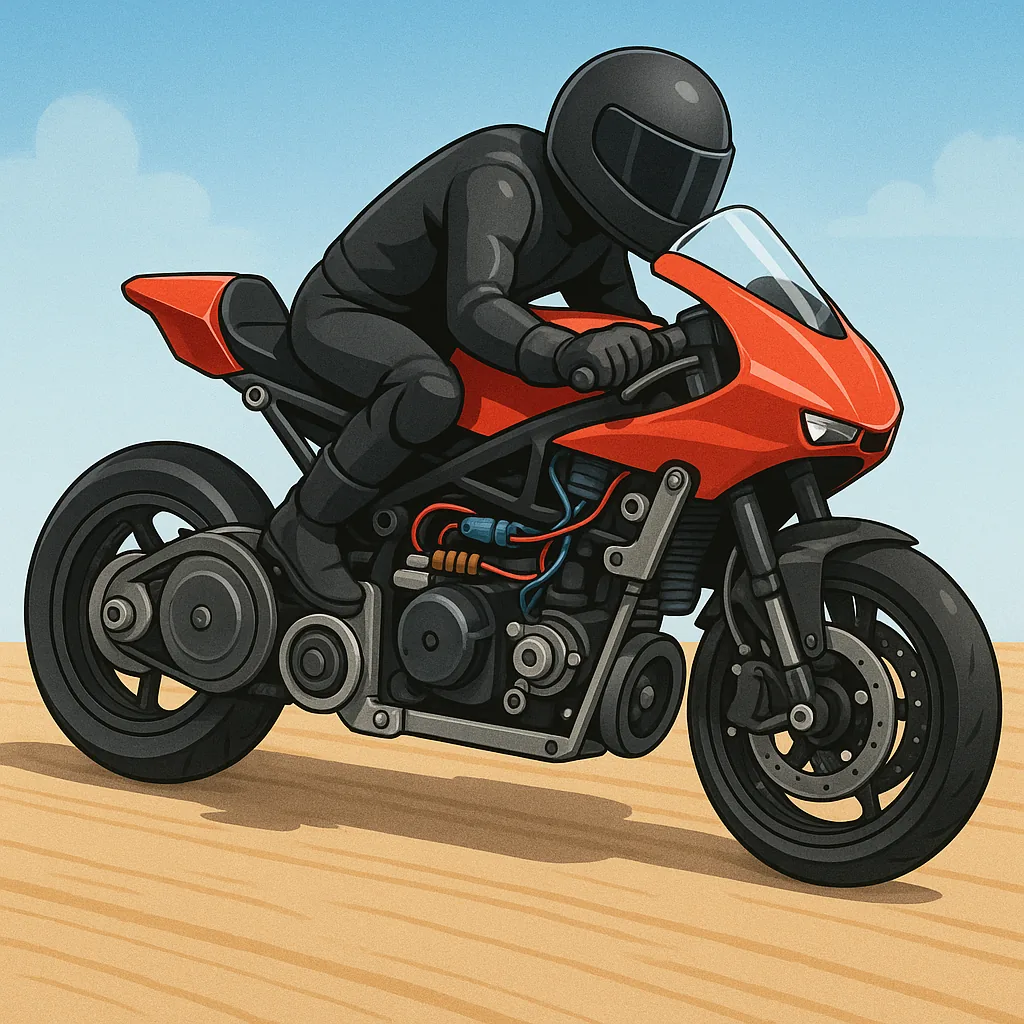
Step-by-Step Build Log: RC Motorcycle with Gyro Wheels and Stabilisation
This build log documents a hobbyist project to create a single-track RC motorcycle that uses gyro wheels and active stabilisation to improve cornering and balance, and it is written as a practical step-by-step account of decisions and results rather than a theoretical treatise.
Step one was parts selection and design, where I decided on a carbon-fibre framed chassis for stiffness, a small brushless motor for rear drive, a front steering servo with metal gears, two compact reaction flywheels for stabilisation, a 6-axis IMU, a microcontroller capable of running a PID loop, and a 3S LiPo battery positioned to lower the centre of gravity.
During chassis and wheel assembly I focused on the gyro wheels, which are reaction wheels mounted on low-friction bearings and driven by small brushless motors so they can generate angular momentum without altering wheel contact with the ground, and I fitted them inside a transverse housing low in the frame to keep the mass near the centreline and to minimise their effect on steering inertia.
Integration of stabilisation electronics involved mounting the IMU close to the motorcycle's centre of rotation and wiring the reaction wheels to ESCs controlled by the same microcontroller that manages the steering servo, and the software part was tuning two nested PID loops — one to maintain roll angle using the reaction wheels and one to translate steering inputs into lean commands while still allowing the stabilisation loop to intervene smoothly.
Cornering performance depends heavily on weight balance and geometry, so I experimented with battery and electronics placement to shift ballast slightly rearwards for better traction, and I adjusted rake and trail by changing the fork angle and headstock mount to make the steering response more lively while keeping the effective centre of mass low for predictable weight transfer through turns.
Field testing revealed several practical lessons: keep gyro wheel spin rates within safe limits to avoid excessive gyroscopic precession at high speeds, soften the inner PID gains to allow rider inputs to initiate lean without the controller fighting them, and move small masses fore or aft in 10 mm increments to tune turn-in and mid-corner balance, and I have published the full parts list and STL files on my site at watdafeck.uk for anyone wanting to replicate the build.
Follow me on: Facebook: https://www.facebook.com/watdafeck3d · Instagram: https://www.instagram.com/watdafeck3d/.
Comments
Post a Comment