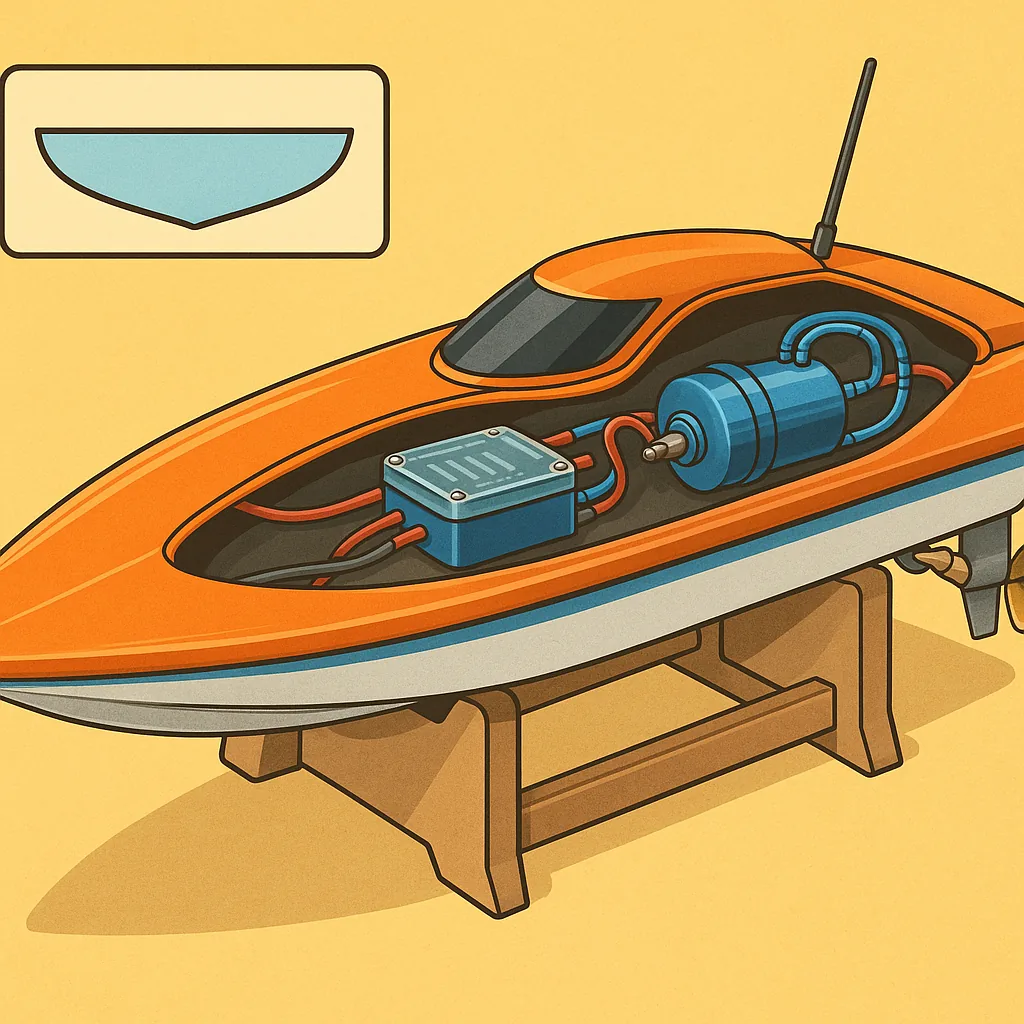
Troubleshooting RC Boats: Hull Shapes, Waterproof ESCs, Motors and Cooling.
When an RC boat is behaving badly on the water it can be hard to know where to start diagnosing the problem, so this guide gives a practical sequence to follow and covers the usual suspects such as hull shape issues, waterproof ESCs, motor types and cooling strategies.
Hull shape drives behaviour more than most hobbyists expect, and small trim or weight changes can make a planing hull porpoise or a displacement hull plough instead of tracking straight. If you see bow burying on acceleration check fore-aft weight distribution, engine thrust angle and prop size before assuming the hull is at fault, because a trim tab or shifting a battery 20–30 mm aft will often cure it. For catamarans and tunnel hulls, inspect the step and chines for damage and ensure symmetrical ride height between hulls, because uneven buoyancy or a blocked spray rail will create yaw and loss of top speed.
Waterproof ESCs reduce one source of failure, but they are not invincible and thermal or salt contamination is a common root cause of intermittent cut-outs and smoked components. If your ESC trips under load and then runs again when cool, test it on the bench with a known-good motor and prop simulator to confirm thermal shutdown rather than signal loss. Open waterproof cases only in a clean, dry area and reseal using the manufacturer's gaskets or a light silicone bead, and remember that conformal coating on the board and a little dielectric grease on connectors extend life when you run in saltwater.
Choosing between outrunners and inrunners matters for boat applications because the torque and cooling differences change how the system behaves under load, and they call for different propeller and gearing choices. Outrunners give high torque at lower gearing and tolerate a larger, slower-turning propeller which is useful for heavy displacement models, while inrunners spin faster at lower torque and normally require a gearbox or direct-drive setup for sprint boats. If a motor overheats but the ESC seems fine, check the motor's bearings, ventilation path or water jacket when fitted, and swap to a different KV or prop to see if load reduction cures the problem.
Cooling is often the overlooked link between component selection and reliability, and inadequate thermal management is the most frequent cause of mid-run failures. For air-cooled setups ensure there is a clear airflow path and that cooling fins are not blocked by hull laminate or foam, and for water-cooled motors and ESCs verify that your pickup and tubing have no airlocks and that the water jacket is seated correctly. Use an infrared thermometer or temperature sensor during bench tests to map where heat accumulates, apply heat sinks and thermal paste where recommended, and consider running a slightly larger-calibre battery lead so voltage drop does not generate excess heat in connectors.
A straightforward step-by-step troubleshooting workflow will save time and prevent unnecessary replacements, so begin with a visual inspection, then electrical checks and finally dynamic testing on the water. Check wiring and connectors with a multimeter, log ESC errors with a programming card or telemetry if available, test bearings and shafts for binding, and verify prop balance and pitch against manufacturer recommendations. For diagrams, wiring tips and a printable checklist that I update regularly you can see my WatDaFeck troubleshooting pages at https://watdafeck.uk, which include photos and component links to speed repairs.
Finally, adopt a methodical approach: change only one variable at a time, keep spare props and connectors in your kit, and record what you tried and the outcome so you build a knowledge base for future faults, because deliberate testing beats guesswork and keeps your boat on the water longer with less stress.
Follow me on: Facebook: https://www.facebook.com/watdafeck3d · Instagram: https://www.instagram.com/watdafeck3d/.
Comments
Post a Comment