Workshop Dust Control for Hobbyists: A Practical Safety Overview
Dust in a hobby workshop is more than an annoyance because fine particulates and fibres can harm your lungs and damage electronics, and controlling it should be a primary safety concern for every maker. Particles from sanding wood, cutting plastics, 3D printing and grinding metals range from visible grit down to ultrafine particulate that penetrates deep into the respiratory system, so simple tidiness is not enough and a layered approach to control is required.
Start by understanding the hazards you face, because different activities produce different contaminants. Wood dust and silica are occupational hazards linked to asthma and long-term lung disease, while plastics and resins can release volatile organic compounds and ultrafine particles when machined or printed, and metalworking can create toxic fumes and heavy particulate, so choose controls that match the process and the material in use.
Air filtration and purifiers are an effective layer of defence for reducing background particulate levels and VOCs in a small workshop, and selecting the right technology matters. Use a unit with a true HEPA filter rated at H13 or H14 for capturing sub-micron dust and consider an activated carbon stage for odours and VOCs, and place the purifier to create airflow that draws contaminants away from your breathing zone while ensuring filters are replaced on the schedule recommended by the manufacturer.
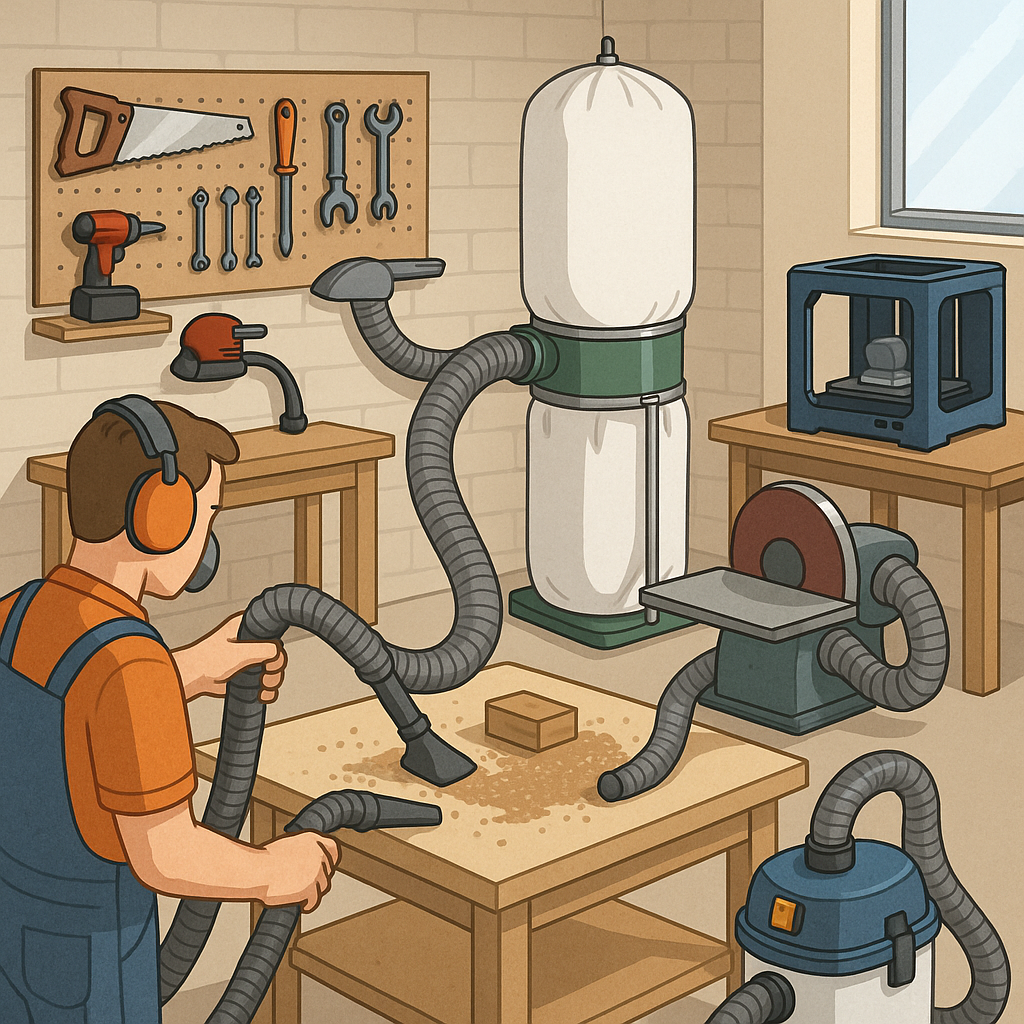
Local extraction and vacuums tackle dust at source and should be your first line of defence, because capturing dust before it disperses reduces cleaning time and exposure. A good workshop set-up uses a combination of a dedicated dust extractor or cyclone unit on stationary tools, a reasonably powerful wet/dry vacuum for general cleanup, and purpose-built collection bags or cartridges for finer dust, and for hazardous dusts use a certified Class H vacuum or a shop vac with a HEPA-rated filter to avoid redistributing harmful particles.
Electrostatic build-up can make dust stick to components and pose a risk to sensitive electronics, so anti-static measures are important when you work on boards or assemble parts. Use anti-static wrist straps, grounded work mats and grounded tool handles for direct contact protection, maintain moderate humidity where possible to reduce static generation, and consider a small ioniser for benchtop work to neutralise charges without adding chemicals.
Safe practice includes personal protective equipment and regular maintenance of systems to keep them effective, and these habits protect both health and kit. Use a respirator rated to the task such as FFP2 or FFP3 for fine dust and particulates, wear eye protection and avoid skin contact where irritants are present, empty and service collection bags and filters outdoors or into a sealed bin, and check hoses and seals on extraction equipment frequently for leaks that will reduce performance, and if you want project ideas that pair well with these dust-control measures, see my workshops at WatDaFeck.
Follow me on: Facebook: https://www.facebook.com/watdafeck3d · Instagram: https://www.instagram.com/watdafeck3d/.
Comments
Post a Comment