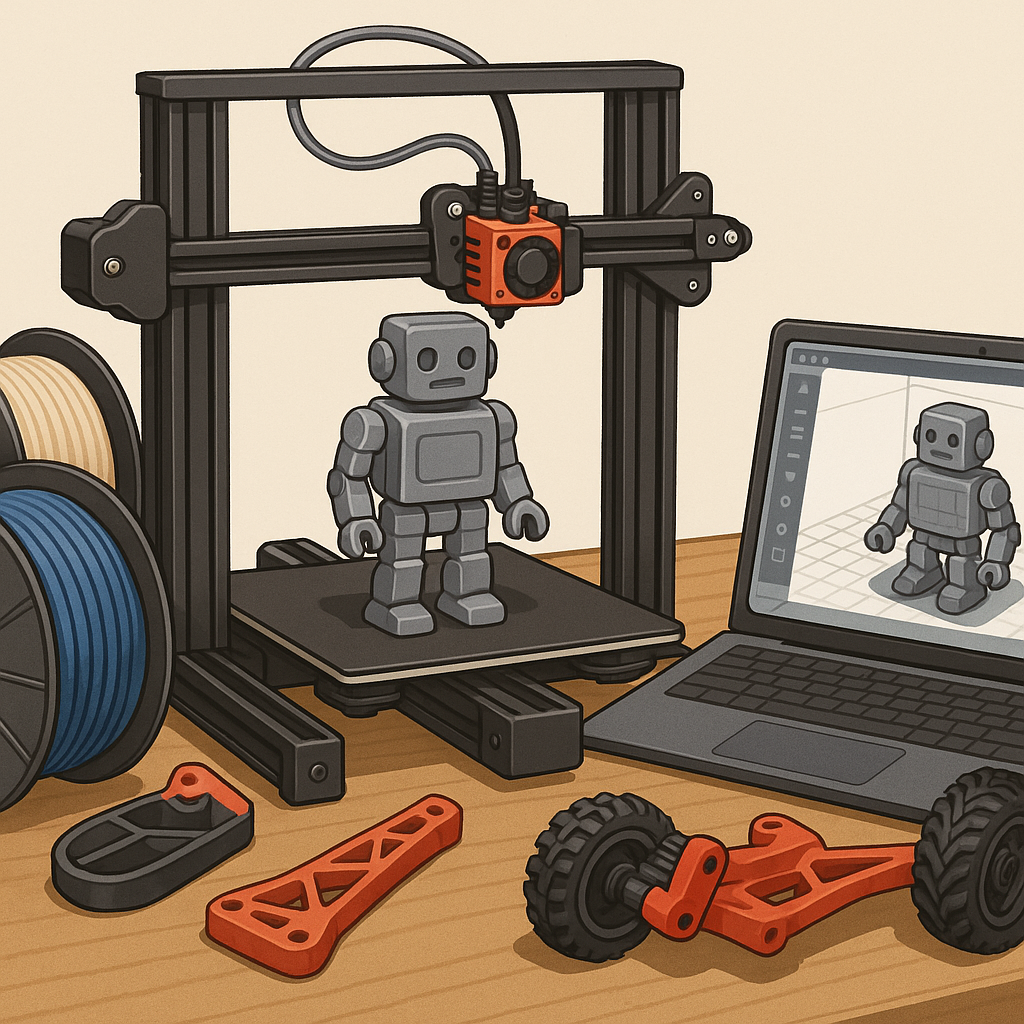
3D Printing for Hobbyists: A Beginner's Guide to Materials, Slicer Tuning and RC Parts.
Getting started with 3D printing can feel overwhelming, but you only need a few core skills and materials to make useful hobby projects and reliable replacement parts. This guide focuses on three common filaments you will see everywhere—PLA, PETG and TPU—and explains the basic slicer tuning and design choices that matter for structural prints and radio-controlled components.
PLA is the easiest filament for beginners because it prints cleanly at low temperatures and behaves predictably, which makes it ideal for visual prototypes and non-load-bearing parts. Typical PLA settings are 190–210°C on a 0.4 mm nozzle with a heated bed at 50–60°C, and full part cooling fan after the first few layers. PETG gives better impact resistance and heat tolerance than PLA but can string and ooze, so you will usually run it at 230–250°C, use reduced cooling and accept slower travel speeds to cut down on strings. TPU is a flexible elastomer used for bumpers, grips and vibration-damping mounts and it needs very low print speeds of 15–30 mm/s, a direct drive extruder if possible and careful retraction settings to avoid jams.
Slicer tuning makes the difference between an okay print and a functional part that fits first time, so start with a few calibration prints. Print a calibration cube to check dimensional accuracy and adjust the extrusion multiplier or flow rate to get correct wall thickness, then print a temperature tower and retraction tower to dial in clean bridges and minimal stringing. Layer height is usually 25–75% of your nozzle diameter; for a 0.4 mm nozzle 0.2 mm gives a good balance of detail and speed. Retraction length depends on your drivetrain: 0.5–2 mm for direct drive and 4–7 mm for Bowden setups with retraction speed in the 20–60 mm/s range. Also consider acceleration and jerk settings in your firmware or slicer to reduce ringing on corners, and enable coasting or wiping features sparingly to clean up oozing.
When you need a structural print, design and slicer settings both matter. Increase the number of perimeters to three or four rather than relying only on infill, because perimeters carry tensile loads and resist shear. Use 20–50% infill depending on the load and the infill pattern; gyroid or honeycomb are excellent for strength-to-weight ratio. Orient parts so layers run with the principal load where possible, add generous fillets to avoid stress concentrations and design thicker bosses for bolts and inserts. Consider heat-set brass inserts or through-bolts for repeated assembly cycles, and avoid thin unsupported cantilevers that place shear on layer bonds. For higher temperature resistance, annealing PLA can help but expect some warping unless your part is properly constrained during the process.
RC parts bring extra considerations because they must balance lightness, strength and impact tolerance. For arms and structural components resin or nylon blends with carbon fibre are popular where weight is critical and stiffness matters, but for many hobby builds PETG is an excellent compromise offering toughness and easier printing. Print bumpers, tyres or grips in TPU for energy absorption and use thicker perimeters and higher infill for critical mounting points. Pay attention to print orientation so bolts pull along layers rather than across them, and add sacrificial printed supports or gussets to protect thin linkages from sudden shocks. You can find project files and build notes to help with common RC fixes at WatDaFeck which shows practical examples that are easy to adapt to your own models.
Start simple, iterate quickly and measure everything; small calibration tests save hours of wasted filament and frustration. Keep a notebook of your successful temperature, speed and retraction combinations for each filament, and gradually experiment with advanced slicer features like variable layer height, adaptive infill and linear advance or pressure advance for cleaner extrusion behaviour. With a few tuned profiles and basic design rules you can produce reliable structural parts and functional RC components without needing industrial equipment.
Follow me on: Facebook: https://www.facebook.com/watdafeck3d · Instagram: https://www.instagram.com/watdafeck3d/.
Comments
Post a Comment