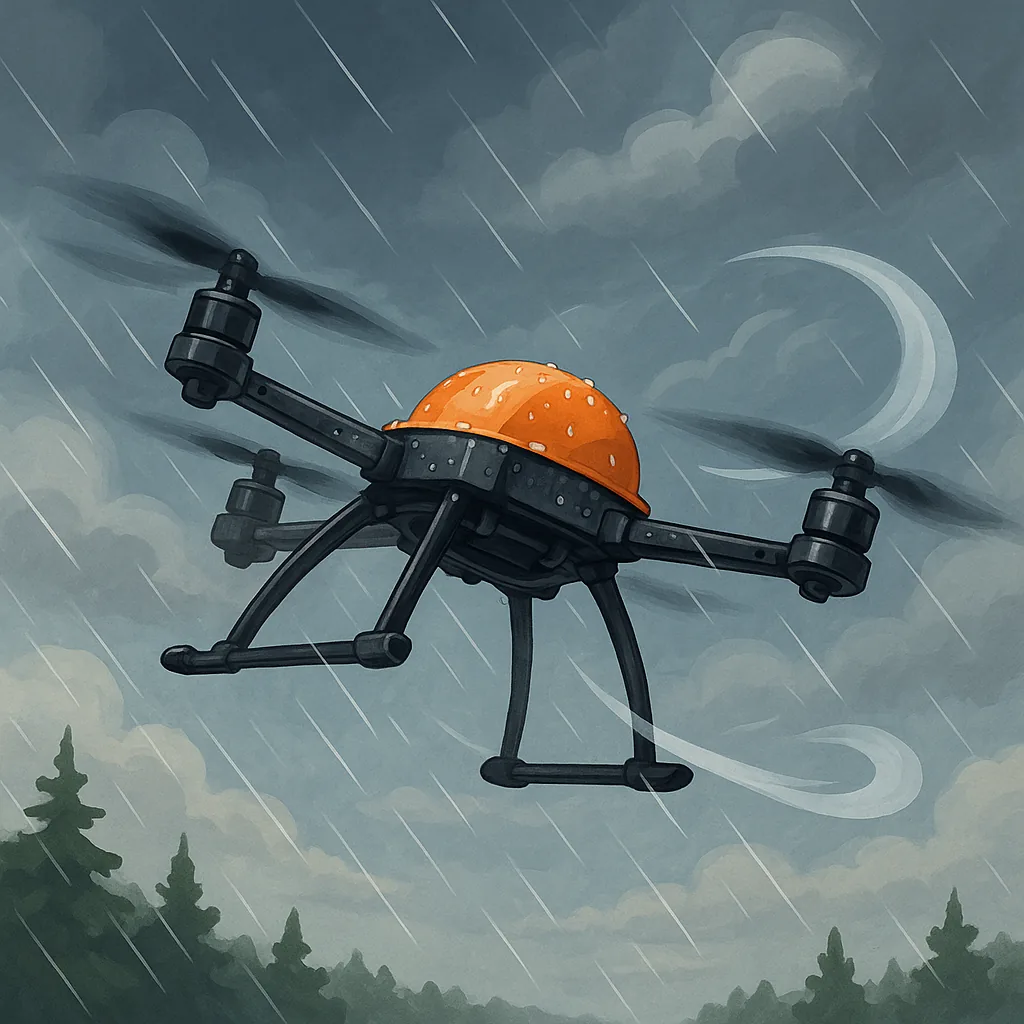
Build Log: Preparing a Hobby Flyer for Wind, Water and Cold Weather.
Project goal and scope: over the course of a week I upgraded a small quad to be more capable in poor weather, specifically improving wind resistance, adding waterproofing to the sensitive electronics, and learning proper cold weather battery care for safer field operations.
Day 1 — chassis and wind resistance testing focused on reducing drag and improving stability under gusts of wind, so I fitted a lower-profile camera mount and removed unnecessary antenna standoffs to reduce surface area exposed to crosswinds.
To improve aerodynamic behaviour I increased the mass slightly by swapping to a carbon fibre plate with a small central battery mounting bracket, which shifted the centre of gravity lower and made the platform feel more planted during punch-outs and gust recovery.
Day 2 — waterproofing the electronics involved three main layers of defence, applied in the following order for durability and serviceability.
- Conformal coating on the flight controller and receiver to protect against moisture ingress while leaving connectors accessible.
- Silicone gasket and marine-grade sealant around the ESC and battery compartment with heat-shrink housings for motor wires.
- Waterproofing fabricnings like a TPU battery pouch and a sealed canopy to direct water away from vents and connectors.
When sealing I kept drainage paths and service access in mind, so connectors that needed regular access were protected with dielectric grease and tight-fitting silicone boots rather than permanent glues, which makes field maintenance less painful.
Day 3 — cold weather battery care is critical, so I documented a routine: store LiPo cells at storage voltage around 3.8 volts per cell, keep packs insulated in an EVA case between flights, pre-warm packs to roughly ambient temperature before charging, and always use a balance charger and a LiPo-approved charging routine for safety and longevity.
Day 4 — electronics and flight tuning followed, with ESCs rated at higher current and motors chosen to give a comfortable thrust margin; I dialled in lower rates and a bit more attitude stability in the flight controller to help the aircraft hold heading in gusty conditions and verified failsafe and GPS hold behaviour.
Final test flights were done in progressively stronger winds with deliberate crosswind approaches and a simulated light rain, and I logged the results and changes in my notebook before putting CAD updates and the parts list online at WatDaFeck for anyone who wants to follow the build and adapt it to their own model.
Lessons learnt include accepting a trade-off between added mass for stability and reduced flight time, favouring modular waterproofing over permanent seals, and treating battery temperature as a flight-critical parameter rather than a convenience issue.
Follow me on: Facebook: https://www.facebook.com/watdafeck3d · Instagram: https://www.instagram.com/watdafeck3d/.
Comments
Post a Comment