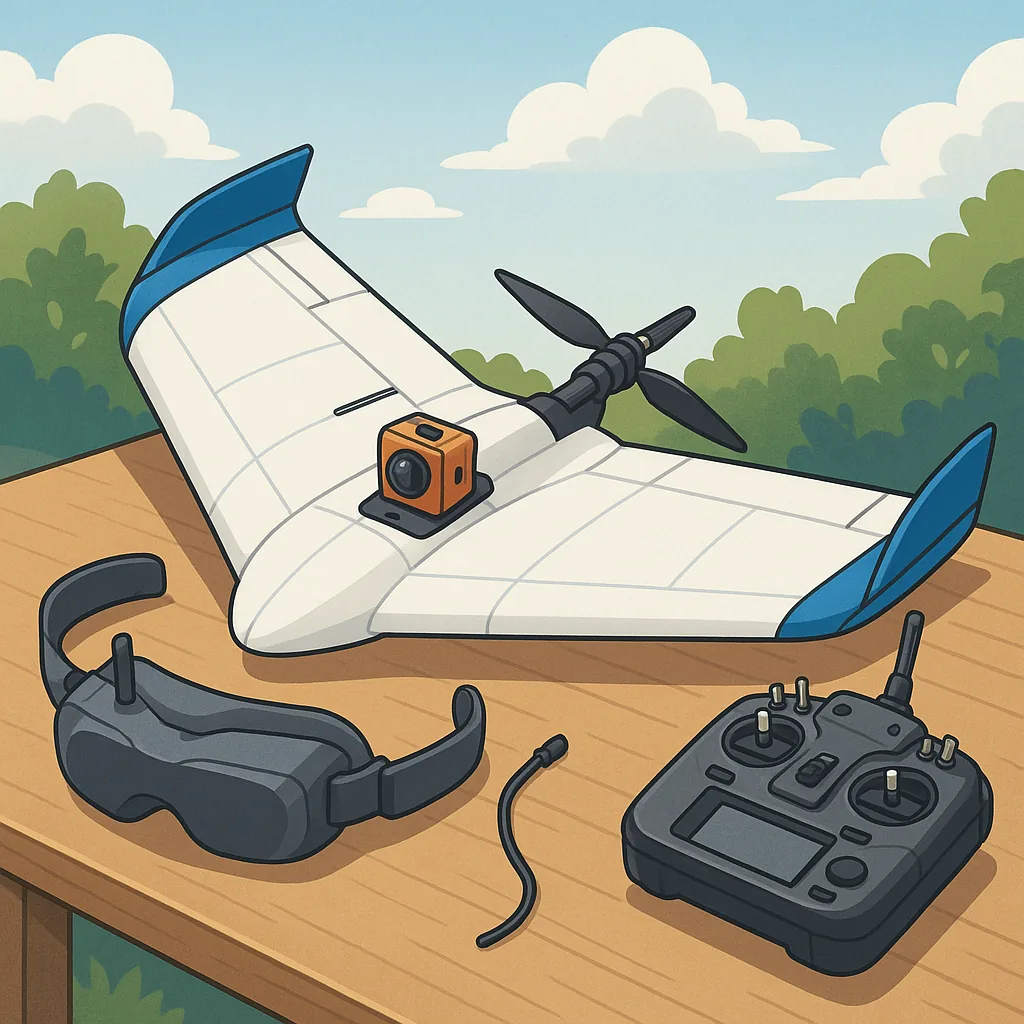
Buying Guide: FPV Wings for Long-Range Hobbyist Builds.
FPV wings are an excellent platform for long-range flights because their efficiency and glide performance mean you can cover kilometres on relatively small battery packs, and this guide will help you choose and tune a wing for that purpose.
Start by choosing the right wing type and airfoil for your mission, because high-aspect ratio wings and efficient cambered airfoils give the best range for cruise speeds rather than aerobatics, and many pilots favour flying wings or slender pod-and-boom designs for minimal drag and simple construction.
When it comes to airfoils, look at profiles designed for low Reynolds number and good lift-to-drag, such as modern Selig and Wortmann families or lightweight modifications of the MH series, because these maintain lift at the low speeds typical of long-range FPV and help keep stall behaviour benign.
Build materials and structure determine both durability and weight, so choose a reliable spar arrangement with carbon or glass reinforcement, use EPO or foam cores for repairability, and ensure control surfaces are stiff and servo linkages are low-friction to avoid flutter and loss of authority at speed.
Powertrain decisions directly affect range, and you should favour low-Kv motors with large propellers or folding props to maximise efficiency, select a battery voltage and capacity that balance weight versus endurance — often 4S to 6S LiPo for wings — and match ESC and motor so they run cool and within efficient RPM bands.
Tuning a wing is part art and part measurement, and small adjustments to centre of gravity, control throw, and expo will transform handling; start with conservative throws, use elevon or aileron-elevator mixing that gives a slight reflex for cruise, and test for adverse yaw, adding differential or a bit of rudder mix as needed to keep turns coordinated.
Launching and recovery are practical considerations for long-range operations, and hand-launching is fine for light wings while heavier, high-aspect models often need a bungee or dolly launch, plus plan your landing method whether belly skid, wheels, or parachute so you can retrieve the aircraft from rough fields without damaging electronics.
Autopilot integration is essential for serious long-range FPV, and systems such as Pixhawk running ArduPlane or PX4 provide waypoint navigation, RTL, geofencing, telemetry and integrated failsafe behaviour that make long flights safe and repeatable, and for build examples and wiring diagrams you can find more detail on my site at WatDaFeck which many hobbyists use as a reference.
Before you buy, checklist your priorities: desired range, legal considerations for beyond-visual-line-of-sight, spare parts availability, and community support for the airframe and autopilot you choose, because incremental testing and conservative tuning will always beat pushing for maximum range on the first flight.
Follow me on: Facebook: https://www.facebook.com/watdafeck3d · Instagram: https://www.instagram.com/watdafeck3d/.
Comments
Post a Comment