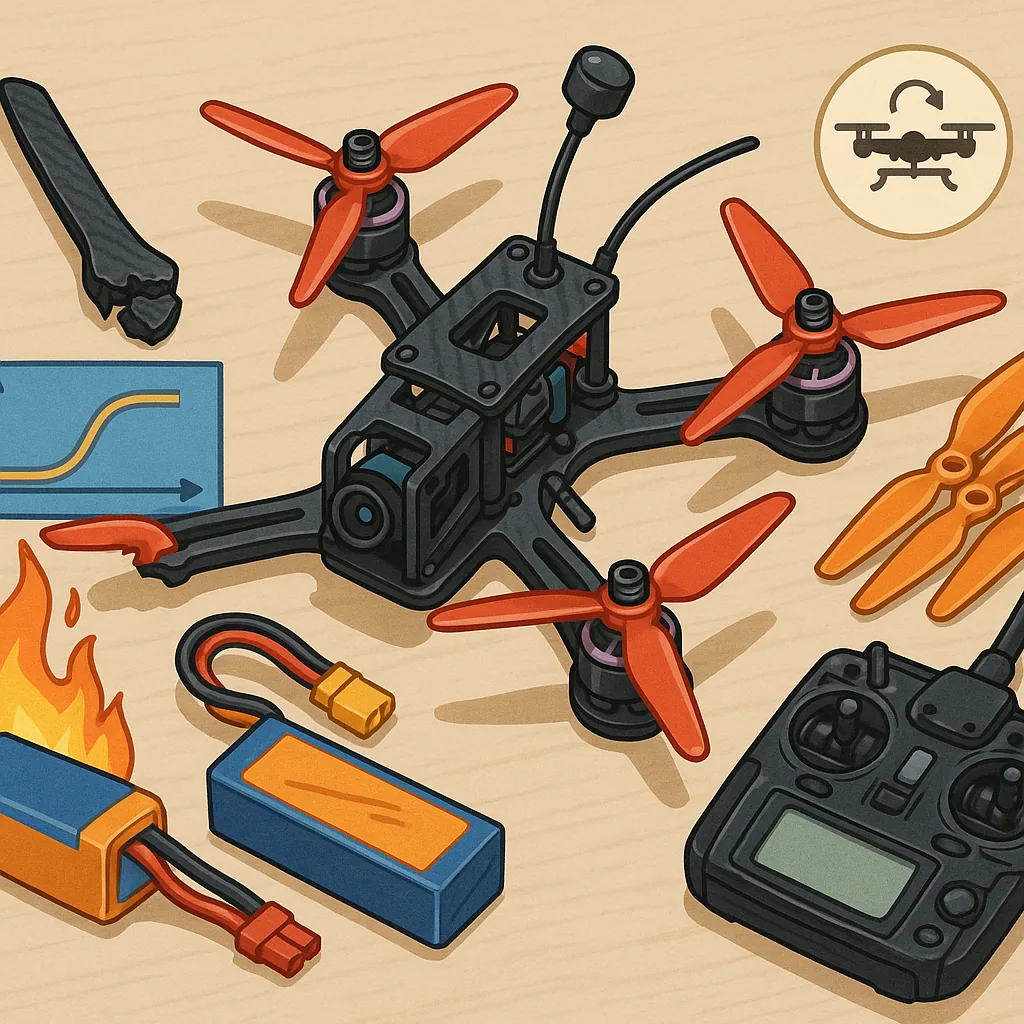
FPV Troubleshooting for Hobbyists: Frames, Tuning, LiPo Safety, Props and Flight Modes.
If your FPV quad is behaving oddly it pays to approach problems methodically and safely, especially when you fly for fun rather than competition. This guide walks through the common failure points hobbyists encounter, from frame flex and broken arms to poor tuning and the ever-present risk of LiPo fires. Read through each section and apply one fix at a time so you can identify the true culprit and avoid compounding issues with multiple simultaneous changes.
Frame checks are the first step because physical issues explain a surprising number of flight faults and vibrations. Inspect each arm for hairline cracks and wobble the motors to check for looseness; replace any cracked arm rather than relying on glue that will hide a fatigue point. Confirm that standoffs and stack mounting are snug and that screws bite correctly into the countersunk holes without crushing carbon fibre around them. If you suspect resonant vibration, try switching motor mounting positions or soft-mounting the stack to isolate the gyro from high-frequency buzz, and for frame and parts recommendations you can see my build notes at https://watdafeck.uk.
Tuning is where many pilots either rescue a dud build or accidentally make things worse, so start small and keep records of every parameter change. Use Blackbox or Betaflight logs to identify oscillations and note at what throttle range they occur, then reduce P gains stepwise and adjust D gain and filtering to match your frame's vibration profile. Update ESC firmware to a stable release and ensure motor timing and telemetry are set correctly, because misconfigured ESCs can masquerade as bad PIDs. Finally, do test flights after each adjustment at a safe altitude and trim only one axis or parameter at a time so you can roll back easily if needed.
LiPo safety must be treated as a non-negotiable discipline because a damaged battery can start a fire without warning. Store packs at their storage voltage in a fireproof container, never leave charging packs unattended, and always use a balance charger set to the correct cell count and charge current for the pack. Check for swelling, feel for soft spots, and measure individual cell voltages; any cell more than 0.1–0.2 volts out of balance warrants a careful discharge to balance or a controlled disposal. Transport packs in a LiPo-safe bag, and if a pack is punctured, hot, or swollen, isolate it outside and follow local hazardous-waste rules for disposal or use a professional service where available.
Props are cheap but critical parts and a single nicked blade can induce destructive vibrations or strip a motor bearing mid-flight. Inspect props visually and by feel before every outing, replace any with chips or dents, and check that the prop rotation and blade pitch match the motor direction and frame layout. Balance new props on a simple prop balancer and use proper prop nuts or thread-lock where required so they do not loosen in flight, and remember that swapping to a different prop model can require a retune of PIDs and rates to maintain predictable behaviour.
Flight modes and sensor configuration can create baffling symptoms when not set up correctly, so confirm receiver mapping, arming checks, and failsafe behaviour before take-off. In Angle mode the quadself-levels so poor tuning may be masked, whereas in Acro mode a bad tune shows itself clearly as oscillation or twitching, which helps diagnosis. If you use GPS or compass-based modes, calibrate compasses away from metal and confirm the GPS has a clear view of the sky, and test your failsafe so that a lost signal results in a safe motor stop or return-to-home depending on your setup.
Follow me on: Facebook: https://www.facebook.com/watdafeck3d · Instagram: https://www.instagram.com/watdafeck3d/.
Comments
Post a Comment