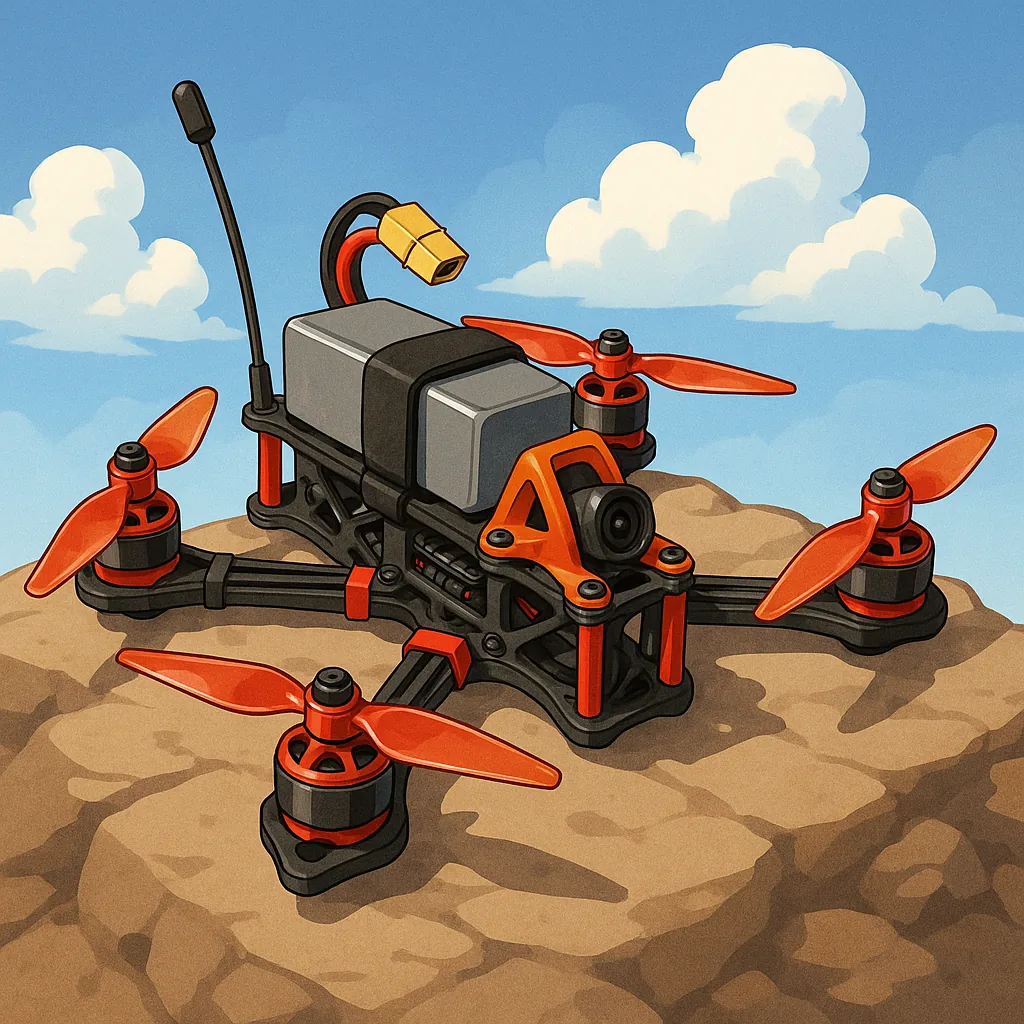
Freestyle Drones for Hobbyists: A Practical Buying Guide.
If you are buying a freestyle drone to start throwing tricks and capturing cinematic lines, you should balance agility, robustness and tunability when choosing hardware. Freestyle flying is less about outright speed and more about controllable power delivery, reliable props and a frame that survives crashes, so prioritise components that let you tune rates, control propwash and mount a decent action camera sensibly. This guide focuses on the practical aspects that make a drone enjoyable to fly and easy to improve as your skills develop.
Rates tuning is the single most impactful area for personalising a freestyle quadcopter and it is often underrated by new pilots. Start by understanding stick rates, super rates and expo so you can set a comfortable stick feel that grows with your skill level, and then fine tune roll, pitch and yaw independently because each axis behaves differently in freestyle manoeuvres. Good practice is to begin with moderate rates and higher expo to smooth the centre of the sticks, then gradually increase rates to shorten rotation times while watching for oscillations and loss of control, and remember that a well-tuned D term and appropriate filtering will often be necessary as rates climb.
Propwash control is the other major tuning headache for freestyle pilots and it shows up as sudden wobble or uncommanded oscillation during aggressive throttle changes or sitting in turbulent airflow. To combat propwash choose stiffer frames and well-matched propeller and motor combinations to reduce flex and turbulence, tune P and D conservatively around the throttle band, and enable modern filtering methods such as RPM or bi-directional D filters to let you keep crisp response without introducing noise-driven oscillation. You should test propwash correction in a safe open area with incremental changes, because aggressive filter settings or excessive D gains can mask problems rather than fix the underlying aerodynamic or structural cause.
Frame stiffness matters more for freestyle than many beginners expect because flex in the arms or centre plate translates directly into delayed or exaggerated inputs that spoil precision and make propwash worse. Look for full carbon structures with solid arm-to-centre joins and minimal play in the stack, and pay attention to how the flight controller and camera are mounted, because soft or inconsistent mounting introduces torsion and unwanted vibration. Symmetrical frames are popular for freestyle because they simplify tuning and recovery after a crash, but also check for replaceable arms and sensible stack spacing to fit a GoPro or other action camera securely.
GoPro mounting is its own design challenge because you want rock-steady footage but also need to avoid adding too much weight or isolating the camera so much that it wobbles independently of the frame. There are two common approaches: rigid mounts that bolt the camera to the frame for crisp footage at the cost of transmitting prop-induced vibration, and soft or damped mounts that reduce jello but can cause camera bounce on hard manoeuvres, which looks worse on fast spins. A practical compromise is a semi-rigid mount with TPU isolation blocks and low-profile foam that keeps the camera tight to the centre of mass while attenuating high-frequency vibration, and always balance the camera fore-aft so the quadcopter’s centre of gravity remains predictable during flips and rolls.
When compiling a short buying checklist, prioritise an FC that supports a fast gyro and modern filtering, ESCs that can handle your chosen voltage and motor combination, and motors in the 2205–2306 size with appropriate KV to suit 4S or 6S setups depending on whether you prefer punch or efficiency. Choose a 5-inch freestyle frame with proven arm stiffness, plan for a GoPro mounting solution that you can upgrade as you learn, and ensure your stack includes a reliable VTX and antenna placement to avoid interference with the camera and radio signal. For build walkthroughs, kit reviews and local meet-up notes, see the resources over at WatDaFeck which I update from time to time and which may help you choose parts that match your flying style.
Follow me on: Facebook: https://www.facebook.com/watdafeck3d · Instagram: https://www.instagram.com/watdafeck3d/.
Comments
Post a Comment