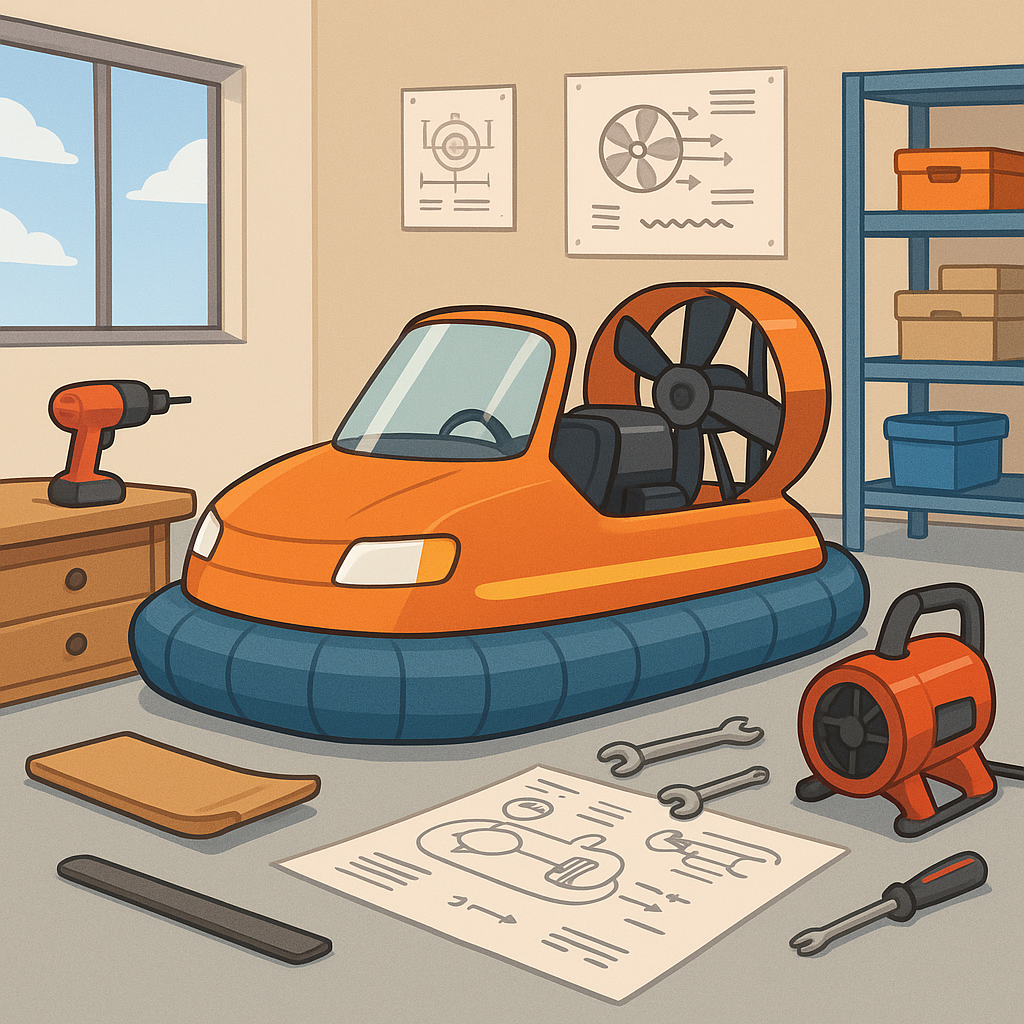
Land Hovercraft Project Ideas for Hobbyists
Land hovercraft are a fantastic maker project for anyone who enjoys mechanical design, lightweight fabrication and a bit of experimentation, and this roundup collects practical ideas focused on low-friction skids, blower tuning and reliable surface transition testing for hobbyists of all levels.
Low-friction skids are the unsung heroes of a land hovercraft and deserve dedicated attention in any build, with choices ranging from UHMW and HDPE runners to PTFE pads and hard-anodised aluminium skids that reduce drag and resist wear under repeated use.
When designing skids think about contact area and shape, because narrow runners cut less friction but concentrate wear while wider skids distribute load but can snag on rough surfaces, and consider replaceable sacrificial strips, spring-mounted skids to allow articulation over bumps and low-friction coatings for quick maintenance.
Blower tuning is equally important and will determine whether your craft floats, surges or simply stalls, so start by deciding between a centrifugal blower for higher static pressure or a high-flow axial fan for thrust and match the blower to the cushion orifice area to avoid starving or over-pressurising the plenum.
Practical blower work includes testing different shroud shapes and duct lengths, fitting variable-speed control to dial in lift versus efficiency, using a simple manometer or inline pressure gauge to quantify cushion pressure and keeping an eye on motor heating and noise levels while experimenting with baffles and lip seals to reduce leakage.
Surface transition testing should be planned as a repeatable programme, because moving from grass to gravel to tarmac will reveal the true behaviour of skirts and skids, and a basic test rig can be built from plywood ramps of different coefficients with repeatable weight and speed inputs to measure lift loss and pick-up behaviour.
A few compact project ideas put all of these elements into practice, and they are suitable for weekend builds as well as longer experimental rigs, starting with a minimal commuter-scale model using simple UHMW runners, a centrifugal blower and a PWM speed controller tuned for low-speed stability, followed by a dedicated skirt-test platform that allows swapping between vinyl, neoprene and segmented skirts to compare sealing and wear, and a transition-tester that records cushion pressure and vertical displacement when crossing boards or small ledges to reveal tendencies to snag or bounce; if you want step-by-step notes and parts lists you can find additional build guides at WatDaFeck.
When you set up tests bring simple instrumentation and safety measures, using a digital scale or load cell to measure lift capacity, a cheap hand-held anemometer for throat velocities, a camera to catch skirt flutter and a clearly marked test area with remote kill switch and a tethered cut-out for the blower in case of a runaway condition, and record each run so you can correlate changes to blower speed, skirt length and skid material in a spreadsheet for iterative improvement.
Follow me on: Facebook: https://www.facebook.com/watdafeck3d · Instagram: https://www.instagram.com/watdafeck3d/.
Comments
Post a Comment