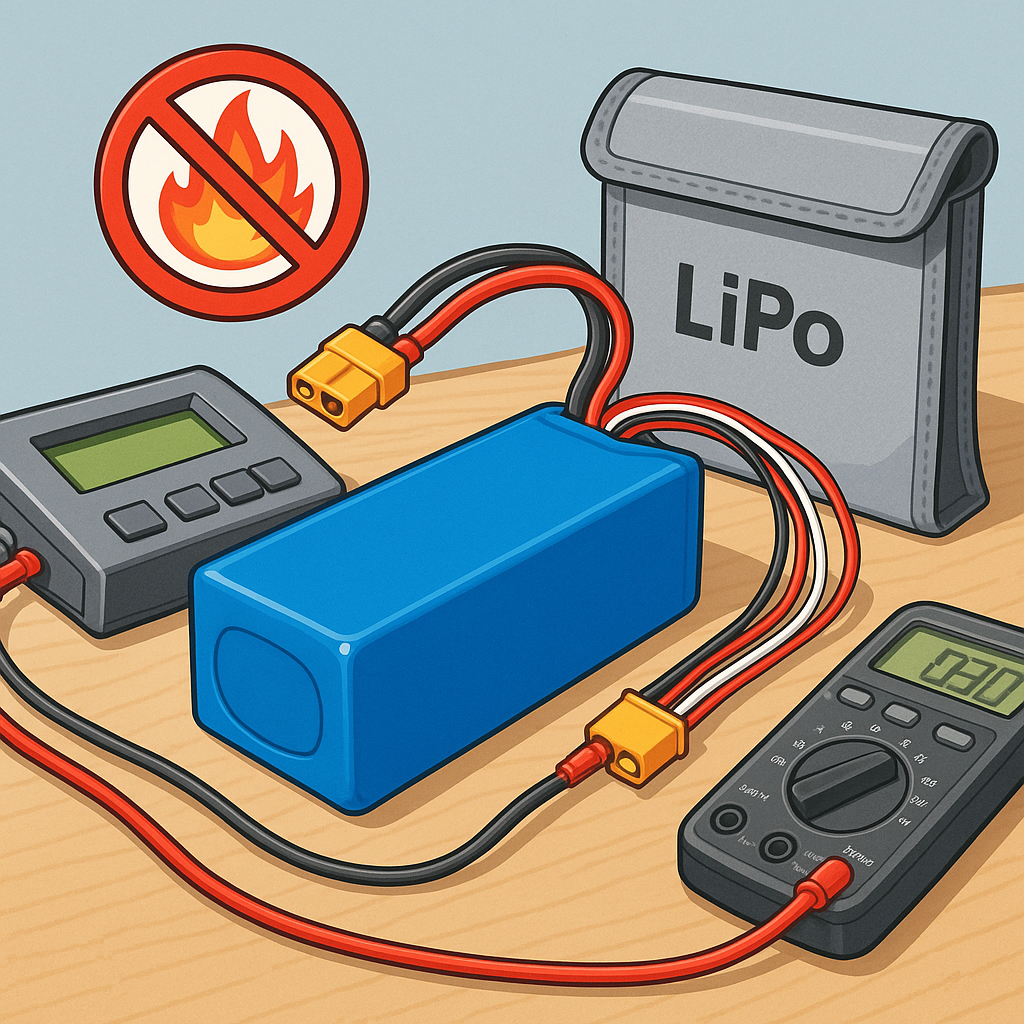
LiPo Battery Safety Buying Guide for Hobbyists
LiPo batteries give excellent power-to-weight ratios for RC, drones and other maker projects, but they demand care when buying and using them for safety and longevity. This guide focuses on what to look for when purchasing LiPo packs, with practical advice on storage, charging, C-rates, internal resistance measurement and the role of LiPo bags.
Storage is often neglected but it is the most important factor for keeping LiPos safe and healthy, so choose batteries and accessories with storage in mind. Buy a pack with a reliable voltage rating and use a balance charger to bring cells to the manufacturer’s specified storage voltage, typically about 3.80 to 3.85 volts per cell for long-term storage. Store packs in a cool, dry place away from flammable materials and avoid leaving batteries in a car on hot days, because elevated temperature accelerates degradation and increases the risk of thermal runaway. For multi-month storage consider a smart charger’s storage mode and never store batteries fully charged or fully discharged for long periods.
Charging is another area where the right purchase decisions reduce risk and improve convenience, so opt for a quality balance charger rather than cheap single-cell chargers. Look for chargers with accurate cell balancing, stable current control and safety features such as temperature sensing, short-circuit protection and auto cut-off for balanced charge completion. Charge at sensible rates: use the pack’s recommended continuous charge rate and never exceed a safe margin unless the manufacturer explicitly rates the cell for higher currents. Invest in proper connectors and a simple inline fuse or a charging station with a switch if you frequently change packs, because good connections reduce heat build-up and contact resistance during charging.
Understanding C-rates will help you match a battery to your motor, ESC and application, so don’t buy packs based only on capacity. The C-rate indicates how quickly a battery can be discharged relative to its capacity, with a 1C discharge meaning the pack would theoretically empty in one hour and a 50C pack able to provide fifty times the capacity in amperes. Calculate expected current draw from your motor and ESC and choose a pack whose continuous C-rating comfortably exceeds that draw, allowing margin for bursts and voltage sag. For burst demands like big climbs or sudden acceleration, check the pack’s burst C rating and ensure your ESC and wiring are rated to the same currents to avoid overheating.
Internal resistance, often abbreviated IR, is a crucial health metric that you should check periodically and consider when buying used packs or spares. Lower IR means the pack delivers current more efficiently and generates less heat, and IR typically rises as cells age or suffer damage. Many modern chargers provide an IR or cell impedance reading, but a proper LCR meter or dedicated battery tester gives more repeatable results. When shopping, compare fresh-pack IR values for the cell type and capacity you want, and if a second-hand pack shows a significantly higher IR than new specs or uneven IR across cells, avoid buying it because higher resistance causes heat and performance loss under load. As a rule of thumb, replace packs that show a steady rise in IR or large cell-to-cell variance rather than risking a stressful flight or run.
LiPo bags are a sensible accessory but they are not a cure-all, so include one in your buying list and understand its limitations. A fire-resistant LiPo bag can contain melted plastic and reduce flame spread if a cell vents or ignites, and they make safe transport at events much easier to manage, but they do not prevent thermal runaway nor will they stop a fully developed fire from causing damage outside the bag. When purchasing, pick a bag sized to fit the largest packs you use and consider rigid storage solutions or a metal fireproof box for long-term storage. For product tests and recommended chargers and bags see WatDaFeck for hands-on reviews and purchasing pointers that suit hobbyist budgets and practical needs.
Finally, use a simple buying checklist before you purchase any LiPo pack: verify capacity and C-rates match your application, check physical dimensions and connector type, confirm manufacturer specs for storage and charge voltages, measure or request IR values for used packs, and include a balance charger and LiPo bag in the order. Always follow safe charging and storage practice from day one, retire packs showing puffing, high IR or poor capacity retention, and keep a basic fire extinguisher or sand bucket available in your workshop for peace of mind and responsible making.
Follow me on: Facebook: https://www.facebook.com/watdafeck3d · Instagram: https://www.instagram.com/watdafeck3d/.
Comments
Post a Comment