Micro Whoops for Hobbyists: Project Ideas for Indoor Flying, Brushless Builds, Duct Efficiency and Betaflight Tuning
Micro Whoops for Hobbyists: Project Ideas for Indoor Flying, Brushless Builds, Duct Efficiency and Betaflight Tuning
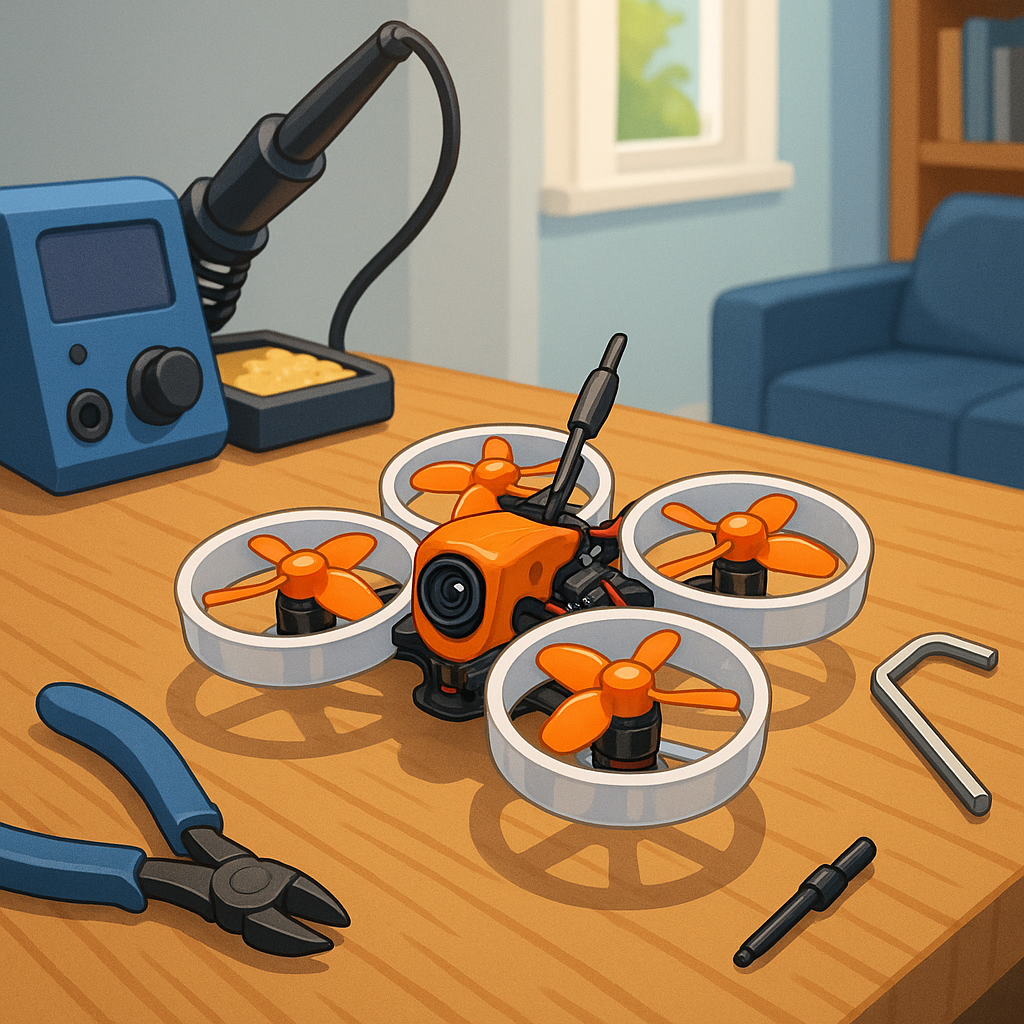
Micro whoops are the perfect small-scale playground for hobbyists who want to fly indoors with reduced risk and clever engineering challenges, and this roundup collects project ideas that reward experimentation and iteration. These tiny ducted quads are safe in living rooms and halls because their propellers are shrouded, yet they still offer a surprising amount of performance when optimised correctly. In the following sections I cover practical build projects, brushless swaps, duct design experiments and Betaflight tuning approaches to get the most from a micro whoop platform.
For indoor flying projects, focus on control, durability and sound rather than outright speed, and design each build around the intended space and obstacles. Try a series of obstacle courses at home with progressively tighter gates and moving obstacles to refine throttle control and low-speed manoeuvres. Build a soft-contact crashbox or modular bumper system that you can swap between quads so repairs are quicker than rebuilding a whole frame after every bump. Consider experimenting with camera tilt and digital stabilisation settings to find the best view for slow, cinematic indoor lines.
Brushless whoops are where a lot of hobbyists find the most satisfying gains because of better efficiency, longer flight times and improved throttle authority, and a good project is converting a brushed Tiny Whoop to a lightweight brushless platform. Choose low-kV motors in appropriate sizes for your 65mm or 75mm frame, and match them to 1.0–1.5 inch props that sit within the ducts. Investigate 4-in-1 or tiny standalone ESCs that support DShot and modern protocols, and prioritise a flight controller with at least an F4 MCU for smoother filtering and more reliable telemetry. A conversion project that keeps mass down while improving motor response is a compact and rewarding build.
Duct efficiency is the single biggest aerodynamics homework task for micro whoop projects, and small changes to shroud geometry or prop clearance can make measurable differences to thrust and noise. Print a few duct profiles in PETG or ASA to test stiffness and compare performance, varying lip radius, inlet smoothing and internal taper to study how each change affects airflow. Use a simple thrust rig with a kitchen scale, or record power draw and hover time, to quantify improvements rather than relying on flight feel alone. Try experimenting with diffuser-style ducts versus cylindrical shrouds and note the behaviour at low RPMs where indoor flying spends most of its time.
Betaflight tuning is vital for getting a ducted micro to feel locked-in and responsive, and there are several compact projects around filtering, PID profiles and blackbox analysis that will sharpen your skills. Start by logging flights with Blackbox and compare spectra to see if you need stronger gyro or motor filtering, and then test RPM filter settings to see if they stabilise the motors without introducing latency. Try running 8 kHz gyro with a 4 kHz PID loop if your FC supports it, and experiment with Betaflight's dynamic notch and harmonic notch settings to tame frequency spikes from ducts. Create multiple tune profiles for different indoor styles, such as slow cinematic, tight freestyling and battery-saving cruise, and switch profiles on the radio to compare them back to back.
If you want parts, kits or step-by-step guides I keep a few project pages on WatDaFeck that cover brushless whoop conversions and duct fabrication. For quick starter projects consider the following list of hands-on ideas you can complete in a weekend to a few evenings depending on scope.
- Convert a brushed whoop to a brushless 65mm build with new motors, ESC and an F4 flight controller and document changes in weight and hover time.
- 3D print three duct shapes and A/B test thrust and noise to learn practical effects of lip radius and internal taper.
- Create two Betaflight tune profiles for indoor slow flight and for quick agility, and use Blackbox to quantify the differences.
- Design a modular bumper system with magnetic mounts so you can swap protective shells without tools after crashes.
- Build a simple thrust measurement rig and battery discharge test to evaluate how prop choice impacts flight duration and control.
Follow me on: Facebook: https://www.facebook.com/watdafeck3d · Instagram: https://www.instagram.com/watdafeck3d/.
Comments
Post a Comment