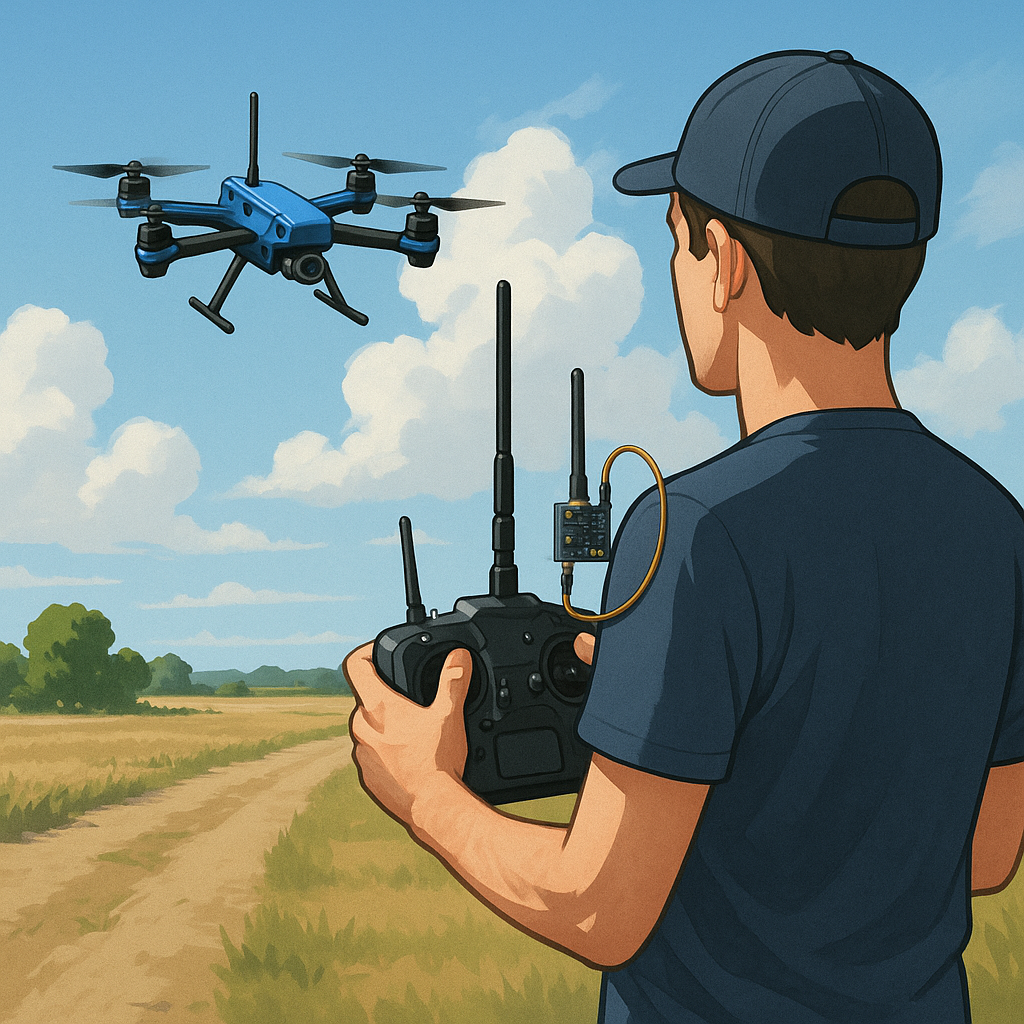
Range Testing for Hobbyists: Safety, Antenna Placement, ELRS Tuning and Noise Reduction.
Range testing is an essential and responsible practice for anyone flying radio-controlled aircraft, running remote boats, or experimenting with long-range radio links, and safety must be the priority at every step.
Antenna placement has a profound effect on both performance and the safety of your tests, and you should position antennas clear of metal structures, large conductive surfaces, and human bodies to avoid detuning and shadowing effects.
For small multirotors and models, keep the receiver antenna at least a few centimetres away from power wires, ESCs and batteries, ensure polarisation matches between transmitter and receiver, and prefer upward or outwards facing orientations for omnidirectional antennas to reduce nulls in the radiation pattern.
When working with ExpressLRS (ELRS), use the built-in range test mode and begin at the lowest comfortable transmit power while observing link quality metrics such as RSSI, LQ and packet loss before increasing power, and always confirm your failsafe behaviour is correctly set so that a loss of link results in a predictable and safe action.
Noise reduction and filtering are critical to reliable long-range links, and you should identify noise sources such as noisy ESCs, poorly routed power leads, video transmitters and USB laptops; fit ferrite beads on motor and servo leads, use decoupling capacitors on power inputs, and route RF and power wiring separately to minimise interference.
In addition to basic measures, consider fitting LC or pi filters on the power feed to sensitive receivers, employing common-mode chokes on feed lines to suppress broadband RF noise, choosing receivers with robust filtering or a dedicated preselector, and performing bench checks with a spectrum analyser or SDR to locate persistent noise peaks before flight.
You can find practical build examples and step-by-step guides on my site WatDaFeck that illustrate good antenna mounts, ELRS settings and filtering methods suitable for a home workshop, and remember to carry out range tests in an open, authorised area with a helper and a clear emergency plan.
Follow me on: Facebook: https://www.facebook.com/watdafeck3d · Instagram: https://www.instagram.com/watdafeck3d/.
Comments
Post a Comment