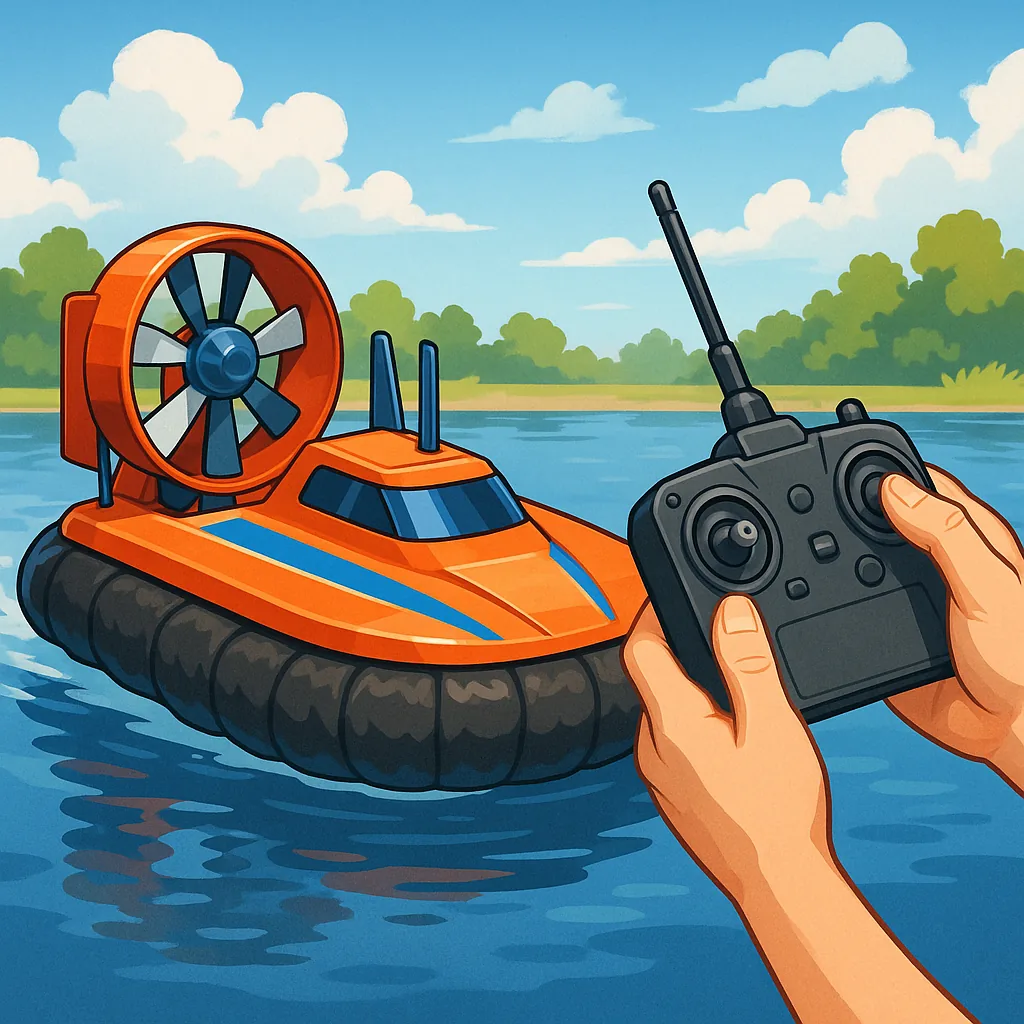
RC Hovercraft Project Ideas for Hobbyists: Skirts, Fans, Drift Control and Waterproofing
RC hovercraft are an excellent weekend project for makers who enjoy combining aerodynamics, marine craft design and radio control, and this roundup highlights practical ideas to get started with focused experiments on skirt design, lift and thrust fans, drift control and waterproofing. For detailed build logs and CAD files you can see the extras on WatDaFeck for inspiration and downloadable templates.
Skirt design is the single biggest factor in hover performance and durability, so experiment with a few common approaches to learn trade-offs between lift efficiency and ground handling. Try a simple bag skirt for ease of construction, segmented finger skirts for rough surfaces and an annular skirt for uniform cushion pressure, and test materials such as PVC, neoprene-backed fabric and ripstop nylon to find the right balance of stiffness and air leakage. Reinforce the attachment flange and use a removable mount ring for quick repairs, and consider internal baffles or a sacrificial wear strip where the skirt meets the hull to extend life.
Choosing lift versus thrust fans determines how the craft accelerates and how controllable it is, so decide early whether to use a single combined fan or split the roles between two systems. Centrifugal blowers give higher pressure for the cushion in a compact package while axial fans provide better forward thrust for speed boats, and you can also duct an axial fan to boost static pressure. Select motors and ESCs that deliver sufficient torque at low RPM for the lift fan and reserve higher RPM motors for thrust, and remember that larger diameter props can be quieter and more efficient for the same thrust.
Drift control on a hovercraft is more about managing lateral forces than steering like a boat, and techniques range from mechanical rudders and skegs to electronic mixing and differential thrust. Simple projects can use a servo-driven rudder in the thrust stream or moveable vanes to vector thrust, while advanced builds can implement yaw control with dual fans and an onboard gyro or IMU for stability. For autonomous trials, tune a basic PID loop to minimise oscillation and use scaled-down flight controllers or microcontrollers to implement steering mixes so the craft will hold heading in crosswinds.
Waterproofing and corrosion protection are essential because hovercraft often operate in spray and shallow water, and a thoughtful layout keeps electronics safe while retaining serviceability. Place batteries and ESCs in sealed compartments with cable glands and pressure equalisation vents to avoid pressure-driven leaks, use silicone or neoprene gaskets on hatches, and coat PCBs with a conformal spray if you expect regular saltwater exposure. Choose marine-grade fasteners or stainless steel for fittings, isolate dissimilar metals to prevent galvanic corrosion, and design access panels so you can remove components for maintenance without compromising the seals.
Project ideas to explore once you have the basics include a lightweight foam experimental hull with a finger-skirt for pond trials, a racer with twin ducted thrust fans and a single centrifugal lift fan, an amphibious craft that auto-adjusts cushion pressure for grass to water transitions, an autonomous hover drone using an off-the-shelf flight controller for yaw stabilisation, a scale-building challenge that copies a classic hoverport shuttle, and a corrosion-hardened saltwater tester to practise waterproofing techniques and materials. These projects are approachable and provide clear lessons in skirt behaviour, fan selection, drift control strategies and proven waterproofing methods.
Follow me on: Facebook: https://www.facebook.com/watdafeck3d · Instagram: https://www.instagram.com/watdafeck3d/.
Comments
Post a Comment