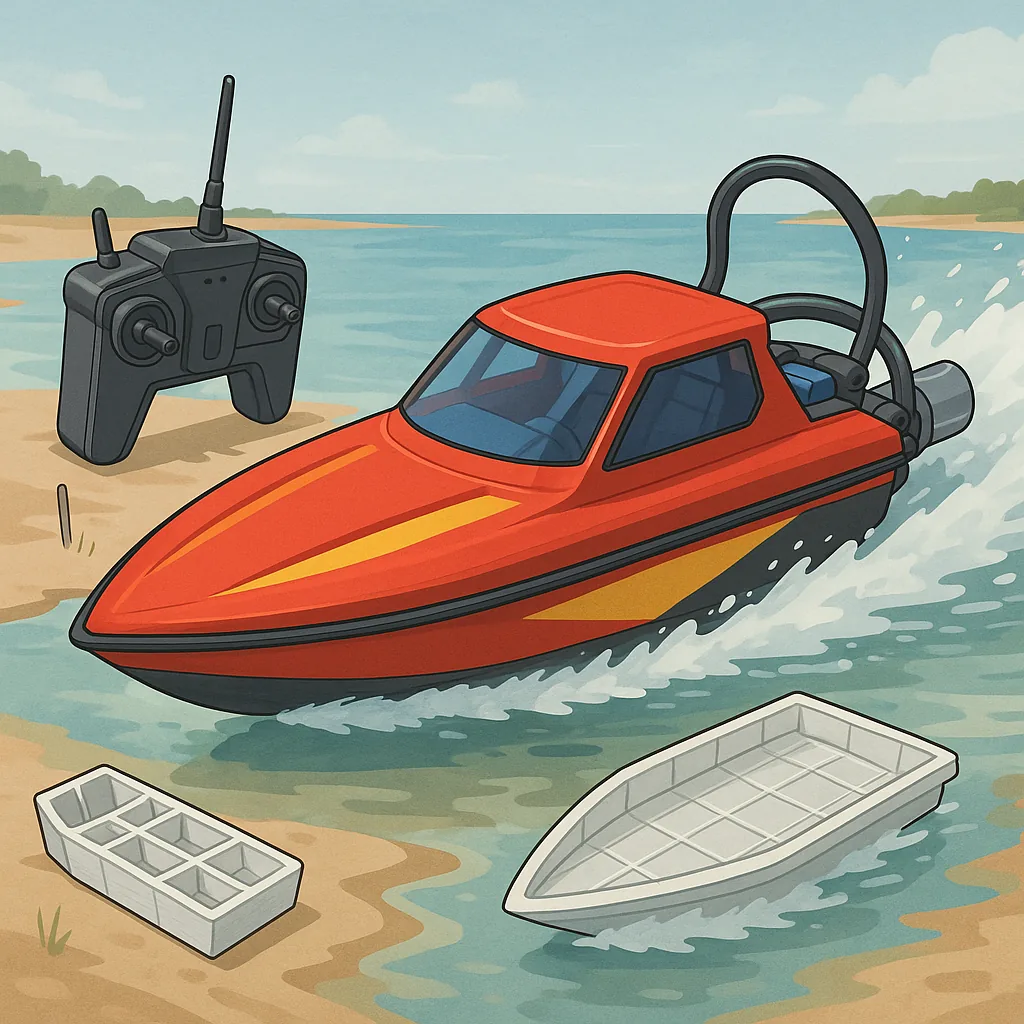
RC Jet Boat Tips and Tricks: Impellers, Shallow Water, 3D Printed Hulls and Cooling
Running a radio-controlled jet boat is immensely satisfying and it rewards careful setup more than raw power, so this guide focuses on practical tips to get the most from impeller design, shallow water operation, 3D printed hulls and cooling solutions for electronics and motors.
Impeller design is the heart of a jet boat and small changes to diameter, blade angle and intake shape can transform performance, so aim for an impeller that balances thrust and efficiency rather than chasing peak RPM alone.
Choose impeller diameter to match the tunnel size and motor torque, because a larger diameter moving at lower RPM often gives better shove and reduced cavitation, and remember that blade pitch is a compromise between top speed and acceleration depending on your typical running conditions.
When fabricating impellers, whether machined or 3D printed, pay attention to smooth surfaces and accurate balance, add a short inlet lip to improve water flow into the eye and fit a well-shaped nozzle to convert velocity into thrust efficiently, and if you want printable templates or mounting jigs I publish useful parts and reference builds on WatDaFeck so you can adapt them to your boat.
Shallow water running introduces its own demands, so protect the intake with a low-profile grate or mushroom guard and design the tunnel to avoid sucking air when trimming or ploughing through weed, because even a brief air intake will cause cavitation, drop thrust and can overheat the motor due to load spikes.
Cooling is often overlooked on compact jet boats and you should plan for both motor and ESC cooling with water pickups placed in smooth, non-turbulent flow; consider a simple water jacket or in-line heat exchanger for the ESC, use thermal paste where appropriate and add telemetry or a temperature cutoff to prevent irreversible damage when running in warm conditions.
- Match impeller hub size to the shaft and use a collet-style coupling to reduce runout and improve balance when revs rise.
- Test different nozzle lip radii on a single hull to see which gives the best combination of acceleration and mid-range response.
- For shallow lakes, add sacrificial wear strips to the keel and a replaceable grate to the intake to cope with rocks and sand abrasion.
- Print hull components in PETG or ASA rather than PLA, and reinforce high-stress areas with glass cloth and epoxy for impact resistance and heat stability.
- Route cooling pickups away from highly aerated flow near the tunnel entrance to ensure steady water supply at idle and full throttle.
Practical troubleshooting usually boils down to three checks: intake integrity, impeller balance and cooling flow, so if your boat loses top end or runs hot inspect the intake for blockage or deformation, spin the impeller on a bench to check balance, and verify cooling hoses are clear and fittings are water-tight.
Follow me on: Facebook: https://www.facebook.com/watdafeck3d · Instagram: https://www.instagram.com/watdafeck3d/.
Comments
Post a Comment