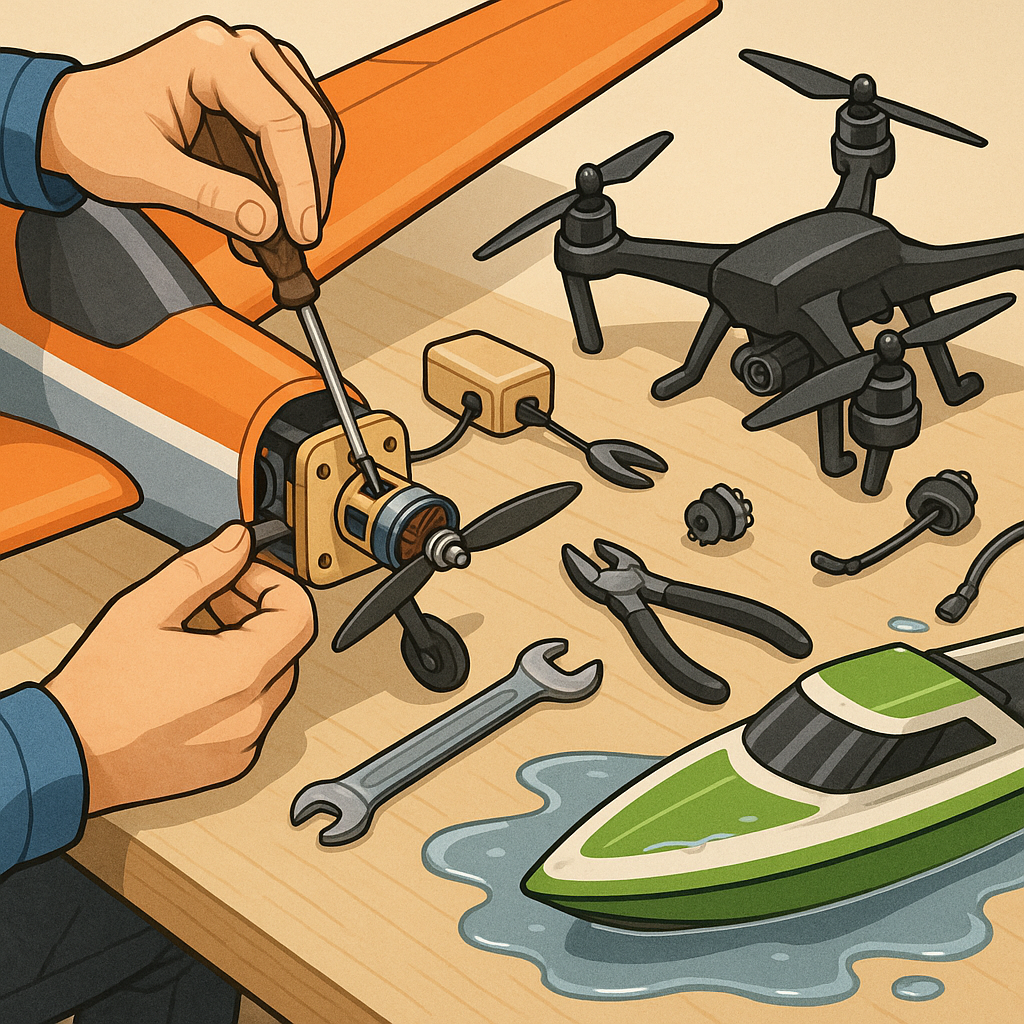
Repair Safety Overview for Hobbyists: Crash Recovery, Mounts, Servos and Water Damage
Repairing model aircraft, drones, boats and other hobby projects is rewarding but it carries real hazards, so safety must be the starting point for every job. This overview concentrates on the practical safety steps to take after a crash, how to handle broken mounts, what to do when servos are stripped, and how to recover from water exposure to electronics. Taking calm, methodical actions reduces the risk of injury and prevents further damage to the model and to the environment.
At a crash site the first priority is to make the scene safe before you touch anything, and that usually means disconnecting the battery or power source at a safe distance. LiPo batteries in particular can be punctured or thermally unstable after impact, so keep your face and hands clear and move the battery only with insulating gloves if it is intact, or with long tools if it is damaged. Check for hot motors, leaking fuel or other hazardous materials, photograph the wreckage for later analysis, and mark any sharp or entangled parts to avoid cuts when collecting components.
Broken mounts and structural failures are among the most common repair tasks and they can be repaired safely if you work deliberately and inspect carefully for hidden cracks. Remove the damaged mount and examine adjoining structure for stress fractures or delamination, then choose a repair approach that restores mechanical strength rather than merely cosmetic appearance. For printable replacement mounts and design tips, see WatDaFeck. When reassembling use proper hardware, consider metal inserts for 3D printed parts, apply threadlocker or lock washers on vibration-prone joints, and torque fasteners to specification to avoid repeating failures.
Stripped servos often present the choice between a quick field repair and a permanent replacement, and safety is a factor in both decisions because small metal fragments and stubborn screws can cause injury. Before opening a servo, remove power and operate it gently to centre the output horn so you can note neutral positions, and wear eye protection when dismantling plastic or metal gears. If the damage is confined to a plastic gear it may be sensible to fit a replacement gear or a full replacement servo rather than risk poor performance, and if you elect to retap a stripped screw hole use an appropriately sized insert or oversize screw to restore reliable engagement.
Water damage requires an immediate, systematic response because corrosion and short circuits can destroy electronics quickly, and saltwater is especially aggressive. Remove batteries and SIM cards, flush saltwater-exposed parts with fresh distilled water, then displace moisture with high-purity isopropyl alcohol before drying in a warm, dry environment with desiccant packs or a gentle fan heater set well below component temperature limits. Inspect connectors and PCBs for corrosion, clean contacts with specialist contact cleaner where necessary, and be prepared to replace any component where corrosion has compromised structural or electrical integrity.
Before returning a model to service run a staged electrical and function test in a safe environment with props or screws removed and the craft restrained. Use a multimeter to verify there are no short circuits, check battery voltage and internal resistance for signs of damage, perform a radio range check and confirm failsafe settings, and only reintroduce full operational loads once the craft is mechanically sound and all repairs use proper fasteners and adhesives. Remember to dispose of irreparably damaged LiPo batteries in accordance with local regulations and to take extra care when handling fuel systems or high-voltage components.
Follow me on: Facebook: https://www.facebook.com/watdafeck3d · Instagram: https://www.instagram.com/watdafeck3d/.
Comments
Post a Comment