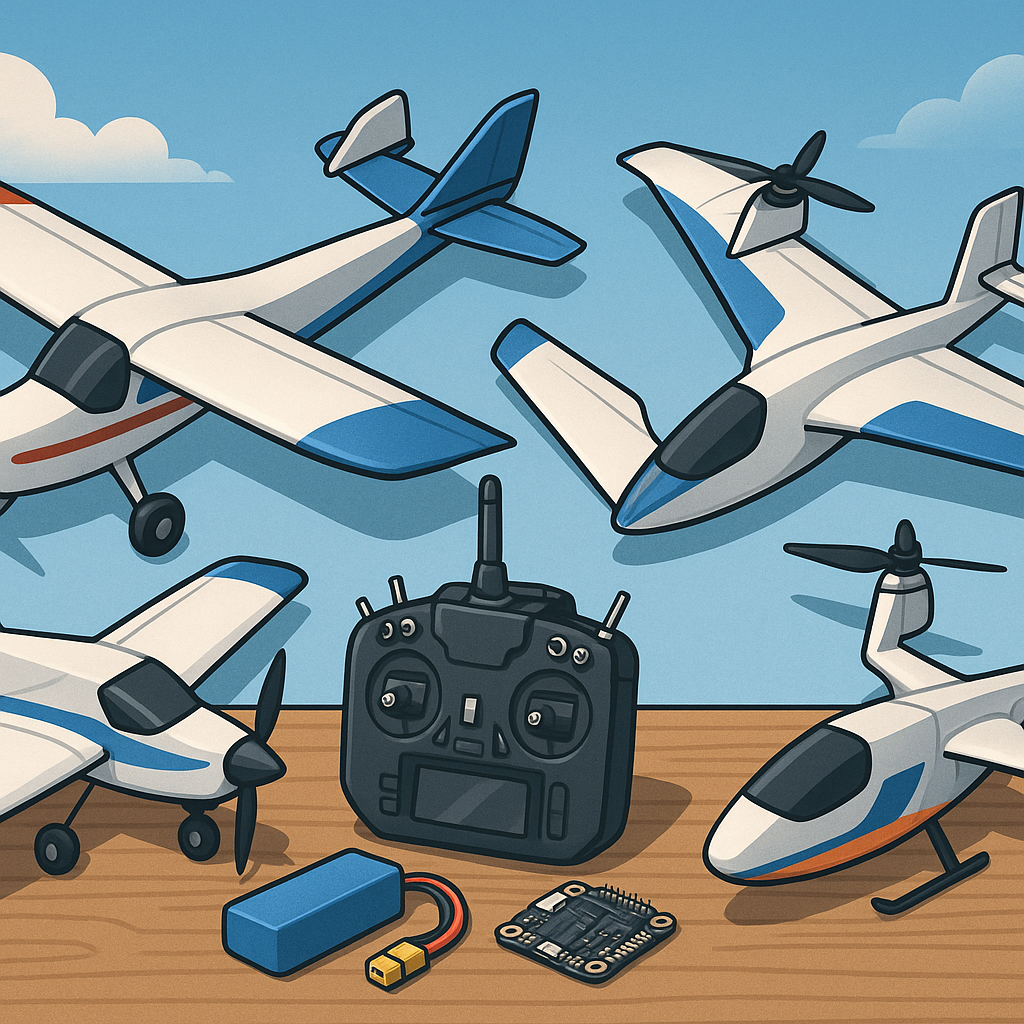
Safety Essentials for RC Planes: Trainers, FPV Wings, VTOL, ELRS, Batteries and Flight Controllers
Getting into RC aeromodelling is great fun, but safety must be the starting point for every session. This overview is written for hobbyists flying foam trainers, speedy FPV wings or experimental VTOL craft and aims to cover the typical risks and practical mitigations for common setups. Before you fly, check local laws and club rules, keep a pre-flight routine and never fly above your skill level or the capabilities of your equipment. If you need local club guidance or setup guides, see WatDaFeck for practical articles and resources.
Foam trainers are the recommended first aircraft for most newcomers because of their forgiving handling and low repair cost, but they still require careful preparation. Always balance the centre of gravity precisely and check control surface travel against recommended throws to avoid over-controlling the aeroplane. Fit a propeller guard for maiden flights if possible and use a soft-field takeoff and landing technique until you understand the model's behaviour. Pre-flight checks should include a secure linkage, tight motor and prop fixings, a working receiver and a failsafe set to neutral or land, and it is wise to check battery voltage under load before each flight.
FPV wings introduce speed and range that can magnify a small error into a big problem, so establish clear safety practices before you operate goggles. Always have a trusted spotter maintaining line of sight and watching airspace for other aircraft while you are eyes-out in the goggles. Antenna placement is critical on wings; keep receivers and antennas clear of carbon or metal and use diversity or robust RX systems such as ExpressLRS configured with a sensible failsafe profile. Respect frequency usage and local radio regulations and practise emergency procedures for signal loss and return-to-home scenarios in a safe area away from people and buildings.
VTOL models combine the complexity of multirotors and fixed-wing flying and deserve particular caution during transitions between hover and forward flight. Make sure motor outputs and mixing are rigorously tested on the ground and check that the flight controller firmware supports the VTOL mode you intend to use. Weight and balance become more critical on vectored-thrust designs, so secure all components to avoid a sudden CG shift in transition. If possible, configure redundant control paths and have a clear plan for failure modes such as motor loss or servo jam, practising controlled autorotation or safe descent procedures in simulation or over open ground.
Modern radio and power systems change the safety landscape and beg attention to wiring, failsafes and battery care. ExpressLRS (ELRS) provides low latency and long range for many hobbyists, but proper binding, firmware updates and telemetry configuration are essential to ensure a predictable failsafe state. Match your flight controller firmware—ArduPilot, INAV or BetaFlight—to the aircraft type and tune PID and mixer settings gently, only increasing aggressiveness once you have data and logs to justify changes. Lithium polymer batteries need the same seriousness: store at recommended voltage, use a quality balance charger, never charge unattended, retire puffed cells, and calculate C-ratings and capacities to avoid over-discharging or overheating during high-current climbs.
Follow me on: Facebook: https://www.facebook.com/watdafeck3d · Instagram: https://www.instagram.com/watdafeck3d/.
Comments
Post a Comment